

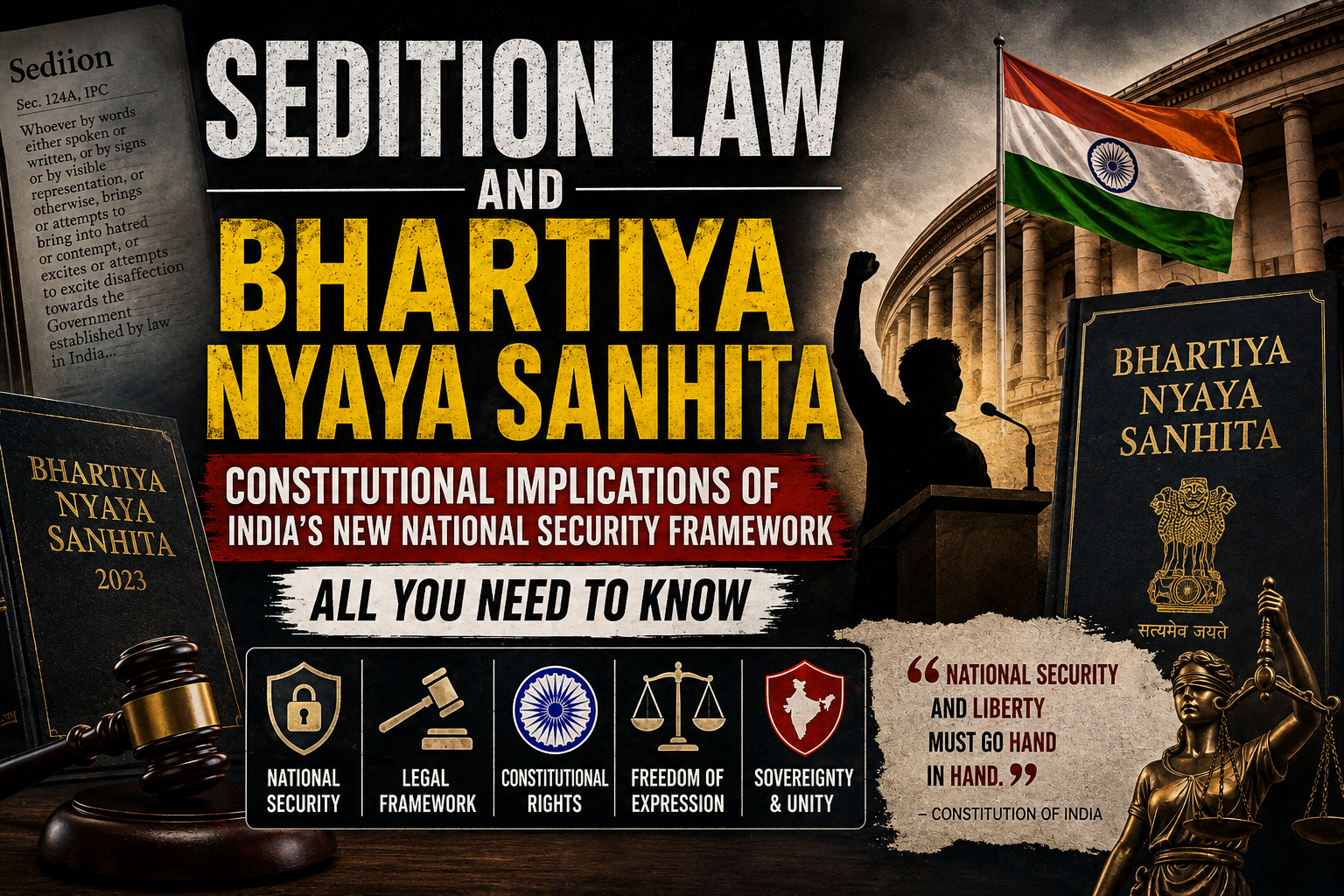
INTRODUCTION
One day while passing by a crowded ground. I noticed a large gathering of people raising slogans and holding placards against the government policies. The entire population was charged with anger, rage, frustration and demanding for change. I was curious and stopped for a while to listen to their demands but within no span of time the police force arrived and began dispersing the crowd and even arrested some of the protesters on the allegation of provoking dissatisfaction against the government. This incident made me question that criticising government policies leads to provocation and a criminal act against the nation ? This question forms the basis of sedition law which is the most debated and controversial subject in the Indian criminal system and in this article author has explained everything about Sedition law and Bhartiya Nyaya Sanhita : Constitutional Implications of India’s new national security framework – All you need to know.
HISTORICAL PERSPECTIVE
The law of sedition has its roots from the colonial era. This law was enacted to overcome the suffering and oppression in the country. Law of Sedition was drafted by Thomas Babington Macaulay while preparing the draft of Indian Penal Code. However this law was not enacted until 1870. Later due to the independence movement and some nationalist activities against the British government, the British era felt the need for enacting a stringent law to suppress the dissent of the citizens. So, James Fitzjames Stephen who was the law member introduced sedition law under section 124A as an amendment under Indian Penal code with life imprisonment as punishment. The primary objective of this law was not to maintain public peace but to suppress the criticism, incitement against colonial rule. Under British era this law became a powerful tool to suppress the opinion of people and prosecute Indian freedom fighters, leaders etc who spoke or wrote against British government.One of the most prominent trial was of Bal Gangadhar Tilak in 1897 and 1908 for his newspaper kesari in which he showed disaffection against britishers. Similarly Mahatma Gandhi also faced trial of sedition in 1922 for his article young India. These prosecutions showed how sedition was used as a weapon to curb the rights of citizens. In 1947 India got independence and sedition law continued its existence. This law became highly controversial and was a centre for debate as it violated the mere ideal of fundamental right of freedom of speech and expression enshrined under Article 19(1)(a) in the constitution. There were demands for repealing the provision but nothing worked out. The courts through judicial interpretation balanced out the approach between state security and fundamental rights. In spite of many judicial interpretations the law faced criticism of its misuse against students , protestors, activists.
Lately with the introduction of Bharatiya Nyaya Sanhita in 2023 the stringent law of sedition under section 124A replaced by the provision of act endangering Sovereignty, unity and integrity of the nation. However debates still continue regarding the newly enacted law whether it departs from the colonial era rule or just amending the heading while retaining the restrictions on speech.
TIMELINE FOR SEDITION LAW
- 1870- Section 124A was added to the Indian Penal Code through the amendment introduced by British politician and lawyer James Fitzjames Stephen.
- 1891- First case named Queen Empress v. Jogendra Chunder Bose on sedition was heard by the Calcutta high court.
- 1897 and 1908-Bal gangadhar tilak was convicted under 124A for writing seditious matters in his marathi newspaper kesari.
- 1922– Mohandas karam chandra gandhi was convicted of sedition for writing politically sensitive articles in young India magazine.
- 1942– In the case of Niherendru Dutt Majumdar v. The King Emperor federal Court of India defined sedition as leading to public disorder.
- 1947-1948- sedition was debated in parliament and the struggle of which can be witnessed through the contentions of various political parties.
- 1962– The constitutionality of section 124A was upheld in the case of Kedar Nath Singh v. State of Bihar.
- 1995– In the case of Balwant Singh v. State of Punjab,Supreme Court stated that mere raising slogans without any action does not amount to sedition.
- 2021– writ petition was filed challenging sedition law.
- 2022– Supreme Court puts section 124A on hold in the case of S.G Vombatkere v. Union of India and no new case to be filed while the provision is re examined.
- 2023– The Indian Parliament passes a new Law i.e Bharatiya Nyaya Sanhita which replaces Indian Penal Code. Sedition is no longer an offence as it is replaced by a new offence under BNS.
MEANING AND SCOPE
What is sedition?
As per Section 124A of Indian Penal Code it states that if any person by words, either spoken or written or by sign or by visible representation brings or attempts to bring disaffection or hatred towards the government is said to commit sedition.
Ingredients
- Words, signs, gestures Visible representation or otherwise
It is the most important essential of sedition. In a trial for sedition under section 124A the most important thing that is to be checked is whether the act is seditious or not. There must be concrete evidence for any words ,gestures, sign or visible representation that is used to show disaffection against the government. If not then the case of sedition cannot exist.
- Brings or Attempts to bring into Hatred or Contempt, or Excites or Attempts to Excite Disaffection
This essence states that if any person is showing hatred or attempts to excite citizens against the government then the intention of the person behind such act is mandatory. However, it does not matter whether he achieved the purpose or not.
Punishment
The punishment for sedition mentioned below:
- Imprisonment may extend 3 years
- Imprisonment for life
- Imprisonment for life and fine
- Imprisonment may extend to 3 years and fine
- Only fine
TUSSLE BETWEEN SEDITION AND FREEDOM OF SPEECH AND EXPRESSION
BARE PROVISION
Article 19 protection of certain rights regarding freedom of speech etc
(1) All citizens shall have the right—
(a) to freedom of speech and expression
(b) to assemble peaceably and without arms
(c) to form associations or unions
(d) to move freely throughout the territory of India
(e) to reside and settle in any part of the territory of India
(g) to practise any profession or to carry on any occupation, trade or business.
(2) Nothing in sub-clause (a) of clause (1) shall affect the operation of any existing law or prevent the State from making any law in so far as such law imposes reasonable restrictions on the exercise of the right conferred by the said sub-clause in the interests
- sovereignty and integrity of India
- security of the state
- friendly relations with foreign States
- public order
- decency or morality
- contempt of court
- defamation
- incitement to an offence
The tension between sedition and freedom of speech has been going since colonial rule. This law was implemented by the British government to stop freedom fighters or protesters from speaking against them or provoking other people against them.This law was codified in 1870 and till now it has been used as a political tool to stop any person from speaking against the government. After the enactment of the constitution the law of sedition was criticised by everyone as it infringes the fundamental right of freedom of speech and expression enshrined under Article 19(1)(a). In a democratic country freedom of speech and expression is an essential part as it enables citizens to criticize policies or speak against any change and on other hand sedition historically punishes disaffection against government or its policies. Some of the instances are:
- In 1962 in the case of kedar Nath Singh v State of Bihar upheld the constitutional validity of sec 124A of Indian Penal Code,which made potential for abuse.
- In 2010 Dr Binayak Sen who was an activist was arrested for allegedly supporting Naxalite groups.
- In 2012 Aseem Trivedi (cartoonist) was arrested for making cartoons related to corruption in the governance of the system.
Sedition and Reasonable Restriction work on similar principles as their objective is to restrict the speech that shows disaffection against national security or government. These laws may remain reasonable and can be interpreted narrowly but if they violate any law beyond their limits, it violates the core intent of Article 19(1)(a).
BHARATIYA NYAYA SANHITA: A SIGNIFICANT SHIFT
BARE PROVISION
Section 152- Act endangering Sovereignty unity and integrity of India
Whoever, purposely or knowingly, by words, either spoken or written, or by signs, or by visible representation, or by electronic communication or by use of financial mean, or otherwise, excites or attempts to excite, secession or armed rebellion or subversive activities, or encourages feelings of separatist activities or endangers sovereignty or unity and integrity of India; or indulges in or commits any such act.
Punishment
Imprisonment for life
imprisonment for 7 years and fine.
Although that provision was replaced by a new one with a changed title it aimed at achieving similar goals. Many scholars argued that Article 152 is the broader version of sedition because the terms such as ‘subversive activities’ can be widely interpreted. In general, Bharatiya Nyaya Sanhita represents a significant shift as it reduces the scope of sedition and focuses more on action that threatens government and national security rather than criticism of government.
COMPARATIVE ANALYSIS
United Kingdom
The sedition law in the UK was introduced during monarchical rule to suppress criticism against the Crown and government. However, after several years and after considering modern values, sedition was abolished in 2009 through Coroners and Justice Act.
Australia
The sedition law was retained by Australia for many years until 2010. The law was criticised by many eminent scholars. They contended this law is a direct violation of their right of speech. So in 2010 the government replaced the term sedition with offences relating to urging violence against the government. Australia shifted its focus from disaffection to prevention of violence.
Malaysia
Malaysia inherited sedition law from British colonial rule. There is frequent criticism against law as it violates the mere principle of free speech and is used against journalists, protestors and opposition.Although many reforms were proposed but law still remains operational.
New Zealand
In 2007 New Zealand repeated its sedition law as the offence threatened the democratic freedom of speech and was used against journalists,writers etc.The government recognised that they have sufficient laws to deal with any kind of national security issue and there is no need for any stricter provision.
CONCLUSION
India is the largest democracy in the world and the right to freedom of speech and expression is an essential ingredient of democracy and law of sedition always stood as a hindrance in achieving that freedom. It has been witnessed from the colonial era that sedition is used as a weapon to threaten people who voice their opinion. From colonial era to contemporary times, sedition laws have repeatedly become a tool to suppress dissent. Although Bharatiya Nyaya Sanhita 2023 replaced the term ‘sedition’ with the new provision but it still raised concerns regarding the impact on democratic speech.Therefore, in democratic system national security and freedom of speech must coexist rather than compete because a democracy is flourished through open debate or criticism rather suppression of dissent.
About Author
Sugandha is an advocate and a law graduate with an LL.M from Damodaram Sanjivayya National Law University. Her academic interests encompass criminal law, gender-neutral legal framework, and security laws. Through her writings, she seeks to critically analyse legal frameworks and contribute to discussions aimed at ensuring justice, equality, and effective legal protection.
FAQs
- Has sedition law completely removed in India?
No, the law of sedition has not been completely removed. It has been replaced by a new law passed in 2023 by the Indian parliament i.e Bharatiya Nyaya Sanhita. A new provision is added with similar objective under section 152 of the sanhita.
- What replaces section 124A IPC in BNS?
Section 152 of BNS replaced the earlier provision. It punishes the act of person who endangers unity and sovereignty of the nation. The new provision involves –
- Armed rebellion
- Subversive activities
- Encouraging separatist feeling
The new provision works on threats rather than disaffection.
- What are constitutional Concerns regarding new law?
The major concern is the use of words like subversive activities and encouraging separatist feeling. As these words are broad and can be interpreted according to the need. Eminent people argue that this provision can be misused and is affecting the freedom of speech and expression under article 19(1)(a).
- Is criticism of the government still protected under the constitution?
Yes, the Constitution of India protects dissent, political criticism etc under article 19(1)(a) if they do not violate the unity and integrity of the nation.
REFERENCES
https://www.scobserver.in/journal/sedition-in-india-a-timeline/amp