

Introduction — Understanding Corporate Fraud in India
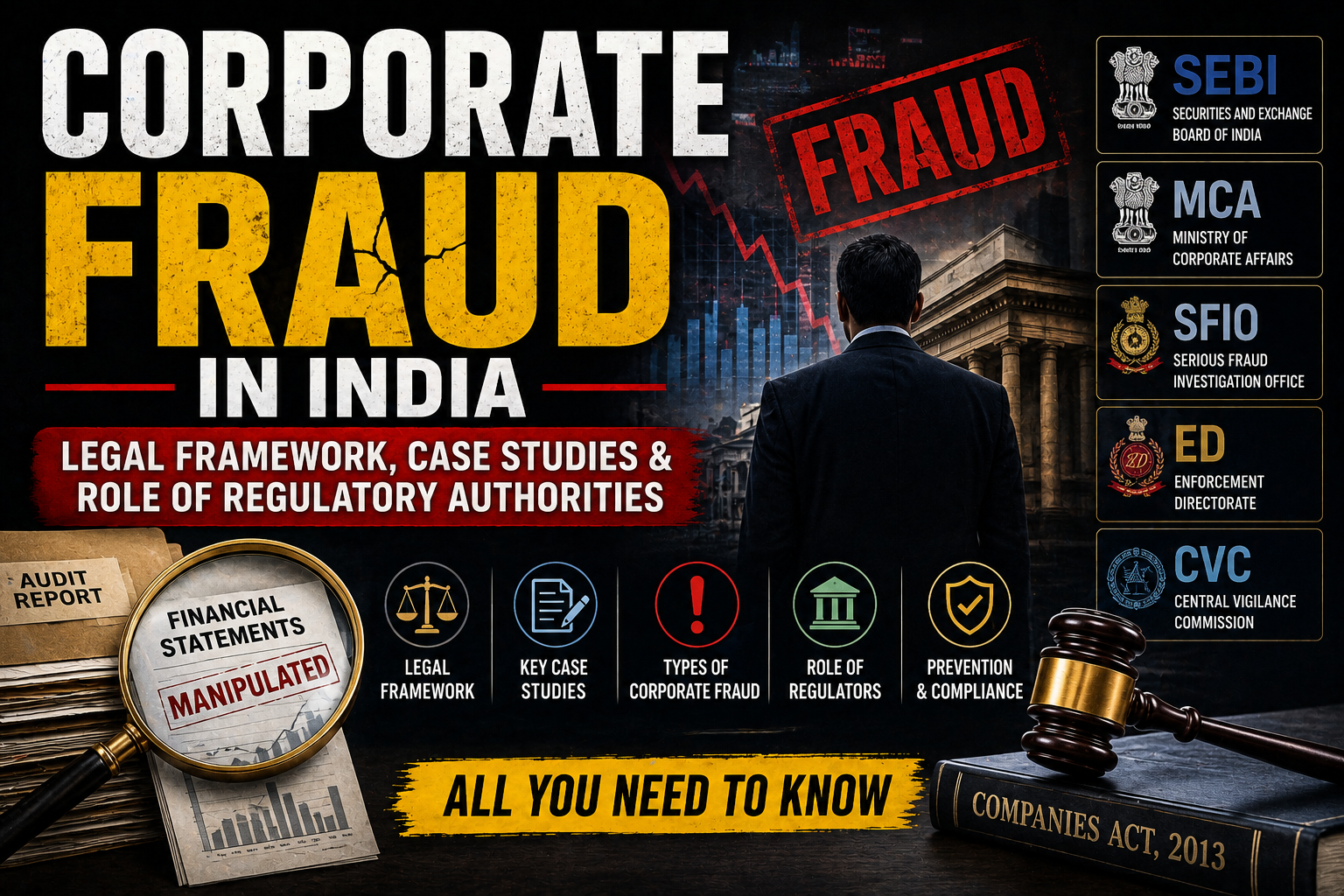
In recent years, corporate fraud has emerged as a global problem. In India, this menace has become an inseparable part of corporate history. Corporate misconduct is an illegal act using corporate power or the actions of employees for private or organizational gain. It’s so large and complex that it takes forensic accountants months to completely disrupt it. The Satyam Computer Services scandal (2009) and the Nirav Modi-PNB scam (2018) are significant cases in India. This has a major impact on corporations, shareholders, and the general public. The Companies Act, 2013 clearly provides the consideration of fraud and the penalty provisions. This article explores corporate fraud in India, legal framework and case studies, impact and challenges.
Meaning and Types of Corporate Fraud in India
Corporate fraud can occur in various forms, some of the main types are explained below.
1. Asset misappropriation
It refers to the theft or misuse of property of an organization by directors, employees, or any person entrusted with a single asset. The stolen assets may be cash, assets, or financial instruments. Common techniques for this fraud include faking sales records, manipulating stock, or creating fake data on property records and transfers. For example, an accountant in a shop who records transactions without proper documentation and takes cash may hide this by making false charges or false account entries.
2. Insider trading
This method takes place when a worker or individual buys or sells an organization’s securities using confidential or unpublished information for improper gain. Such practices are illegal under securities law in most countries because they harm fairness and transparency in trading.
3. False economic statements
This happens when a company attempts to appear financially stronger than it honestly is by presenting false financial data. It is considered one of the most devastating forms of corporate fraud because it misleads buyers, regulators and the public. This type typically involves overemphasizing revenues, assets, or investments, understating payments, and hiding important monetary information. The Enron scandal and the Satyam scandal are well-known corporate instances where organizations provided fake monetary statements to misinform stakeholders.
4. Bribery and corruption
Bribery and corruption are serious economic crimes that can have a negative impact on a company’s growth and popularity. Bribery is when someone offers, gives, or receives money or any advantage to induce a respectable selection. Corruption is a broad concept that includes bribes, illegal rewards, and abuse of power for non-public gain. This occurs when employees or officials abuse their authority in business transactions to unfairly benefit themselves or others. In many of the latest instances, it’s been discovered that CEOs and directors are worried about bribery of stable projects or approvals past their authority.
Causes of Corporate Fraud in India
Poor company governance
The weak corporate governance occurs when the agency doesn’t have the right rules and policies in place, it becomes easy for person to hide wrongdoing. A lack of proper checks and balances or transparency can also provide an opportunity to conceal unethical practices. Example Chairman of Satyam has been falsifying financial statements for years due to poor governance. The lack of checks allowed the fraud to go unnoticed for a long time.
Regulatory loopholes
This happens when the policies designed to handle the problem are not up-to-date enough. Laws should be updated accordingly with the criminal’s advanced methods. If not, loopholes may arise, and it will likely be easier for criminals to carry out financial irregularities.
Negligence of the auditor
This occurs when the auditor does not exercise due care or expert skepticism to examine the financial report. Auditors are not liable to prevent fraud, however, they are legally liable for negligence if stakeholders suffer financial loss. Example in the Enron scandal, auditors failed to properly discover hidden money, loans, and financial statements. This made the company look financially strong, while miles away it is almost falling apart.
Greed and pressure to perform
This is the most common cause of many fraud instances. Pressure to perform pushes individuals toward fraudulent movements. This can be due to unrealistic sales targets or a need to meet the expectations of the marketplace. Example: The Nirav Modi–Punjab National Bank is a fine example of greed and pressure in which officials of financial institutions and businessmen abused the banking systems to make fraudulent loans.
Legal Framework Governing Corporate Fraud
Companies Act, 2013 (Section 447 – Fraud)
Corporate fraud in India is an intentional act or concealment of facts for personal gain or inducing damage to others, even if no actual loss. The punishment for this offense is stated in Section 447 of the Companies Act, 2013. The imprisonment is 6 months and is capable of extending up to ten years, with fine that may extend up to 3 times the amount contemplated. If it is a matter of public interest, the minimum imprisonment is 3 years. The penalty can be for imprisonment up to 5 years or a fine up to ₹50 lakh or both if the amount is less than ₹10 lakh or is 1% of the turnover of the enterprise. Auditors and directors play an essential role in fraud. An auditor is an impartial professional appointed by the board of directors and the shareholders of the entity under Section 139 of the Companies Act, 2013. Their responsibility is to examine financial facts, detect fraud or error, know the internal system of the corporation and cast professional scepticism while auditing. Auditors are not specifically responsible for preventing fraud, but they may be held liable if their negligence causes any loss. Directors are the main responsible people within the company organization. Their duties include preventing fraud, establishing strong internal control systems and take prompt action when fraud occurs.
SEBI Regulations
The Securities Exchange Board of India is the main body regulating the Indian stock market. It takes measures to ensure fairness, protection of the market and integrity. The SEBI Act lays down the penalties for fraud and insider trading. Insider trading is disallowed as certain parties are unfairly enriched because of this. All investors should have equal access to information, and no one needs to use insider facts for their own benefit. Section 12A of SEBI mentions the penalty for insider trading and treats essential policy adjustments, mergers, and acquisitions as sensitive facts. SEBI prevents misuse of sensitive information, monitors trading activities, and punishes offenders.
The disclosure requirements are listed under SEBI LODR policies. Companies should regularly disclose important data to let buyers know the situation. It guarantees transparency, fairness, and trust in the stock market. There are 3 types of this, which can be periodic disclosure, continuous disclosure and corporate governance. Companies should expose all information that will have an impact on investors. SEBI is the authority that sets rules and monitors the market to prevent dishonest investors and protect investors. In F&O, it identifies the weakest and strongest stocks. It has very few expiry dates and one group can’t dominate the market. Technical mechanisms such as AI are used to monitor the whole market at all times.
Prevention of Money Laundering Act (PMLA), 2002
The PMLA is a provision that deals with illegal or black money. First, it looks for suspicious transactions and reports suspicious funds being transferred. The Financial Intelligence Unit (FIU) load collects reports from banks including investigating suspicious activities, combining clues of other banks or sharing information with investigation agencies. Subsequently, the Enforcement Directorate conducts search of person who are concerned within the case, and it searches homes or offices, or freezes assets or funds of bank accounts. Lastly the court will determine if the money is illegal, if it is proven then the money will be confiscated entirely through the authorities.
Indian Penal Code (IPC)
The Indian Penal Code, now called Bharatiya Nyaya Sanhita, mentions cheating and criminal breach of trust. Cheating occurs when a person with dishonest motives deceives others in order to take their money or property. Criminal breach of trust occurs when a person entrusts someone else and that trust is abused. The law treats fraud as a serious crime because it includes a deceptive purpose to induce harm or loss to others. Such offenses are extreme and punishable under this Code.
Role of RBI & Banking Regulations
RBI regulates banking systems in India and ensures monetary stability. RBI monitors Non-Performing Assets to keep banks financially solid. NPAs means non-performing assets, which are loans that are not repaid on time. The RBI ensures that banks report fraud and suspicious activities at once to curb financial scams. It maintains trust and security within the banking system.
Role of Regulatory Authorities in Preventing Corporate Fraud in India
Securities and Exchange Board of India (SEBI)
Securities and Exchange Board of India is the regulatory authority of stock market in India. It ensures that companies and investors act with integrity in buying and selling stock. It can impose consequences or restrict organizations to provide some transparency.
Serious Fraud Investigation Office (SFIO)
The SFIO is a government agency investigating significant complex corporate frauds in India. It deals with cases that involve large financial losses or public interest. It also includes experts from several fields, including law and finance. Its primary motivation is to detect, investigate and take actions against misconduct.
Enforcement Directorate (ED)
ED is likewise a government company that investigates financial crimes like money laundering and violation of foreign exchange in India. PMLA and FEMA aim to stop illegal transactions and black money to prevent it from entering the legitimate financial system. It delineates illegal budgets, implicates the assets of these related parties in fraud, and takes drastic action against criminals. It is also important in controlling financial fraud and ensuring the financial sector.
Reserve Bank of India (RBI)
RBI is the most important bank in India that regulates the banking system and helps in preventing monetary frauds in banks. It has recommendations for banks to confront and prevent fraud early. It monitors cases of fraud and guarantees banks proper control systems. It maintains stability within the banking sector.
Central Bureau of Investigation (CBI)
The CBI is India’s apex investigative agency that handles serious fraud, corruption cases and monetary crimes. It investigates primary bank frauds, scams, and instances involving vital public interest. It involves in critical instances that involve more than one state or international hyperlinks. Its goal is to analyze extreme crimes that influence public thought.
A landmark case study on corporate fraud in India
Satyam Scam
The Satyam scam is one of the most significant corporate frauds in India that the agency made falsified financial statements. The employer reported fake income and hefty revenues to defraud the trader and the marketplace. It ruined the company’s reputation and the trust of the primary investor, while the fraud was exposed. This is the most important case that highlights a serious weak point in company governance and led to tougher regulatory reforms in India.
Punjab National Bank Scam
The Punjab National Bank scam turned into an infamous financial institution fraud involving Nirav Modi and his associates. They used hoax LoUs to obtain huge amount from bank without right authorization or collateral. This exposed the vulnerability of the banking system and management to manipulation.
Infrastructure Leasing & Financial Services
IL&FS was a major infrastructure finance firm in India. It had huge debt and could not pay it and that caused severe crisis in the financial system when it collapsed. This had led to official intervention in financial institutions and had to reform stronger regulatory oversight.
Impact of corporate fraud on economy and society
Corporate fraud in India has serious effects on the financial system and society. It undermines the confidence of investors in the marketplace as they lose faith in institutions. It also causes financial instability due to financial losses in banks and agencies and leads to unemployment. If an organization collapsed, it damages the company’s reputation and weakens confidence in the company sector. Besides, non-performing assets (NPAs) in banks will increase due to unpaid loans.
Preventive Measures and Corporate Governance Reforms
In India Corporate fraud can be avoided through strong internal controls in businesses to reduce budget misuse and errors. Independent administrators ensure transparency and prevent abuse of power in control. Whistle blower systems help report fraud without employee concerns. Regular audits help in early detection of financial irregularities. The use of AI and forensic auditing helps in early detection of suspicious transactions. A strict compliance culture ensures that organizations strictly adhere to rules and regulations.
Challenges in Controlling Corporate Fraud in India
Controlling corporate fraud in India is difficult because of several demanding situations. One of the major problems is the delayed investigation and delayed punishment which leads the delayed justice. Another problem is the lack of coordination between various regulatory bodies such as SEBI, RBI, SFIO and CBI which delays action against the fraud. Complexities in the corporate structure also make the detection of fraud and finding the guilty persons difficult. These problems lead to the continuation of fraud and that too for a longer period of time without being detected.
Conclusion
Corporate fraud is a serious problem in India despite the presence of stringent laws and regulatory bodies. Control of frauds requires strict enforcement of laws, improved coordination among agencies and ethical corporate practices. Auditors, directors and regulators have an important part to play in ensuring transparency and accountability. Technology and tighter compliance can help reduce the risks. Strengthening of legal framework and case studies analysis of corporate fraud in India is essential for a transparent and stable economy.
FAQ
- What is corporate fraud in India?
Corporate fraud is a term used for illegal or dishonest activities committed by corporations or their officers to cheat the investors, banks, the public to earn unfair benefits.
- Which law governs company fraud in India?
Corporate fraud in India is governed by several laws especially Companies Act, 2013, SEBI Act, PMLA (Prevention of Money Laundering Act, 2002), and relevant sections of Indian Penal Code (IPC).
- What are the examples of company fraud in India?
Some prominent examples of company fraud in India include the Satyam scam, where fake financial statements were fabricated, and theft of Punjab National Bank which also include fraudulent undertaking letters, and the IL&FS crisis, due to monetary mismanagement and hidden credit difficulties.
- Which authority investigates company fraud in India?
Corporate fraud in India is investigated by several authorities like Serious Fraud Investigation Office (SFIO), Securities Exchange Board of India (SEBI), Enforcement Directorate (ED), and Central Bureau of Investigation (CBI). These agencies stumble upon fraud, monitor instances, and take legal action against perpetrators.
About Author
Ei Khaing Moe, an international student pursuing BA.LLB at Parul University, Vadodara with a growing interest in Corporate Law and Intellectual Property Law. Through legal research and writing, Ei Khaing Moe particularly explores issues relating to corporate fraud, business ethics, regulatory compliance, and the evolving challenges within the corporate legal framework.
One thought on “Corporate Fraud in India – Legal Framework, Case Studies & Role of Regulatory Authorities – All you need to know.”