

Introduction
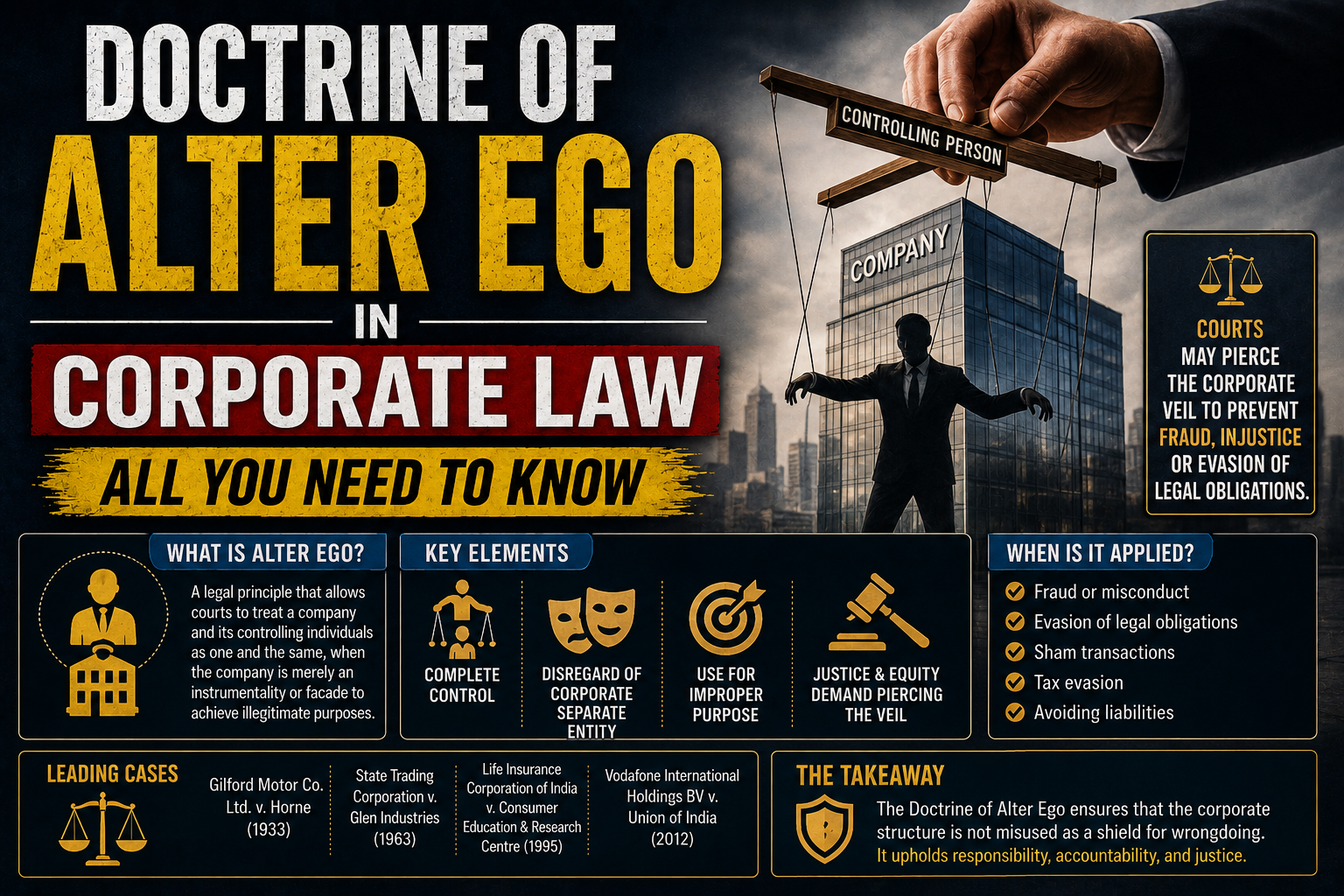
Corporate form is among the oldest and most influential inventions of the modern commerce as it is the driver of economic growth of the world. The key to this invention is the idea of separate legal personality a legal fiction according to which a registered company is viewed as one thing rather than as the one that is created by the people who founded it or run its business. This distinction provides a shield of protection commonly referred to as the corporate veil that cushions shareholders and directors against the infinity of the liabilities and risks that the business enterprise is subject to. It is through this principle that capital formation, risk-taking and accumulation of resources needed to engage in large-scale industrial activity are promoted. This protection is not absolute though. Though the law is highly vigilant in protecting the sanctity of the corporate entity so that economic growth is welcomed, the law is also aware that this privilege can be easily abused. The judiciary interferes when the corporate system has been weaponized to defeat common sense and sanction wrong, cover fraud, or even defend crime. The main form of legal intervention is the Doctrine of Alter Ego. It enables the courts to pierce or to lift the corporate veil and bypass the separate legal personality of the company to attack the individuals behind it. The name “alter ego,” is derevied from the Latin phrase which means for “the other self & it is used when the line between corporation and controllers has become so thin that they are in actuality identical. In this case, the corporation itself is but a shell, an instrumentality, or a vehicle of personal transactions of the owners.
The Doctrine of Alter Ego application will be used to make sure that statutory privilege of limited liability is not transformed into statutory immunity of fraudsters. This report is an exhaustive study of the Doctrine of Alter Ego, and how it was transformed within the tradition of rigid formalism of 19th century to the 21 st century with its new focus on the justice-oriented jurisprudence. It looks at the theoretical basis of the doctrine, how it is applied specifically in life in India and other parts of the world, and the current trends that make it stand out as a concept in arbitration, such as the Group of Companies doctrine.
This report explains the process through the which courts strike a balance between the competing interests of commercial certainty and equitable justice using a concerted examination of the landmark case laws and the statutes.
Meaning and Origin of the Doctrine of Alter Ego
The Jurisprudential Definition
The Doctrine of Alter Ego is an equitable remedy. It postulates that while a corporation is a separate legal entity, it can be stripped of that status if it is found to be the “second self” of its owners. In the context of corporate law, an alter ego finding implies that the corporation lacks a separate identity from an individual or corporate shareholder.1 The court applies this rule to ignore the corporate status of a group of stockholders, officers, and directors with respect to their limited liability.
This doctrine is used as a test of separation; it assesses the business whether it is an independent entity or is merely an extension of the owner’s personal actions or benefits. Any business if declared as an alter ego, is a business that is designed for no good reasons for that the entity is treated as a separate entity from the individuals who actually own it and run it as per their directions. If the conditions are met the owners are stripped from the shield of limited liability protection and then are help personally liable and responsible for the debt and actions of the company. This is legally termed as the “alter ego liability.
The courts have relied on specific categories of evidence to establish the alter ego relationship. These include the inspection of the personal and corporate funds received, meeting of the corporate formalities of holding board meetings and following of proper procedure, inadequate capitalization or under capitalization, diversions of the company profits for personal use. As in the hypothetical scenario of Joe Badman, if an individual forms a limited liability company and uses it to pay off his personal debts or payments or uses it for some other purpose i.e. anything except for the actual purpose of the money, the court will after examining the whole mechanism declare the LLC to be Joe’s alter ego and press liabilities against Joe.
Historical path of the principle of Separate Legal Entity
In order to grasp the exception, it is necessary to first grasp the rule that it aims to modify, that which is the principle of separate legal entity. This was solidly embedded in the United Kingdom in the late 19th century and this was a watershed point in corporate law.
The Foundation: Salomon v. Salomon & Co Ltd (1897)
The modern company law can be linked back to the ruling of House of Lords in Salomon v. Salomon & Co Ltd. Aron Salomon was an effective manufacturer of boots and shoe and traded as a sole proprietor. He later on included his business to a limited liability company, Salomon and Co Ltd. Salomon and his wife as well as five children were also subscribers to the memorandum. Salomon sold the new company his business at price of 39,000 out of which 10,000 was to be paid in debentures (secured debt) to ensure his priority over other creditors.
By the time the company had failed and gone into liquidation the liquidator claimed that the company was a sham; a mere alias or agent of Salomon. The lower courts concurred, considering the arrangement to be a fraud on the unsecured creditors, since Salomon was virtually the sole actual shareholder (with 20,001 shares in his possession and his family having one share each).
Nevertheless, this was reversed by the House of Lords with unanimity. They developed the basic principle according to which as soon as a company is duly incorporated, it turns into an independent legal person possessing rights and liabilities independent of its members. The intentions behind the promoters do not make a difference in the legal existence of the company. This ruling gave the corporation the qualities that it would need to be the giant of capitalism, but these qualities made it a separate entity and enabled individuals to engage in economic activities without endangering their personal wealth.
The “Two-Edged Sword” and the Birth of the Exception
Although Salomon was a good choice as a company personality, it was also termed as a two-edged sword. It unwittingly has invited fraud and evasion of the law by extending the benefits of incorporation and limited liability to small, one-man companies. Ruthless players knew that they could enjoy the protection of the corporate form to shield themselves against the adverse effects of their irresponsible or criminal act. The courts established the doctrine of lifting or piercing the corporate veil in order to reduce the severity and possibilities of misuse of the tough use of Salomon. The Doctrine of Alter Ego became the main theoretical justification of this court action. It was founded on the reasonable jurisdiction of the courts to check the abuse of the corporate form. The rationale behind this is that when a company is a vehicle to perpetrate fraud or avoid a legal responsibility the veil of incorporation should be pierced in order to view the economic reality behind the veil.
Theoretical Frameworks of Liability
The Doctrine of Alter Ego is not applied arbitrarily, but it has certain theoretical underpinnings of law that underlie the failure to consider the corporate entity. The knowledge of the theories can explain the reason why courts behave the way they do.
1. The “Mere Facade” or Sham Theory
This is the prevalent theoretical foundation of the English and Indian law. It assumes that in case a firm is established as a mere facade to hide the actual facts, the court may peep behind the newly constructed facade. This is mostly done when an organization is organized in a certain way to avoid the legal requirement that has already been mandated. In Jones v Lipman (which is discussed below), the company is characterized as a device and a sham, a mask which [the defendant] lifts in front of his face in the attempt to evade identification by the eye of equity.
2. The Instrumentality Theory
In American jurisprudence and other cited Indian court judgements, this theory implies that the corporate veil must be lifted in order to unveil the corporation’s actual action and see who is actually controlling the corporation, so that the company turns into a mere puppet of the majority of the shareholders. And to apply the doctrine there exists three element’s that needs to be satisfied in order to establish this doctrine:
Control Test:
To look into the complete domination of finances, policy, and business practices in day-to-day transactions.
Fraud or Wrong Test:
To test that the control must have been used to commit fraud, wrong, or a dishonest and unjust act which results in the contravention of legal rights of the people directly in effect of the actions of the company.
Proximate Cause Test:
To see if the control and breach of duty must be the proximate cause of the injury or unjust loss incurred.
3. The Identification or Attribution Theory
This theory stands as a crucial point in criminal law, since a company is an artificial person which no mind of its own, it cannot possess a guilty mind (mens rea). This identification theory allows the court to identify the individuals who are the ones controlling the actions and decisions of the company. This can be applicable on the Director of a company for the purpose of applying the criminal intent.
Judicial interpretations through global precedents
The Evolution of the Alter Ego doctrine can be best understood by the following cases:
Gilford Motor Co Ltd v Horne (1933)
This case is the seminal authority on the “evasion principle”—using a company to evade a pre-existing legal obligation. Mr. Horne was the managing director of the Gilford Motor Company. His employment contract included a restrictive covenant (a non-compete clause) that prohibited him from soliciting the company’s customers after leaving his employment. Upon his departure, Horne wished to compete with his former employer but was legally barred from doing so personally. To bypass this contract, he incorporated another company “J.M. Horne & Co. Ltd,” assigning his wife and friends as shareholder and directors and then this new company then began soliciting Gilford’s clients. Horne argued that the solicitation was done by the company, a separate legal entity distinct from him, and since the company had not signed the non-compete clause, it was free to solicit. The Court of Appeal rejected this sophisticated legal manoeuvring. Lord Hanworth MR described the company as a “mere cloak or sham” formed for the specific purpose of enabling Horne to commit a breach of his covenant. The court issued an injunction against both Horne and his company, treating the company as Horne’s alter ego and prevented this evasion of the contract.
Jones v Lipman (1962)
Mr. Lipman contracted to sell a property to Mr. Jones for £5,250. Before the completion of the sale, Lipman changed his mind. To avoid a court order for specific performance (which would force him to sell), Lipman quickly formed a company, “Alamed Ltd,” and transferred the property to it for a lower value. He then claimed he could not sell the land to Jones because he no longer owned it; the company did. Justice Russell applied the Alter Ego doctrine rigorously. He found that the company was under the total control of Lipman and was created solely to defeat Jones’s equitable right to the land. The court characterized the company as a “creature” of Lipman and ordered specific performance against both Lipman and the company. This case brought light to the principle of corporate veil cannot be used to escape contractual obligation.
Prest v Petrodel Resources Ltd (2013)
The UK Supreme Court in the case of Prest v Petrodel clarified the limits of the doctrine. Lord Sumption distinguished between two principles:
Concealment Principle: Whether the court looks behind the corporate façade to find out who the true working and ownership of the assets. This does not strictly “pierce” the veil but merely looks through it.
Evasion Principle: The court pierces the veil only when a person is under an existing legal obligation which he deliberately evades by interposing a company under his control. The court emphasized that the veil should only be pierced (Evasion Principle) if there is no other legal remedy available.21 This marked a trend toward restraining the doctrine to “last resort” scenarios.
United States Perspectives
US courts have generally been more willing to pierce the corporate veil, particularly in cases of “undercapitalization.”
Walkovszky v. Carlton (1966): In this case a taxi fleet owner designed his business into many separate corporations, each owning two taxis and carrying the minimum liability insurance. When a pedestrian was hit and injured by one of these taxis, he sued the owner personally arguing the structure designed was a fraud. After this matter being heard in the court the court discussed the instrumentality” rule but held that this mere division of the business into smaller corporations to limit the liabilities is not a sufficient cause to pierce the veil unless there is evidence saying that the owner was conducting the business in his individual capacity
Doctrine of Alter Ego under Indian Law: Civil Jurisprudence
Indian laws have been observed to adopt the principles laid down the English law but have expanded the coverage of the doctrine to protect the public revenue and state resources. This application in Indian courts consists of an intersection of constitutional law and administrative law.
LIC of India v. Escorts Ltd. (1986)
The Life Insurance Corporation of India (LIC), a public financial institution and majority shareholder, sought to remove the existing management of Escorts. The Supreme Court had to decide whether it could look behind the foreign companies investing in Escorts to determine if they were truly owned by Non-Resident Indians (NRIs) as required by the Foreign Exchange Regulation Act (FERA). The Constitution Bench held that the corporate veil may be lifted where a statute itself contemplates it to be done, or where it is necessary to prevent fraud or improper conduct and meet the ends of justice. The Court stated: “Generally and broadly speaking, we may say that the corporate veil may be lifted where a statute itself contemplates lifting the veil, or fraud or improper conduct is intended to be prevented, or a taxing statute or a beneficent statute is sought to be evaded or where associated companies are inextricably connected as to be part of one concern.”.
This judgement made it clear that while company is a separate legal entity, the court has the power to lift the corporate veil and look into the realities of the situation and it becomes a necessity when the corporate form clashes with public interest or statutory intent.
Revenue and Taxation: State of U.P. v. Renusagar Power Co. (1988)
Renusagar Power Co. was a wholly-owned subsidiary of Hindalco. It generated electricity solely for Hindalco’s use. The state government levied a duty on electricity but provided an exemption if the electricity was generated by a person for their “own use.” The state argued Renusagar (the subsidiary) and Hindalco (the parent) were separate entities, so the exemption did not apply.
The Court lifting up the corporate veil, treated the Renusagr and Hindalco as one economic entity and held that the subsidiaries companies were the alter ego of the parent company and was created solely for the purpose of supplying power to it. Therefore, consumption by Hindalco was “own consumption,” and the tax exemption was granted. This illustrates that the doctrine can be used to prevent an unjust tax burden just as it can be used to prevent tax evasion.
State of Rajasthan v. Gotan Lime Stone Khanji Udyog (2016)
The Gotan Lime Stone Khanji Udyog (GLKU) claimed a mining lease from the state government as its right, but such mining leases are a valuable public asset and are not transferred without the permission and payment towards the government. The partnership firm converted itself into a Private Limited Company (GLKUPL), with the partners becoming directors. This conversion was permitted by the rules as a mere “change of form.” However, immediately after the conversion, the new company sold its entire shareholding to a third party (Ultra Tech Cement) for ₹160 Crores. The company argued that the mining lease still belonged to GLKUPL; only the shareholders of GLKUPL had changed. Since a company is a separate legal entity from its shareholders (Salomon), the lease had not been “transferred.”
The Supreme Court pierced the corporate veil. It held that this two-step process (conversion then sale of shares) was a “device” and “subterfuge” to achieve an illegal result—the sale of the mining lease without government permission. The Court looked at the substance over the form and declared that the company was merely an alter ego with a purpose to hide the real transaction and the lease transfer was cancelled.
The Gotan Lime Stone case signifies this shift from strict private law applications (like Salomon) to public law applications. When public interest or natural resources are involved, Indian courts are far more aggressive in applying the Alter Ego doctrine to expose the “real” transaction.
Other significant Civil Applications:
New Horizons Ltd. v. Union of India: The court lifted the veil to allow a joint venture company to claim the past experience of its parent partners for a tender process. The court recognized the reality that the JV was an alter ego of its experienced partners.
Vodafone International Holdings BV v. Union of India (2012): This case is a part of a task dispute, in which the supreme court initially refused to lift the corporate veil, but later acknowledged that the veil can be lifted if the structure was a “sham” or used for tax evasion.
Doctrine of Alter Ego in Criminal Law: The “Directing Mind”
A challenging area for the Alter Ego doctrine has been corporate criminal liability. Indian courts have resolved this by applying the Doctrine of Attribution or the Identification Doctrine.
Iridium India Telecom Ltd. v. Motorola Incorporated (2011)
Iridium India filed a criminal complaint against Motorola for cheating (Section 420 IPC). They alleged Motorola made false representations about the Iridium satellite project to induce investment. Motorola argued that a corporation is incapable of having the “guilty mind” required for cheating. The Supreme Court rejected Motorola’s argument. It held that a corporation is virtually in the same position as any individual and may be convicted of common law and statutory offenses requiring mens rea. The Court utilized the Alter Ego principle: the criminal intent of the “alter ego” of the company (the persons in control) is imputed to the corporation. The company and its controllers are treated as one for the purpose of criminal liability.
Standard Chartered Bank v. Directorate of Enforcement (2005)
Before Iridium, there was confusion about whether a company could be prosecuted for offenses where the mandatory punishment was imprisonment (since a company cannot be jailed). In Velliappa Textiles, the court had said no. In Standard Chartered, the Supreme Court overruled Velliappa and held thet in cases where the statues make it mandatory for imprisonment and fine, the courts must impose fine on the company, as it cannot imprison the company. This ensures that the corporations cannot escape the liability of crimes serious in nature simply on the ground that it the company lacks a physical body.
Sunil Bharti Mittal v. Central Bureau of Investigation (2015)
This case clarified the limits of the doctrine. While Iridium allowed the director’s intent to be imputed to the company (to punish the company), the CBI in this case tried to do the reverse: impute the company’s alleged crime to the directors (to punish the directors) without specific evidence of the directors’ active role. The Supreme Court ruled that the principle of alter ego acts in one direction: establishing the liability of the company based on the acts of the directors. This does not work in reverse making the directors liable for the company’s actions, unless the statute governing it specifically provides for it or there exists a direct proof for the active involvement of the director. A director cannot be held vicariously liable for the company’s acts on the basis of their position as the director.
How The Companies Act, 2013 govern this?
While this doctrine is evolved from the judge-made law, the Companies Act, 2013, in India codified and recognised these principles in sections making the liability of “alter egos” statutory.
Section 447: Punishment for Fraud
This section is the legislative embodiment of the Alter Ego doctrine. It defines “fraud” comprehensively to include “any act, omission, concealment of any fact or abuse of position committed by any person… with intent to deceive, to gain undue advantage from, or to injure the interests of, the company or its shareholders or its creditors”.
Section 251: Fraudulent Application for Removal of Name
If persons in charge of a company file an application to remove the company’s name from the Register of Companies with the intent to deceive creditors or defraud others, they become personally liable. The section disregards the limited liability status, holding the individuals jointly and severally liable for the management of the company’s debts.
Section 339: Liability for Fraudulent Conduct of Business
In the course of winding up, if it appears that any business of the company has been carried on with intent to defraud creditors, the Tribunal can declare that any persons who were knowingly parties to such conduct shall be personally responsible, without any limitation of liability, for all or any of the debts of the company. This is a direct statutory application of piercing the veil.
Difference Between Separate Legal Entity and Doctrine of Alter Ego
The relationship between these two concepts is that of a general rule and its necessary exception. The following table shows their operational differences.
| Feature | Separate Legal Entity (The Rule) | Doctrine of Alter Ego (The Exception) |
| Legal Basis | Established in Salomon v. Salomon (1897). | Evolved by Equity (e.g., Gilford Motor Co) and Statute (e.g., S. 447 Companies Act 2013). |
| Core Philosophy | The company is a distinct “juristic person” separate from its members. | The company and its controllers are “one and the same” due to abuse of form. |
| Liability Status | Limited Liability: Shareholders are liable only to the extent of unpaid share capital. | Unlimited/Personal Liability: Controllers are personally liable for corporate debts and acts. |
| Primary Objective | To encourage entrepreneurship, risk-taking, and capital aggregation. | To prevent fraud, tax evasion, crime, and the circumvention of public policy. |
| Burden of Proof | Low: Proved by Certificate of Incorporation. | High: Requires proof of “sham,” “façade,” “fraud,” or “total domination.” |
| Judicial Attitude | Courts staunchly defend this to maintain commercial certainty. | Courts apply this cautiously and only in “exceptional circumstances” or “public interest.” |
| Applicability | Applies to all validly registered companies in normal course of business. | Applied in specific instances of criminal acts, fraud, or where statutory intent is defeated. |
Emerging Trends of the “Group of Companies” doctrine in arbitration process.
The modern distinction is made between the doctrine of Alter Ego and the “Group of Companies” doctrine used in the arbitration process which was clarified by the constitution bench of Indian Supreme Court in Cox & Kings Ltd. v. SAP India Pvt. Ltd. (2023). In complex commercial transactions, multinational corporations often operate through a web of subsidiaries. When a dispute arises where the subsidiary had signed the arbitration agreement and the parent company which did not sign the arbitration agreement is the actual decisions maker. Can the parent company called into the arbitration?
To this previously, courts used “piercing the veil” or “alter ego” language to bring the binding effect on non-signatories to arbitration, arguing that they were actually the same entity.
The Clarification given in Cox & Kings:
The Supreme Court clarified that the Group of Companies doctrine is distinct from the Alter Ego doctrine. Alter Ego doctrine is based on piercing the veil to find fault or fraud. It disregards the separate legal personality and Group of Companies is based on consent. It maintains the separate legal personality of the group members but finds that, through their conduct and the commercial reality of the transaction, the non-signatory companies impliedly consented to be bound by the arbitration agreement.
The Alter Ego doctrine requires a finding of wrongdoing (sham/fraud). The Group of Companies doctrine does not; it only requires a finding of mutual intention to arbitrate. This prevents the overuse of Alter Ego doctrine and being diluted in purely commercial arbitration disputes that occur.
Significance of the Doctrine of Alter Ego
The Doctrine of Alter Ego serves as the conscience of corporate law as,
Ensuring Corporate accountability of the companies and prevents the corporate veil being used as a curtain for crime and fraud and holding the directing minds accountable aligning the legal liability with moral culpability
Protecting the stake holders: the creditors, employees and the government are protected from such schemes where the assets are stripped from the company as in Jones vs Lipman case and this doctrine allows such stakeholders to hold on to their assets as their true owners.
Safeguarding the Public Revenue: As observed in Renusagar and Gotan Lime Stone case the doctrine stands indispensable for the counter tax avoidance schemes and the illegal transfer of resources.
Adapting to the modern complexity: With a rise in the complexity of the shell companies (revealed in scandals like the Panama Papers), this doctrine provides the court with the ability to look at the economic unit rather than just the legal form, ensuring that the ends of the justice are met.
Conclusion
This is evidenced in the Doctrine of Alter Ego which credits the flexibility of the common law. It recognises the great usefulness of the corporate form, without allowing it to base itself on that as a haven of the scrupulous. Since its inception as a limited fairness corrective in Gilford Motor Co, it has become a solid rule of law in India, which has been strengthened by such cases as Iridium and Gotan Lime Stone and has been codified by the Companies Act, 2013. According to the jurisprudence, it is evident that separately legal entity, although, is still kept as the rule, but the exceptions are broadening especially where there is a concern of public interest and the intent of the crime committed. The modern corporation is strong but it is not a sovereign due to the Doctrine of Alter Ego. The doctrine, by allowing the veil to be lifted when taken by the courts, ensures the delicate balance between doing business and upholding justice, and is something to prove that when it comes to the law, the reality of the matter will always prevail over the appearance of fiction.
About Author
Aayush Pradip, a law student at Symbiosis Law School, Nagpur, is a budding legal writer and researcher with a sharp eye for the intersection of law, technology, and corporate strategy. Passionate about Intellectual Property Rights, Legal-Tech & AI Innovation, and Corporate Governance, Aayush actively explores contemporary legal nuances—ranging from AI inventorship under WIPO frameworks to the evolution of digital regulatory compliance—through rigorous research and practical application.