

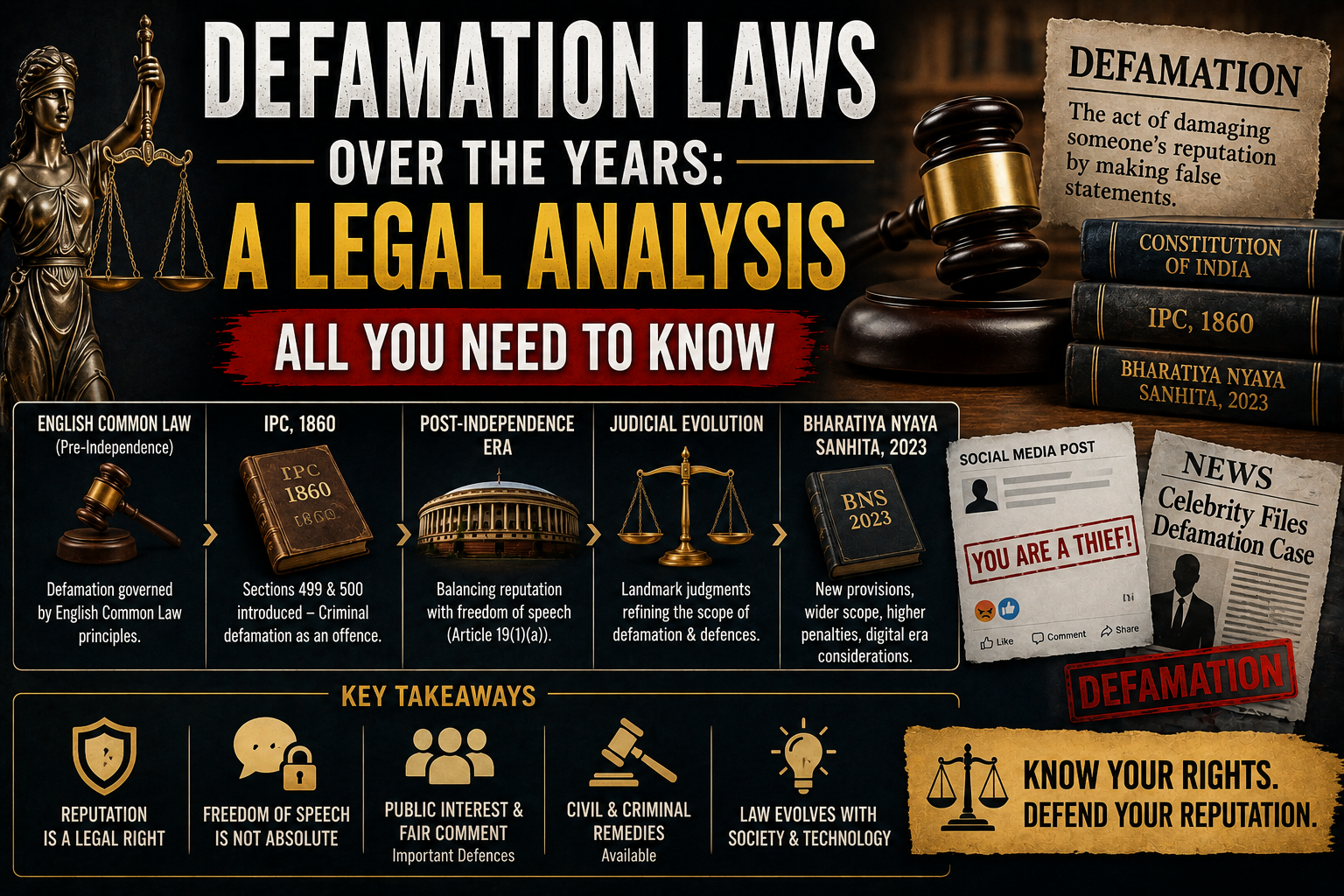
Introduction to defamation law in India
A person’s reputation is one of the most valuable assets, and a single statement, post, or blog can ruin it all for the person. Nowadays defamation cases are surging, because the digital age provides a platform where reputations can be damaged with a single click. Defamation is a dual-natured legal concept, existing both as civil wrong and a criminal offence.
This article will include a breakdown of elements of defamation, from traditional to electronic mediums, exploring how legal systems balance the protection of individual reputation with the fundamental right to free expression.
Definition and legal meaning of Defamation law in India
Defamation is the act of communicating false statements about a person, to harm their reputation, and establish a negative image of the harmed person in the society. It contains untrue information of any person for dishonouring their character.
Essentials of defamation law in India
Defamatory statement: The published statements framed for the victim, must be false, and must lower the reputation of the victim in the eyes of society.
Identification: The statement or remarks made for the victim must clearly indicate that it is related to the victim.
Publication: The statement must be shared/communicated to at least one person, other than the victim.
Fault: The person publishing the defamatory statement (defendant) must be at fault (negligent or intentional), and the statement must cause harm to the victim’s reputation, or personal life.
Defamation law in India in criminal and civil context
The relief for the offence of defamation is different in both civil and criminal defamation. In civil defamation an individual’s reputation is affected, and the courts provide remedy for them in the form of monetary compensation.
Criminal defamation used to be governed by the Indian Penal Code- Section 499 and 500, including punishment of upto 2 years or fine or both.
Defamation law in Civil Cases
Civil Defamation is governed by the law of torts. In civil defamation, a person’s image should be exposed in a way that it creates dislike, and a wrong impression of the person in society.
The defamation must be expressed in a way that makes it clear to the public that the act is targeted for maliciously depicting the person.
The content of defamation must be published, where it is displayed to the rest of the world. Civil defamation only leads to individual harm, and not to the society, hence, monetary compensation is provided to the victim. Civil Defamation remedies focus on compensating the victim and restoring their reputation through civil suits.
Defamation law in India in Criminal Cases
Criminal defamation is faintly different from civil defamation. Criminal defamation affects the society at large and is now being regulated by the provisions mentioned in Bhartiya Nyaya Sanhita.
Criminal defamation amounts a person to imprisonment, which includes paying a fine for the same; or both. For criminal defamation, a person must have a mens rea (guilty mind), to cause harm maliciously through defamation to another person. It is a bailable, non-cognizable offence. The defamatory content must be shared with at least one person, other than the victim.
Remedies for criminal defamation include filing a complaint under Section 356 of the Bharatiya Nyaya Sanhita.
Types of defamation law in India
Defamation is classified into two main types- Libel (written/permanent) and slander (spoken), both can be addressed through civil lawsuits for compensation or through criminal prosecution.
Libel: Libel is a type of defamation, which is in written, permanent, and visible form. Libel is tangible in form. Libel includes written statements, articles, social media posts, print etc. Libel is considered more damaging than Slander because of its permanent nature. Libel defamation does not need the victim to prove the damage done to their reputation, as the harm is presumed by law.
Example: A social media post or falsely accusing someone of fraud.
Illustration: Mr. B falsely accused Mr. C of theft, in libel.
Slander: Slander defamation damages the reputation of a person through spoken words, gestures or signs. It is temporary in nature, and harder to prove. With slander, people also face false allegations of defamation, due to lack of evidence.
Slander requires a proof to be considered as defamation unless it falls under specific exceptions. Slander is intangible in nature.
Example: A person affected a person’s reputation through speech, in a debate competition.
Defamation per se: Defamation ‘per se’ refers to statements so inherently harmful, such as- false accusations of serious crime, loathsome disease (making people believe that a person currently suffers from a contagious disease, that they are actually not). Professional incompetence (suggesting that a person is unfit for their trade, business, or profession). It is considered defamatory directly to the person without needing outside context.
Defences for defamation ‘per se’
If a statement is true, it is not Defamation.
A person’s personal opinion, that cannot be proven false, is protected by law, and is not considered defamation ‘per se’.
How defamation laws were shaped over the years in India
History of defamation laws
Defamation laws in India were primarily introduced by Lord Thomas Macaulay, during the British Colonial Era. Macaulay drafted the Indian Penal Code in 1837, which codified criminal defamation under section 499 and 500.
Primarily, Section 499 and 500, was introduced by the British to protect reputation, but was frequently used to silence freedom fighters and media in the earlier times. After independence, defamation laws were balanced against Article 19 (1)(a)- ‘Freedom of Speech’ and Article 21- ‘Right to dignity’. Article 19 (2) includes reasonable restrictions on people, including defamation.
Why Defamation laws are necessary
Protects Fundamental Rights: The right to dignity and reputation is recognised as an essential component of the “right to life”. Defamation laws protect individuals from having their hard-earned reputation unfairly destroyed by false and malicious claims.
Deterring Malicious Misinformation: In the digital era, defamation laws protect victims from being targeted by individuals, trying to destroy one’s hard earned reputation within seconds.
Balancing free speech: Right to Freedom of Speech and Expression is an essential part under Article 19 of Constitution of India, Article 19 ensures that people are not deprived of their rights, by maintaining crucial boundaries for it, it maintains speech for public interest, criticism by people of society and ensures no person faces any defamatory attacks on them.
Promoting Media Accountability: Defamation law’s framework ensures that media outlets are not publishing any content without accountability, and it directs the media outlets to maintain credibility for their content.
Safeguarding vulnerable groups: In socially sensitive climates, these laws act as a check against hateful or discriminatory statements, targeting women and minority groups.
Judicial Interpretation of Defamation
Judicial interpretation of Defamation in India revolves around a ‘balancing act’ between Article 19 (Right to Freedom of Speech) and Article 21 (Right to Reputation). The Supreme Court has historically upheld the validity of criminal defamation.
Reputation as a fundamental right
In the landmark case “Subramanian Swamy vs Union of India”, the Supreme Court ruled that ‘right to reputation’ is an inseparable facet of the ‘Right to Life’ under Article 21.
The court held that freedom of speech cannot be used to ‘crucify’ another person’s reputation. It stated that Section 499 and 500 of Indian Penal Code are reasonable restrictions under Article 19(2).
Changes in defamation laws over the years
Over the years Defamation has changed so much as a crime. New Acts were enforced on 1st of July 2024, including – Bhartiya Nyaya Sanhita, Bhartiya Nagarik Suraksha Sanhita, and Bhartiya Sakshya Adhiniyam. Under these statutes, defamation is defined in a broader sense. Defamation which was earlier defined under Section 499 and 500 of Indian Penal Code, has transitioned into the digital age, under Section 356 of Bhartiya Nyaya Sanhita, 2023. Section 356 of Bhartiya Nyaya Sanhita addresses digital and social media defamation, adding community service as a penalty, and stricter provision for group defamation.
Evolution of Defamation laws
Pre-digital Defamation: In earlier times defamation focused on words spoken through people (slander) , or through written, printed statements (libel) in newspapers, or public speech, and protected an individual’s right to reputation under Article 21.
Digital Age (Cyber Defamation): Over the years, technology has enhanced, and is accessible to every person, connecting one another to each other, and spreading messages, or any information instantly.
With the internet, defamation became instantaneous and global. It includes any derogatory content on social media, blogs etc, that comes under the meaning of defamation.
Digital defamation creates several issues, one of which is anonymity of the content, and makes hurdles for making any person held liable for the crime. Cyber Defamation is covered by Section 356 BNS, but it also falls under the Information Technology Act, 2000, where Section 66 & 67 deals with electronic fraud and obscene content.
Focus on technology: The new provisions are aimed at controlling ‘social media defamation’, and protecting groups from online hate, and not just individuals, the legal framework has been updated to address digital-age challenges, specifically through broader interpretations of ‘visible representations’ and ‘published content’.
Definition of Defamation under Bhartiya Nyaya Sanhita: Under Section 356, Making or publishing any imputation concerning a person intending to harm, or knowing it will harm their reputation is known as defamation.
Punishment for defamation: Imprisonment for up to two years, a fine or both.
‘Community Service’ has been added in Bhartiya Nyaya Sanhita under Section 356 as a penalty, this signifies a shift from purely monetary form or imprisonment penalties.
Enhanced Punishment: The provision in Section 356(3) increases the punishment to 3 years if the defamation involves printing or selling material that defames an ‘identifiable group or community’, targeting hate speech.
Why criminalizing defamation is debated
Criminal defamation is debated because, on one hand, it is protecting a person’s reputation, but on the other hand it goes against the Fundamental Right to Speech.
Some believe it suppresses journalism and public dissent, while proponents believe it protects individual dignity and maintains public order. Proponents argue that reputation and dignity is crucial to be protected by criminal law, and deserves special provisions, for protection against malicious attacks.
Burden on judiciary: The high volume of criminal defamation cases loads to a backlog of legal matters, with cases dragging on for years, primarily due to complex free-speech balancing acts, Courts struggle with evaluating subjective reputational damages and managing the sheer volume of cases.
Case laws of defamation
Subramanian Swamy vs Union of India : This case is considered as the foundational case for the constitutional validity of Criminal defamation. The Supreme Court upheld the law, ruling that reputation is a fundamental facet of the Right to life, Article 21, and that criminalizing it’s harm is a ‘reasonable restriction’ on free speech.
Shreya Singhal vs Union of India: Focusing on online speech, this case struck down Section 66 of the Information Technology Act, which had been used to prosecute ‘offensive’ messages. The court held that online defamation must meet the same strict standards as ‘offline’ speech, preventing vague criminal charges for digital expression.
Exceptions of defamation
Defamation as a criminal law, under Bhartiya Nyaya Sanhita provides some specific statutory exceptions to protect free speech and public interest.
Statutory exceptions under criminal law:
Statements for public good, but it must be proven that publishing it was for the benefit of the public.
Opinion or fair comments: Expressing an honest opinion regarding the official conduct or character of a public official. Fair comments on the conduct of any person regarding a public issue. Fair criticism of works available to the public for judgement, such as books, films.
Good faith: A complaint or accusation in good faith to a person in lawful authority. Statements made to protect one’s own interest, the interest of another, or for general public good.
Consent: If any person/party consented for the published statements, they cannot claim defamation.
Privilege: Statements made during judicial or parliamentary proceedings.
Defamation in India, and on a global level
Defamation in India is treated as both a civil wrong (tort) and a criminal offence.
While other countries have decriminalised defamation to favour freedom of speech, treating it primarily as a civil matter.
Defamation in India
Defamation is a punishable offence in India. Defamation is a reasonable restriction on Freedom of Speech under Article 19(2), while reputation is protected under Article 21.
Defenses: Truth (for public good), criticism in good faith for public conduct.
Defamation on a global level
Globally, several countries observe defamation as a civil wrong. The vast majority of Countries globally (around 80%) still treat Defamation as a criminal offence. In several Nations, this involves the threat of imprisonment. Global rights organisations strongly advocate for decriminalization.
USA: Defamation is purely treated as a civil wrong. The 1st amendment protects speech, requiring ‘public figures’ to prove ‘actual malice’.
Uk: Criminal libel was abolished in 2009.
Other countries like Australia, Canada, Sri Lanka have moved towards civil-only defamation.
Cross-border Challenges: The internet and social media have made global defamation an increasingly difficult legal hurdle, because a defamatory post or article is instantly accessible worldwide, a victim might attempt to sue in the country where they suffered the most reputational damage, rather than where the publisher is based.
Sedition law in context of Defamation Offence
Offence: It criminalizes any act which excites, or attempts to excite any armed rebellion, secession, subversive activities, or encouraging any separatist feelings. These acts can be carried out through spoken or written words, signs, electronic communication, or by financial means.
Punishment: Conviction can lead to life imprisonment or a prison term extending up to 7 years, along with a fine.
Differences in BNS & IPC Sedition law
The term ‘sedition’ and concept of exciting ‘disaffection’ against the government have been removed. Instead the law focuses explicitly on threats to national sovereignty and integrity.
Shift from ‘Defamation of government’ to ‘Threats to the state’
Under the colonial-era, Section 124 of the Indian Penal Code, Sedition was triggered by any speech or action that brought “hatred, contempt, or disaffection” against the government.
This effectively functions as a criminal defamation law protecting the ruling government’s reputation.
Section 152 of Bhartiya Nyaya Sanhita completely removes the words “hatred”, “contempt”, and “disaffection”. The law no longer punishes a citizen for ‘defaming’ or hurting the reputation of the government or state agencies. Instead the legal threshold has moved from protecting political reputations to protecting the literal existence, sovereignty, unity and integrity of India.
The speech that strongly criticizes, insults, or exposes flaws in the nation or state is legally protected unless it intentionally incites concrete harm.
Secession: Demanding a separate country outside India’s territory.
Subversive activities or encouraging separatist actions.
Sedition as a law is necessary because it safeguards the country’s and state’s reputation, similar to safeguarding an individual’s reputation, and if provoked, the defendant shall face legal consequences by provisions provided under Bhartiya Nyaya Sanhita.
Impact of defamation law on Public Figures & Private Individuals
Usually, Courts apply stricter rules on public figures than private individuals. These rules protect the freedom of speech. The statements from public figures may spark debate among people, or, people may get influenced by these statements, hence, the liability of public figures is different from private individuals.
Private individuals are not treated the way public figures are being treated for defamation, but courts make sure that private individuals understand the depth, and seriousness of Defamation as a crime.
Does defamation trigger only a single person, or society as a whole
Defamation is legally recognised as a harm to an individual’s reputation, but it also triggers consequences for society as a whole.
The Supreme Court of India has specifically held that, because of individuals, a society exists, hence, a harm to reputation affects the whole society.
How defamation triggers both: Defamation law protects the public from false information, ensuring reputations are not ruined unjustly. In India, criminal Defamation is considered an offence against society. While defamation usually pertains to an individual, it can extend to a company, association, or a clearly defined group of persons.
Conclusion
The balance between freedom of expression and the sanctity of Reputation remains one of the most complex puzzles in modern law, Defamation law exists not to silence critics, but to draw a line between fair opinion and malicious representation. It is a necessary safeguard to ensure that in our pursuit of discourse, we do not sacrifice our dignity. Defamation laws should never serve as a tool for the powerful to suppress the truth, but rather it should work as a necessary shield to protect every individual’s fundamental right to dignity. True justice lies in ensuring the noise of Defamation never drowns the truth.
About Author
Vatsla Singh is a law student at Shri Ramswaroop Memorial University. She has completed her internships at District Court and Tax Tribunal, which helped her in gaining practical legal exposure and knowledge of the legal system. She is committed to understand the constantly evolving system of law, and applying the legal knowledge in her work.
References
- https://www.manupatrafast.com
- Bhartiya Nyaya Sanhita
- Law of torts
FAQs
1. What is meant by defamation?
Defamation is an act of making false, published statements, that intentionally damage a person’s or entity’s Reputation.
2. Which law deals with Defamation?
Both Civil and Criminal law deals with Defamation under BNS, Tort law, Constitution of India.
3. What are the key elements of a defamation claim?
False statements, publications, harm to Reputation, identification.
4. What is not considered as Defamation?
Truth, fair opinion, statements made in legal proceedings, parliament, or high-level official duties.
5. Consequences of a Defamation lawsuit
Civil: Monetary compensation for damage to reputation.
Criminal: Punishment can lead to imprisonment and fines up to 2 years in India.