

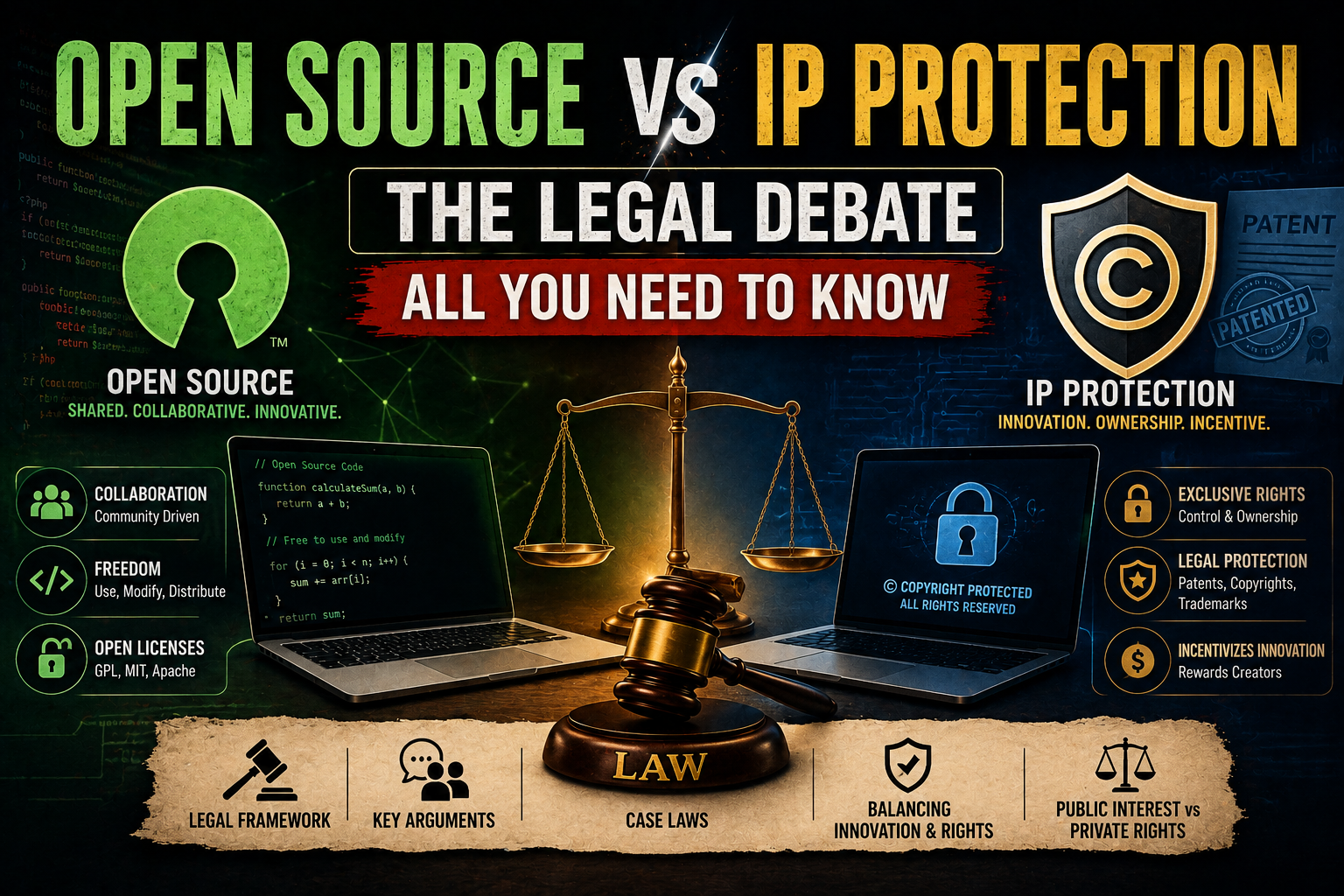
Introduction — Understanding the Core Conflict of Open Source vs IP Protection
The pattern of modern life today has been completely changed by software today. With this growth, the question of whether software should be freely shared to accelerate innovation or whether should they be carefully protected to reward its creators arises. In 1959, an ethical rebellion by programmers in the MIT Artificial Intelligence Lab (AIL) led to the foundation of open-source software. Today, systems of artificial intelligence are trained on large codebases. Startups are also building products by basing them on foundations that are open-source and easily accessible. The debate highlights how innovation is incentivized in light of these developments today. Traditional IP protection promises rights that are exclusive, encouraging both investment and development. On the other hand, open-source licensing promises collaboration with rapid iteration. This tension creates legal risks, shapes business models and determines whether innovations should be made widely accessible for the public to use. This paper examines the legal dimensions of this very conflict. Even though the idea of open-source and IP protection may seem fundamentally incompatible with each other, both rely on intellectual property law. Whether IP law applies or not is not the question, but how different licensing frameworks leverage IP rights to achieve either freedom or control is and in thi article author has explained in detailed about Open Source vs IP Protection.
What is Open Source Software?
A. Key Principles of Open-Source Development
The open-source idea rests on three fundamental principles which are transparency, collaboration, and accessibility. Open-source projects make their source code available to the public for free inspection, modification and redistribution. In contrast to this, proprietary code is legally restricted. This transparency enables peer review that helps catch bugs faster and allows developers all around the sphere using that same code to contribute improvements. It also prevents vendor lock-in that ensures that users are not trapped with a single supplier.
The idea that innovation must be cloaked and proprietary is antithetical to open-source development, which is driven by collaboration. Open-source projects such as Linux, Apache and Mozilla Firefox have shown how distributed teams of volunteers and corporate contributors can create a software that is equal to or better than proprietary offerings. The “bazaar” model of development, where many developers reviewing code make bugs shallow which helps in producing even more robust and secure software than the “cathedral” approach of closed development teams.
Accessibility means more than merely viewing code. The freedom to run programs for any purpose, study the process of how they work, and redistribution of the copies and modified versions are granted by open-source licenses. These freedoms articulated by the Free Software Foundation provides developers worldwide with an approach that is driven by values and where technical excellence is on par with the autonomy of the person using it.
B. Common Open Source Licenses
Open-source licenses fall into two broad categories that present different philosophical approaches to both sharing and control.
Permissive licenses are those licenses that put minimal restrictions on the reuse of code. The MIT License, BSD licenses, and Apache License 2.0 allow developers to use, modify, and redistribute code with few requirements without the need for attribution to the original creator of the work. One such license which has become hugely popular for its simplicity and flexibility is the MIT license originating from Massachusetts Institute of Technology. It lets users incorporate open-source code into proprietary products. This then further allows the companies to build commercial offerings atop freely available foundations.
The BSD (Berkeley Software Distribution) licenses come in several variants. The 2-Clause BSD License only requires the users to preserve copyright notices which simply means that the code can be used however as long as the original creators of it are credited. The 3-Clause BSD adds a non-endorsement clause which prohibits the usage of the original creators’ or contributors’ names to advertise or sell the newly crafted product. Basically, these permissive licenses allow their users to use the code as long as they credit the creators. The users cannot sue later if the code breaks.
Copyleft licenses adopt a different approach. Instead of maximizing freedom for downstream developers, the freedom for the users at the end is prioritised. The GNU General Public License (GPL) places an obligation requiring that any modified or extended versions of the GPL code shall be distributed under the GPL. This is done to prevent proprietary capture. Companies cannot take open-source code and then add features to sell the result as closed-source software without sharing the new improvements back to the community.
The GPL comes in multiple versions. GPLv2 (1991) became the license for Linux and many other projects. GPLv3 (2007) addressed the concerns regarding software patents, management of digital rights, and “tivoization” which refers to a practice of using hardware restrictions or digital signatures to block users from installing their own modified versions of that software . The Affero GPL (AGPL) does away with the “ASP loophole” where companies used to modify the GPL code for web services without the distribution of those modifications by extending copyleft to software accessed over networks.
Between these extremes lie “weak copyleft” licenses like the Mozilla Public License (MPL) and Lesser GPL (LGPL). Under these licenses, the copyleft requirements are applied at the file level rather than the whole program. Proprietary code can be linked to the LGPL libraries without forcing the entire application to become open-source. This can be done as long as modifications to the library itself remain open.
Licensing matters so much today because it determines the legal relationship between creators, distributors, and users. What can be done with a code is defined by a license. The obligations they must fulfill and what will happen if the terms are violated. In essence, open-source licenses use copyright law which is the same mechanism that protects proprietary software. This ensures that the software remains free and accessible rather than controlled and restricted.
Understanding Intellectual Property Protection in Software
A. Types of IP Relevant to Software
Four distinct intellectual property regimes can protect different aspects of software, though there is a significant difference in their application to various jurisdictions
Copyright protects the expression of ideas that are present or are embodied in the source code and sometimes in object code. Copyright comes into existence the moment a programmer writes code, thereby making it automatic. This grants the programmer with exclusive rights to reproduce, distribute, display, and create derivative works.
Copyright does not guarantee the protection of underlying algorithms or functions but only the particular way code expresses them. This distinction matters a lot because copyright prevents someone from copying the code exactly, but it does not guarantee protection against someone from implementing the same functionality through a different code.
Patents protect innovative inventions. It does so by granting exclusive rights to the creations that are new and are not very evident to a person skilled in that very relevant field. Software patents cover algorithms, processes, and methods embodied in the code. Unlike automatic protection like in the case of copyright, patents require filing applications, through which novelty and non-obviousness is demonstrated, followed by an examination by patent offices. Successful software patents grant broader protection than copyright since they can block others from implementing the same functionality even through an entirely different code. This power makes software patents particularly favourable in communities that are pro open-source.
Trademarks protect the names, logos, and brand identities that are associated with software products. Although they play a significantly lesser role in the open-source and intellectual property debate, they are significant for projects such as Mozilla Firefox and Red Hat Enterprise Linux where open-source code coexists with a branding that is legally protected. Firefox’s code can be modified freely under its open-source license but that modification cannot be called “Firefox” due to issues with trademark.
Trade secrets protect confidential information that could provide one with a competitive advantage. Companies with proprietary software often rely heavily on trade secrets. This is done with the aim of keeping their source code confidential which then helps them to maintain market advantages. Trade secret protection turns to waste once information becomes public. Hence, making it fundamentally incompatible with open-source distribution. A code cannot be simultaneously published openly and then claimed to be a trade secret.
B. Why IP Protection Matters
Traditional justifications for intellectual property protection rest on incentivizing innovation and creativity. The economic argument states that the development of software requires substantial investment in time, talent, and resources and without proper legal protections that allow creators to recoup investments and profit from their work, grave injustice would occur that would also hamper technological advancement. IP rights tend to create monopolies that may encourage risk-taking. The innovations that are successful get rewarded.
IP protection for businesses does more than just give them exclusivity. Licensing of patents and copyrights for revenue can then be used as collateral for financing or cross-licensed to resolve disputes and facilitate collaboration in complex deals. Investors are attracted to healthy IP portfolios because protected technology is an asset. Venture capitalists looking at startups often want to see if the companies own or license their core technology, and if they have adequate IP protection.
IP protection also prevents unauthorized use that could compromise legitimate business models. Absence of IP laws would put a company at an unfair disadvantage if the competitors decided to freely copy the software after the costs of development had been bore by that one company. Protection allows companies to build market positions, brands and sustainable competitive advantages based on technological superiority rather than just faster execution.
Critics argue that IP protection can go too far in the context of software. Patent “thickets” of overlapping claims may lead to the creation of legal minefields that may stifle innovation. Too broad patents might block follow-on innovations. Similarly, excessively long copyright terms like the life of the author plus 70 years in many jurisdictions vastly exceed what is necessary to incentivise software creation where product cycles are measured in months or years and not centuries.
The excessive propertization of software is what led to the emergence of open-source movement. Rather than rejecting IP law entirely, open-source licenses repurpose IP rights toward a different end which is to use copyright not to restrict, but to ensure freedom.
The Legal Clash – Where Open-Source and IP Collide
The fundamental clash results from various philosophies that may be considered irreconcilable about the nature and purpose of software. Proprietary models treat software as a product to be owned, controlled, and monetized through exclusive rights. Whereas open-source models treat software as a commons to be shared and improved collectively and then to be distributed freely. Both rely on intellectual property law, but the wielding of those rights tends to follow opposite goals.
Consider a practical scenario. A developer creates an image processing library and then releases it under the GPL license. A commercial software company incorporates that library into its photo editing application. Under the terms of the GPL license, the company must make public the entire source code of their application which would effectively convert their proprietary software into open-source. This “viral” nature of the GPL forces businesses to make their code open source even if they used a small part of it and this is exactly the conflict many businesses fear.
Hybrid scenarios tend to add to legal ambiguities such as what may constitute a “derivative work” that may trigger copyleft obligations. If a proprietary application merely links to a GPL library through well-defined interfaces, can that be considered a derivative work? To this debate, the courts and legal scholars show their disagreement. The LGPL was created to permit linking without viral effects, but even that license has its own grey areas.
License compatibility issues create additional complexity. A developer might want to merge code from various open-source projects. But if licenses of components are incompatible, it causes legal issues. Not all open source licenses are created equal. Some might have requirements that may be in conflict with the other licenses which may leave developers to choose between valuable pieces or a constant fear of legal action.
The collision between software patents and open-source creates particularly nasty problems. Patents can cover algorithms used in open-source software which may lead to the company holding such patents demanding licensing fees or suing for infringement, even though the development of the code was done independently. It is also not an easy task for the developers working on open-source projects to easily determine whether they are unknowingly infringing patents or not.
There are companies that have weaponized patent portfolios against communities that support open-source development. Although the threat has diminished as major technology companies increasingly contribute to open-source, the danger still remains. Newer licenses like GPLv3 and Apache 2.0 include explicit patent grants to address these concerns, but older code under different licenses may lack such protection.
Licensing Battles and Legal Risks in Open Source vs IP Protection
A. Copyleft vs Permissive Licenses – Legal Implications
The choice between copyleft and permissive licenses carries legal consequences that may be profound. Permissive licenses minimize legal risks for downstream users. If one were to use an MIT-licensed code, then they would have to simply include the copyright notice and license text. Then the code can be modified and incorporated into proprietary products and later be sublicensed however one wants. Hence, the legal obligations are clear and minimal.
Whereas in the case of copyleft licenses, there are more complex obligations and higher compliance burdens that may be faced. To use GPL-licensed code, one shall understand what constitutes a derivative work. This understanding is required to determine whether the modifications trigger distribution obligations and to ensure that the entire program complies with the terms of the GPL license or not. Companies often maintain strict policies that prohibit the usage of GPL code in their products or may establish careful processes in order to isolate GPL components and comply with distribution requirements.
If the terms of the license are not complied with, the financial stakes would be enormous. Violation of a copyleft license can lead to copyright infringement lawsuits. It can also lead to injunctions that may lead to a halt in product sales along with substantial damages. Some companies have faced demands to make their entire codebases open-source after inadvertently including GPL components. The other companies have agreed to comply by dedicating their engineering resources to extricating GPL code or complete restructuring of their products.
B. Common Legal Pitfalls
Legal liability arises when developers copy any piece of code without carefully reviewing licenses assuming that everything on GitHub is free to use. Many ignore license requirements they find inconvenient in hopes that they will not be paid attention to. Others misunderstand license terms by believing that they comply when they do not.
Attribution failures happen even with permissive licenses. When there is a removal of copyright notices or the failure to include required attribution files or claiming someone else’s work as their own, it leads to a violation of the licensing terms. While attribution requirements might seem trivial, they are conditions that are legally enforceable.
Mixing incompatible licenses leads to the creation of legal impossibilities and ambiguities. When GPL code is combined with another code under incompatible licenses, it may lead to a failure to comply with both sets of requirements. Developers sometimes discover these conflicts only after putting in hours of substantial work of combining components.
Dependencies are external pieces of software such as libraries, frameworks, or packages that a project depends upon to function properly. Failing to track dependencies proves to be problematic. This is what happens when any modern software incorporates hundreds of open-source libraries through dependency managers. Each dependency might be using a different license.
Keeping a close track of this web of licensing obligations requires diligent management. Companies that neglect the tracking of licenses might unknowingly distribute products that violate multiple licenses.
Impact on Innovation and Business Models
A. How Open-Source Encourages Innovation
Vulnerabilities in security often get discovered and patched faster in popular open-source projects than in proprietary alternatives where only the employees of the company can review code.
Lower costs means lower barriers to entry, which means that there is more room for innovation. Startups don’t have to reinvent the wheel; instead, they can build on mature open-source foundations. Companies do not want to be locked into a vendor, so open-source allows them to jump between providers or edit the code to do whatever they need. Researchers and students can experiment with real world systems and learn from production code and contribute to improvements,
Global collaboration pools talent regardless of geography or organizational boundaries. This distributed development model can tap expertise no single company or companies could assemble by themselves.assuming everything on GitHub is freely usable. Many ignore license requirements they find inconvenient in hopes that they will not be paid attention to. Others misunderstand license terms by believing that they comply when they do not.
Attribution failures happen even with permissive licenses. When there is a removal of copyright notices or the failure to include required attribution files or claiming someone else’s work as their own, it leads to a violation of the licensing terms. While attribution requirements might seem trivial, they are conditions that are legally enforceable.
Mixing incompatible licenses leads to the creation of legal impossibilities and ambiguities. When GPL code is combined with another code under incompatible licenses, it may lead to a failure to comply with both sets of requirements. Developers sometimes discover these conflicts only after putting in hours of substantial work of combining components.
Dependencies are external pieces of software such as libraries, frameworks, or packages that a project depends upon to function properly. Failing to track dependencies proves to be problematic. This is what happens when any modern software incorporates hundreds of open-source libraries through dependency managers. Each dependency might be using a different license.
Keeping a close track of this web of licensing obligations requires diligent management. Companies that neglect the tracking of licenses might unknowingly distribute products that violate multiple licenses.
Impact on Innovation and Business Models
A. How Open-Source Encourages Innovation
There are many ways in which open-source helps in innovation. It helps in shortening development cycles by allowing contributors from all over the world to identify bugs, suggest improvements and submit patches. Vulnerabilities in security often get discovered and patched faster in popular open-source projects than in proprietary alternatives where only the employees of the company can review code.
Lower costs means lower barriers to entry, which means that there is more room for innovation. Startups don’t have to reinvent the wheel; instead, they can build on mature open-source foundations. Companies do not want to be locked into a vendor, so open-source allows them to jump between providers or edit the code to do whatever they need. Researchers and students can experiment with real world systems and learn from production code and contribute to improvements,
Global collaboration pools talent regardless of geography or organizational boundaries. This distributed development model can tap expertise no single company or companies could assemble by themselves.
B. How IP Protection Supports Commercial Growth
Despite the obvious advantages of open source, IP protection still remains crucial for many business models. Companies invest millions and spend years on software development to bring a product into the market. Without IP protection allowing them to earn what they had invested initially, many innovations might never receive adequate funding.
Investors evaluate companies based on their IP portfolios. The rise of the Software-as-a-Service (SaaS) model shows a company can give away its intellectual property to the public and still run a highly profitable business. Tech companies like Elastic and MongoDB proved this by giving away the foundational blueprints of their software for free under open-source agreements. Instead of selling the software itself, they built a business around everything surrounding it by creating a hybrid strategy called the “open-core” model.
Case Studies and Real-World Examples
A. Jacobsen v. Katzer – Enforcing Open-Source Licenses
Jacobsen v. Katzer stands as a landmark case law that establishes open-source licenses as legally enforceable under copyright law. Robert Jacobsen created the Java Model Railroad Interface (JMRI) software for controlling model trains and later released it under the Artistic License. Matthew Katzer and Kamind Associates copied some portions of JMRI code into their commercial software which was meant to be a competitive product but it failed to comply with the attribution requirements of the license.
The initial ruling of the district court treated license violations as mere breach of contract rather than copyright infringement. This distinction mattered enormously as remedies in the case of a breach of a contract are limited to damages while, copyright infringement allows statutory damages, attorney’s fees and injunctions which are considered to be much more powerful enforcement tools.
The Federal Circuit reversed on appeal, establishing crucial legal principles. The court recognized that open-source copyright holders have real economic interests despite not charging money. Economic benefits include reputation enhancement, increased market share for related services, and network effects. The terms of the Artistic License were not mere covenants, but conditions that defined the scope of the copyright grant. Breaking those conditions meant going beyond the scope of the license . That use was not authorized and so it was a copyright infringement .
On appeal, the Federal Circuit reversed and set forth important legal principles. The court recognized that copyright holders of the open-source have real economic interests despite them not charging money. These interests are enhanced reputation, increased market share for complementary services and network effects all of which lead to economic benefits. The terms of the Artistic License were not mere covenants but conditions that defined the scope of the copyright grant. To breach those conditions meant going beyond the scope of the license and therefore the use of it was unauthorized and considered to be a breach of copyright.
This ruling strengthened open-source licensing across the United States. Developers now had a clear precedent that stated that license terms could be enforced through remedies under the copyright law. The decision affirmed that a free software is also given the protections of the law. These protections are created by licenses and a violation of the conditions under those licenses results in serious legal consequences.
B. Oracle v. Google – API Copyright and Fair Use
The 10-year legal fight between Oracle and Google over Android’s use of Java Application Programming Interfaces (APIs) had raised questions about the scope of copyright and fair use that were relevant to both open-source and proprietary development.
In 2010, Oracle bought Sun Microsystems and then sued Google for using 37 Java API packages in Android. Google had re-implemented these APIs by writing new code that offered the same functions with the same names and the same structure. Oracle claimed the reimplementation infringed its copyrights in the Java API structure.
In 2021, the Supreme Court of the United States of America (USA) decided that Google’s use was a fair use. It was because the reimplementation by Google was done for the transformative purpose of creating a new mobile platform. The alleged infringement was such that it allowed interoperability and caused minimal harm to the market for Java in the smartphone bracket.
This case matters for open-source because APIs get implemented by many projects compatible with proprietary software in order to enable interoperability. If Oracle won the case, the introduction of compatible APIs would lead to the creation of copyright liability, chilling the development of open-source alternatives to proprietary platforms.
Balancing the Two—Is Coexistence Possible?
A. Hybrid Models in Practice
Many successful businesses have adopted the approach of blending both open-source and IP protection. Dual licensing offers software under two parallel licenses. Like in the case of an open-source license, the license offers access that is for the public to use and a commercial license for customers who want to incorporate their code into proprietary products without any copyleft obligations. MySQL pioneered the model of blending both approaches by offering its database under the GPL license while selling commercial licenses to companies that wanted to embed MySQL without releasing their source code that they wanted to keep as proprietary.
Open-core models provide basic functionality by open-sourcing the code with basic features. While building paid products like proprietary extensions, management tools or enterprise features on top of that basic functionality. Red Hat used open-source components and rigorously tested them to build a multibillion dollar business around this model with Red Hat Enterprise Linux (RHEL). Subscriptions are then sold while code is contributed to upstream projects and further value is added through integration, testing, and support.
Software-plus-services models provide software for free and then charge for the hosted services, support, training, or certification. This approach aligns well with open-source because making source code available builds trust within the community. While the revenue depends on services rather than software licenses.
These hybrid approaches acknowledge that various kinds of needs are expected by different users. Individual developers and small businesses benefit from free open-source access. Large enterprises pay for support and features that matter for mission-critical deployments.
B. Best Practices for Legal Compliance
Organizations that are serious about managing the risk pertaining to open-source code implement several key practices. These include conducting license audits in which every component’s license is reviewed before incorporation and then an inventory is maintained of all open-source code that is used in products. Regular scans detect new open-source components introduced as dependencies.
Clear documentation helps in maintaining records of what open-source code is brought in implementation or usage, the license each component carries, and what obligations must be fulfilled to ensure risk-free usage.
Legal consultation proves essential for complex scenarios. Any counsel with open-source expertise shall be brought in to review licensing strategies, to resolve ambiguities and to ensure proper compliance. For mixing multiple licenses or dual-licensing approaches, legal guidance shall be considered essential.
Developer education shall be given to train the programmers about the basics of licensing and company policies regarding acceptable licenses. The proper procedures that are to be followed for the incorporation of open-source components. Compliance with licenses should be part of the development culture, not an afterthought.
Automated compliance tools assist in deploying software composition analysis to scan repositories for open-source components thereby identifying licenses and flagging potential violations to track vulnerabilities. Tools can help to catch issues before they become a legal risk.
Future of the Debate in a Tech-Driven World
A. Role of AI and Emerging Technologies
Training of AI models raises novel questions about open-source licenses. AI models are large language models trained on vast corpora which might potentially include copyrighted code that might be under various open-source licenses. If an AI system learns from GPL code and subsequently generates code of a similar kind, does that trigger any sort of copyleft obligations? Can an AI-generated code infringe licenses even if developers never directly copied code?
These questions have no clear answers under existing law. It is argued that AI training constitutes fair use as transformative processing cannot substitute original works. Another argument states that training on copyrighted material without permission is a clear violation of copyright regardless of transformation.
Programming tools like GitHub Copilot and other similar ones particularly blur lines. These systems now suggest code snippets that are based on training on public repositories. If Copilot suggests any code that is substantially similar to the GPL-licensed code and then a developer accepts that suggestion, has a license violation occurred? Does intent matter when the developer might not realize the suggested code derives from licensed material?
B. Increasing Regulatory Attention
Governments worldwide are paying more attention to the role of open-source software in maintaining critical infrastructure. When major vulnerabilities like Log4Shell affected software used everywhere, policymakers noticed that volunteer-maintained open-source components support massive economic value.
The European Union’s Cyber Resilience Act proposes requirements for software security that could affect projects that are related to open-source. It is feared that liability for security vulnerabilities would discourage contribution from open source developers. Others are of the view that accountability is needed because critical systems rely so heavily on open-source components.
U.S. government initiatives demonstrate open-source security practices and promote the usage of software bills of materials (SBOMs) that capture all components, including open-source dependencies. These regulatory developments could make license compliance more than a contractual issue and could lead to regulatory obligations for open-source usage and security.
C. Evolution of Licensing Frameworks
Open-source licenses are evolving even today. Newer licenses like Server Side Public License (SSPL) or Business Source License (BSL) provide for a central path between open development and commercial sustainability. These licenses do so by restricting cloud providers from offering software as a service without contributing back or paying fees. Traditional open-source freedoms are still preserved for other uses.
Such licenses have proven to be controversial as the Open Source Initiative (OSI) declined to approve SSPL as a genuine open-source license. They say it has restrictions that break the Open Source Definition. The debate is around the ongoing struggles about how to fund open-source development in a sustainable way while maintaining the collaborative spirit that makes open-source so valuable.
Conclusion – Striking the Right Legal Balance
The open source vs. IP protection debate isn’t really about choosing sides. Both have important functions and both rely on intellectual property law to function fundamentally. The use of copyright is to guarantee freedom in open source licenses and to guarantee control in proprietary licenses. Both are working within the limits of IP law, but for different reasons.
The complexity of modern software development creates legal challenges. Code consists of snippets from dozens or hundreds of sources. Each code comes with different licenses and obligations. Navigating license compatibility, defining derivative works and staying compliant across large organizations requires careful legal consideration and due-diligence.
But all that complexity should not obscure the simple reality that open-source and proprietary models can coexist today. Commercial endeavors that have open-source roots can succeed. Open-source projects can flourish by serving commercial needs.
The trick is simply to understand the licensing frameworks and make decisions about which licenses apply to which use cases and institute compliance practices that help mitigate legal risks. The future is probably hybrid models where pure proprietary or pure open source will yield to nuanced strategies that embrace both.
Dual licensing, open-core models and SaaS offerings based on open-source roots prove that the dichotomy between openness and protection is fake. That is possible thanks to smart licensing strategies that create value through collaboration and support sustainable business models.
About Author
Arnav Singh Kushwanshi is a fifth-year law student at DAVV Indore, driven by a strong curiosity for the evolving dimensions of law and society. His areas of interest include intellectual property rights, constitutional law and alternative dispute resolution. Through research and critical analysis, he aims to engage with legal issues that shape innovation, business, and governance in the modern world.
Frequently Asked Questions (FAQs)
1. What is the main difference between open-source and proprietary software?
Any open-source software can be inspected, modified and redistributed by anyone. However, this distribution depends on the terms of the license. Users have transparency and control over how the software works. However, in proprietary software, the source code is closed. Users cannot modify it or view its internal workings. The key distinction lies in control and transparency as a priority. In open-source, it is user freedom and community collaboration, while in proprietary software, it is vendor control and exclusive rights.
2. Can open-source software be legally protected?
Open-source software is protected by copyright and licensing frameworks. Copyright protection is automatically applied to the source code at the time of creation. This copyright protection is used by open-source licenses not to restrict access to the software but to ensure that it stays free and accessible. Licenses like GPL require modifications to be open-source by law. This means that the developers of open-source software can take legal action against anyone who violates the term of the license. In Jacobsen v. Katzer, it was held that open-source licenses are enforceable under copyright law. Also that remedies include injunctions and statutory damages.
3. What happens if an open-source license is violated?
Violation of the terms of a license results in copyright infringement which carries serious consequences. The copyright holder has the right to demand the stoppage of the infringing use immediately by filing lawsuits seeking injunctions that halt product sales or distribution. Remedies include actual damages, statutory damages and attorney’s fees. For GPL violations specifically, companies have faced demands to make their proprietary applications open-source entirely. Other companies have settled by paying damages and agreeing to comply retroactively or restructuring their products such that the infringing code is removed. The severity depends on the type of the license. Like in the case of a GPL violation, it can typically trigger a liability greater than the MIT license violations.
4. Is open-source better than IP-protected software?
There is no universal answer as it depends on use cases and priorities. Open-source is great for fast innovation, as it is driven by developers from all around the world. Open source entails transparency (for security audits), no vendor lock-in, lower development costs and an environment where many developers work on the same codebase. Whereas, an IP-protected software is great for generating revenue to fund development, protection of investment in R&D, creating a sustainable business model and providing support, accountability and legal certainty about liability and warranties. Large enterprises often select IP protected software for systems where single-vendor accountability is an important consideration. Startups usually leverage open source to keep their initial costs down. The only pragmatic solution now is a hybrid approach which is the usage of open-source components while safeguarding proprietary innovations.
References
- Eric S. Raymond, The Cathedral and the Bazaar, THYRSUS ENTERPRISES (1999).
- Top Open Source Licenses Explained, MEND (Oct. 9, 2025), https://www.mend.io/blog/top-open-source-licenses-explained/.
- See M. Zaharia, Open Source Software and Intellectual Property, UNIVERSITY OF BUCHAREST 8-12 (July 2024), https://www.researchgate.net/publication/390825515.