

Introduction
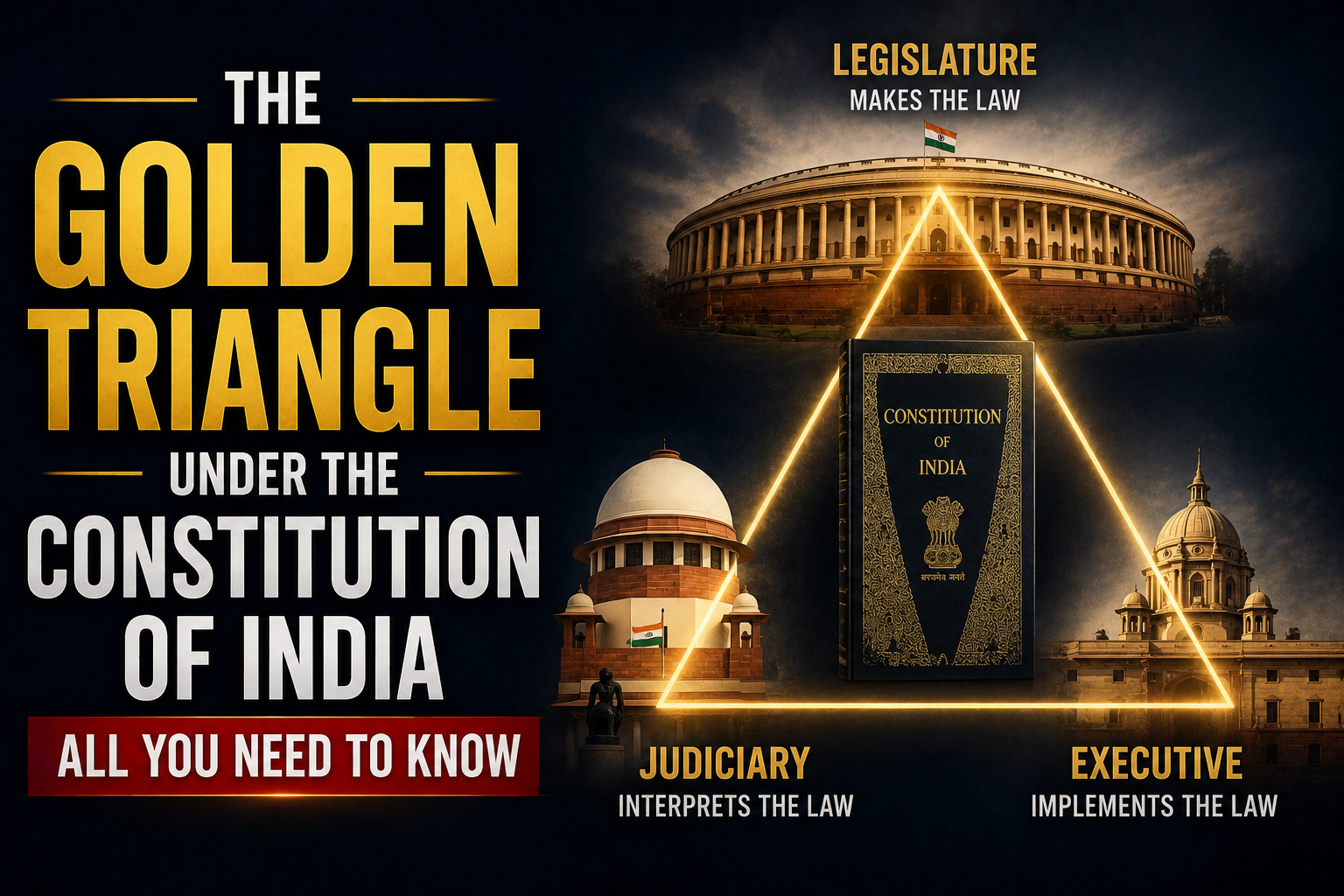
Fundamental rights are the foundational pillars of Indian constitutional democracy. The constitution of India guaranteed six fundamental rights to its citizen and non-citizens for safeguarding their rights and liberties. Right to equality, right to freedom, right against exploitation, right to freedom of religion, cultural and educational rights and rights to constitutional remedies. Out of these rights; right to equality, right to freedom and right to life and personal liberty stand at the core of all individual liberty. These three rights form the concept of Golden Triangle under the Constitution of India. The concept of Golden Triangle ensure that every individual is treated fairly and the state does not act in arbitrary or unjust manner; these articles are interconnected and often understood together to safeguard the basic rights of the citizens. The concept of golden triangle is not explicitly mentioned under the Constitution of India, it is the result of the judicial interpretations. In the case of Menaka Gandhi v. Union of India, the court held that the validity of Article 21 is not to be read in isolation, instead all the violations and procedural requirements under Article 21 are to be tested with Article 14 and 19. Therefore these three articles have interconnected effects. Whether the concept of golden triangle continues to remain interconnected in its ability to safeguard the individual rights and liberties or has it diluted in practice. This article will cover meaning, evolution, judicial interpretation, landmark cases, contemporary significance.
What is the Golden Triangle under the Constitution of India?
The Golden Triangle under the Constitution of India represents the dynamic relationship between Articles 14, 19 and 21. The term golden triangle is used to define the distinct, interconnected, and independent character of these three articles forming the foundation of India’s constitutional protection of individual liberty. These three articles show the core purpose of the preamble to provide justice, liberty, equality to all the citizens of India. The concept of golden triangle is not expressively mentioned in India it is the result of judicial interpretation done by the judiciary. The concept of the Golden Triangle was first observed in the landmark case of Maneka Gandhi v. Union of India, where it was held that any law to be deemed constitutional must pass the test of these three articles.
Article 14 of the Constitution guarantees equality before law. It states that all persons are equal before the law and equal protection must be given to all the persons without any discrimination. Under this article the Constitution of India prohibits the arbitrary action done by the government.
Article 19 guaranteed certain right to freedom such as freedom of speech and expression, association, peaceful assembly, movement, residence, and practicing any profession or carrying on any occupation or trade and business. These rights are essential for promoting democratic values because they give the people the ability to express themselves. Though this freedom is not absolute in nature it has reasonable restrictions mentioned in the constitution which shows that government cannot arbitrarily curtail any freedom other than the reasonable restriction mentioned in the constitution.
Article 21 guaranteed Right to life and Personal Liberty. This article states that no person shall be deprived of his life or person liberty except according to procedure established by law, it means that if a person is deprived of his personal liberty than it must be followed the procedures established or laid down by the law. It properly provided that the process under Article 21 should be just, fair and reasonable, and that any legislation that impacted liberty should also fulfil the need for equality under Article 14 and the freedoms under Article 19. It was an example of how judiciary should transcend the technicality and formalism of the law and uphold constitutional protection. Together these articles form the golden triangle a foundational pillar of the Indian democracy.
Understanding the Three Pillars of the Golden Triangle
Article 14- Right to Equality
Right to Equality is one of the magnificent cornerstones of Indian democracy. Article 14 provides that “The State shall not deny to any person equality before the law or the equal protection of the laws within the territory of India”. This article states that all persons are equal before the law and entitled to equal protection of the laws without any discrimination. Under this article all persons include the citizens and non-citizens. This article has two important elements- equality before law and equal protection of law.
Equality before law
The concept of equality before law adopted from the common law in England. It is also a negative concept which ensures that no special privilege should be given in favour of anyone whatever be his rank or position, all should be equally subjected to the ordinary law of the land. It also means that no one is above the law every person whatever may be his rank or position is subjected to the same law and tried by the same ordinary courts. Equality before law is the second postulate of rule of law given by A.V Dicey.
Equal protection of law
The second concept equal protection of laws is a positive concept of equality and it is adopted from the American Constitution. It does not mean that identically the same law should apply to all persons or that every law must have a universal application within the country irrespective of differences of circumstances. It denotes equality of treatment in equal circumstances. It implies that among the equals the law should be equal and equally administered, that like should be treated alike without distinction of race religion wealth social status or political influence. And unlike should not be treated alike.
Article 14 does not imply that everyone should be treated equally in all cases, but makes provision for reasonable classification. The classification however must not be arbitrary, artificial or evasive but must be based on some real and substantial bearing a just and reasonable relation to the object sought to be achieved by the legislation. Whether a classification is reasonable classification or not based on two tests- i) classification must be founded on an intelligible differentia, ii) the differentia must have a rational relation to the subject sought to be achieved by the statute in question.
Article 14 out-laws arbitrary administrative action. A very new concept of Article 14 has been developed by the courts in India is that Article 14 provides “a guarantee against arbitrariness” on the part of the administration. In the case of E.P. Royappa v. State of Tamil Nadu, Bhagwati J. propounded a new approach to Article 14 in the following words: Equality is a dynamic concept with many aspects and dimensions and it cannot be ‘cribbed cabined and confined’ within traditional and doctrinal limits. Equality is antithetic to arbitrariness. In fact, equality and arbitrariness are sworn enemies; one belongs to the rule of law in a republic while the other, to the whim and caprice of an absolute monarch. Where and act is arbitrary, it is implicit in it that it is unequal both according to political logic and constitution and law and therefore violative of Article 14.
Article 19- Right to Freedom
Article 19 of the Constitution of India guaranteed six fundamental rights to the citizens of India which they can exercise throughout the territory of India. These are the right –
- To freedom of speech and expression;
- To assemble peaceably and without arms;
- To form association or unions;
- To move freely throughout the territory of India;
- To reside and settle in any part of the territory of India;
- To practice any profession, or to carry on any occupation, trade or business.
These rights are not absolute in nature, but are subjected to reasonable restrictions mentioned under Article 19 (2) to 19 (6) to ensure that the people should not misuse these for their personal interests. On the other hand, it can also be said that Article 19 (2) to 19 (6) put limitations on the power of a legislature to restrict these freedoms. A legislature can not restrict these freedoms beyond the requirements of Article 19(2) to 19(6).
Freedom of speech and expression
Freedom of speech and expression is essential for the proper functioning of the democratic process. This freedom is regarded as the first condition of liberty. In a democratic country freedom of speech and expression opens up channels of free discussion of issues and it place an important role in the formation of public opinion on social, political and economic matters. Freedom of speech and expression under Article 19 (1) (a) includes the right to express once view and opinions at any issue through any medium example by words of mouth, writing, printing, picture, clean, movie etc. It also includes the freedom of communication and the right to propagate or published opinion. Freedom of speech and expression also includes right to silence, right to receive information, freedom of press.
But this freedom is not absolute in nature, the Constitution of India guaranteed certain restrictions under Article 19 (2) for the maintenance of social order. Article 19 (2) the Indian constitution provides that the State may make a law imposing reasonable restrictions on the ground of security of state, friendly relations with foreign state, public order decency, morality, sovereignty and integrity of India, contempt of court, defamation or incitement to an offence.
Freedom to Assemble
Article 19 (1) (b) of the Constitution of India guarantees to the citizens of India the right to assemble peaceably and without arms. The right to assemble includes the right to hold meetings and to take out procession. Article 19 (3) impose reasonable restrictions on the exercise of this right in the interest of public order and sovereignty and integrity of India.
Freedom to form Association
Article 19 (1) (c) guarantees to the citizens of India the right to form associations or unions. The right to form Association or union has a very wide scope; and it includes – political parties, clubs, societies, organizations, partnership, trade unions and indeed everybody of persons. Article 19 (4) provides reasonable restriction in the interest of public order or morality of sovereignty and integrity of India.
Freedom of movement and residence
Article 19 (1) (d) guarantees to every citizen the right to move freely throughout the territory of India. Article 19 (1) (e) guarantees to its citizen the right to reside and settle in any part of India. This constitutional provision guarantees that this citizen of India has the right to move freely and reside in any part of India wherever they like. It also ensures that the citizen of India can move freely from one state to another, or for from one place to another within a state; this underline the concept that India is one unit so far as the citizen are concerned. Article 19 (5) provides that the State may impose reasonable restriction on these rights by law in the interest of general public or for the protection of the interest of any Schedule Tribe.
Freedom to carry on Trade and commerce
Article 19 (1) (g) of the Constitution of India guarantees that all citizens have the right to practice any profession or to carry out any occupation trade or business. But this freedom is not absolute in nature; Article 19 (6) of the Indian Constitution provides restriction on this freedom. Under this article the restriction imposed must be required in the ‘interest of general public’ and it must be a ‘reasonable restriction’.
Article 21- Right to Life and Personal Liberty
Article 21 of the Constitution of India is considered as one of the most important fundamental right, as it deals with the fundamental right to life and personal liberty. This fundamental right also completes the concept of golden triangle under the Constitution of India. It also one of the most judicially interpreted article in the constitute of India, as with the changing of time judiciary expanded the scope and ambit of this article to protect the individual’s life or liberty.
Article 21 of the Constitution of India lays down that “no person shall be deprived of his life or personal liberty except according to procedure established by law”. This article means that every person has a right to life this right cannot be taken away except according to the procedure established by the law. This article also protects the personal liberty of individuals. It states that no person shall be deprived of their personal liberty except the procedure established by the law of the state. Personal liberty includes the freedom to move freely, the freedom to choose one’s place of residence the freedom to engage in any lawful occupation or profession. Before Maneka Gandhi’s case (1978) the interpretation of right to life and personal liberty was narrow but after the Maneka Gandhi’s case the supreme court expanded the scope of right to life and personal liberty.
In A.K. Gopalan v. the State of Madras (AIR 1950 SC 27) the Supreme Court held that personal liberty means the liberty of the body of individual. Which is freedom from arrest and detention, from false imprisonment or wrongful confinement. The court also held that the expression ‘procedure established by law’ means procedure enacted by a law made by the state.
In the famous case of Maneka Gandhi v union of India (AIR 1978 SC 597) the Supreme Court held at the right to life and personal liberty and Article 21 is not limited to mere animal existence but includes the right to live with dignity. The court emphasized that the procedure established by law should be fair, just and reasonable and it cannot be arbitrary oppressive or unreasonable. This case also established the relationship between article 14,19 and 21 which is called as Golden Triangle. From this case the supreme court extended the dimensions of Article 21.
In Olga Tellis v. Bombay Municipal Corporation (AIR 1986 SC 180), the court recognized the right to livelihood as an interior part of the right to life under Article 21.
In Visakha v. State of Rajasthan (AIR 1997 SC 3011) the Supreme court has that the right to a safe and secure working environment is a fundamental right under Article 21.
In K.S. Puttuswamy v. Union of India (AIR 2018 SC 237) they Supreme Court recognised the right to privacy is a fundamental right protected under Article 21.
In Hussainara Khatoon v. Home Secretary, State of Bihar (AIR 1979 SC 1369) the Supreme Court held that right to speedy trial is a fundamental right under Article 21.
Evolution of the Golden Triangle under the Constitution of India
The concept of Golden Triangle comprises three articles 14,19 and 21 of the Constitution of India. The concept of Golden Triangle shows that how these three articles are interconnected and establish a fair and democratic society that safeguards the basic freedoms and rights of its people. And also shows the broader interpretation of the fundamental rights given by the judiciary. It reflects the transformation from narrow interpretation of fundamental rights to a broader or integrated approach that strongly safeguards individual liberty.
In the early years of constitutional interpretation, the Supreme Court adopted a narrow and compartmentalized approach of fundamental rights. In A.K. Gopalan v. State of Madras the Supreme Court held that in Article 21 the expression ‘procedure established by law’ means the procedure as laid down in the law as enacted by the legislature. Thus, a person could be deprived of his life or personal liberty in accordance with the procedure laid down in the relevant law, whether the procedure was fair, reasonable or according to the natural justice or not was not the concern of the court. The court further held that if a person’s liberty was violated according to the procedure given by law it cannot be said that it violates the norm of articles 14,19 and 21. Consequently there was no relationship between Article 14,19 and 21and these rights were treated as a distinct right.
A gradual shift in constitutional philosophy became evident through the subsequent decisions of the Supreme Court. In the case of Shankari Prasad v. Union of India (AIR 1951 SC 458), the question before the Supreme Court was whether under Article 368 of the Constitution of India Parliament has the power to amend the Fundamental rights under part III of the Constitution. The Supreme Court held that the Parliament has the power to amend fundamental rights. This decision was overruled by the Supreme Court in the case of Golaknath v. State of Punjab (AIR 1967 SC 1643), and held that Parliament had no power to amend the fundamental rights of the Constitution of India. Later in the case of Kesavananda Bharati v. State of Kerala (AIR 1973 SC 1461), the Supreme Court introduced a new doctrine called Doctrine of Basic Structure and state that Parliament can amend any provision of the Constitution of India but it cannot alter or amend the basic structure or fundamental feature of the Constitution of India. Fundamental rights are the fundamental feature of the Constitution of India, therefore the court held that fundamental rights are the basic structure of the Constitution therefore Parliament cannot amend these rights. These judgements reflected liberal interpretation and preservation of constitutional values and safeguarding individual freedoms.
A gradual change occurs in the case of Maneka Gandhi v. Union of India (AIR 1978 SC 597). In this famous case the court gave a broader interpretation of Article 21 and held that any law that seeks to deprived a person of their personal liberty must not only be backed by legislation but also just, fair and reasonable. Therefore, it must satisfy not only the test of Article 21 but also the test of article 14 and 19. Thus, the court established a relationship between Article 14, 19 and 21which popularly known as Golden Triangle which was earlier denied in Gopalan’s case. And establish a new threshold that legality of every law should be tested on the basis of Golden Triangle. The decision in Maneka Gandhi’s case introduced the concept of substantive due process in Indian constitutional law. Although in Article 21 uses the phrase of procedure established by law. Substantive due process means that procedure established by law must be just, fair and reasonable not arbitrary, oppressive or violative of principle of natural justice. While the Indian Constitution does not expressly incorporate substantive due process, judicial interpretation has gradually infused this principle into Article 21 of the Constitution of India.
Therefore, the evolution of Golden Triangle represents a changed in the constitutional jurisprudence from restrictive view of fundamental rights to a wider view of fundamental rights. It also shows the transformation from an isolated or distinctive constitutional guarantee to a mutually interconnected system which promote equality, protects liberty and prohibits arbitrary state action. This interconnected system served as cornerstone of constitutional governance.
Therefore, the development of Golden Triangle represents a significant change in the way fundamental rights are seen in Indian constitutional law. It shows a move from a strict isolated view of these rights to a more comprehensive and integrated system that promotes equality, safeguards individual liberty and prevents arbitrary actions by the state. This interconnected system has become a fundamental part of constitutional governance in India.
Landmark Judgements that shaped the Golden Triangle
The concept of Golden Triangle under the Constitution of India has been shaped through the judicial interpretation given by the judiciary through various cases which are discussed below:
A.K. Gopalan v. State of Madras (AIR 1950 SC 27)
In this case the petitioner challenged the validity of the Preventive Detention Act 1950. He stated that detention violated his fundamental rights guaranteed under Articles 14,19, 21 and 22 of the Constitution of India. Therefore, he filed a writ petition under Article 32 (1) of the Indian Constitution for his release. He further argued that the detention order issued against him was done with malafide intention. The main question was whether the procedure established by law in Article 21 refers to any legal procedure laid down by a legislature, or whether the procedure should be fair and reasonable. The other issue was whether the Article 19 and Article 21 were interrelated or functioned independently.
In this case the Supreme Court while upheld the validity of the Preventive Detention Act, 1950 and gave a very narrow interpretation of the fundamental rights. The court held that the expression ‘procedure established by law’ means the procedure as lay down in the law as enacted by the legislature nothing more and whether such procedure was fair, reasonable or according to the principle of natural justice or not was not the concern of the court. Procedure established by law was not similar to the concept of ‘due process of law’ in USA Constitution. In the Constitution of India, the word ‘due’ was absent in Article 21. The majority of the court held that the word law in Article 21 could not be read as the meaning rules of natural justice. These rules were vague and indefinite and the constitution could not be read as laying down a vague standard.
The court also gave a very narrow interpretation of the word ‘personal liberty’ under Article 21 of the Constitution. The expression ‘personal liberty’ refers to the liberty of the body of individual means freedom from arrest and detention, from false imprisonment or wrongful confinement. The court also determined that Articles 19 and 21 should not be read together as these articles were mutually exclusive. Because the right to life and personal liberty under Article 21 is limited to procedural aspects which means that the government can deprive an individual of their personal liberty as long as the procedure was established according to the law. While Article 19 (1) guaranteed various freedoms but these freedoms can be exercised by a person who is free not detained under law. Therefore, the reasonable restrictions under Articles 19(2) -(6) could not be used to scrutinize a detention law. Any legislation that violated someone’s right or personal liberty under Article 21 had not to be in line with the liberty’s protected by article 19. Therefore, the court has that Article 19 and article 21 are distinct. The court also held that there is no relationship between article 14, 19 and 21.
R. C. Cooper v. Union of India (AIR 1970 SC 564)
R.C. Cooper v. Union of India, commonly referred as the Bank nationalization case. An ordinance was passed by the President, named the Banking Companies (Acquisition and Transfer of Undertaking) Ordinance 1969, which nationalized 14 of India’s largest commercial banks, which had deposits of not less than fifty crore rupees.
R.C. Cooper who was a shareholder of some banks which comes under the nationalization, challenged the constitutionality of this ordinance on the ground that as a shareholder of some bank it violates his fundamental rights under Articles 14, 19 and Article 31 of the Constitution. But before they were heard parliament enacted the Banking Companies (Acquisition and transfer of undertaking) Act 1969.
In this case the main issue was whether the ordinance was properly made or not. whether the act violated the shareholders fundamental right under Article 19 (1) (f) right to property, Article 19 (1) (g) (right to carry on business) and Article 31 (right to compensation for property acquisition) of the Indian Constitution?
In this case the Supreme Court overruled A.K. Gopalan case by rejecting the mutual exclusivity theory. The court established the “Effect” Test and invalidated “Object” Test, which means that when a legislation made by the parliament it’s effect will be considered. Whether its effect violate any provisions of the constitution or not rather than the objectives of the act. The court held that since the ordinance already been replaced by the act of Parliament, deciding the validity of the impugned ordinance is fruitless. The court found that the act violated Article 31(2) which guaranteed the right to compensation for property acquisition. The court also held that the compensation provided under the act was inadequate and arbitrary and also the compensation formula did not reflect the true value of the shareholders stakes in the bank. The impugned Act also infringed the shareholders right to property under Article 19 (1) (f) as the petitioner is deprived of his property without adequate compensation. But the court upheld the validity of the act in context of Article 19 (1) (g) as the said act is not violative of the freedom to carry trade and business. State can always create a partial and absolute monopoly.
But the court also held that the said act violates Article 14 of the Constitution which deals with the ‘equality before law’ as this act only forbids the 14 banks from conducting banking operations while other banks including the foreign banks were allowed to continue Banking operations in India. This case emphasized that fundamental rights are interlinked. The judgment underscored the importance of protecting individual property rights while acknowledging the state’s power to acquire property for public purposes. This case also led to the 25th Amendment of the constitution which replace the word “compensation” in Article 31 with “amount” to give legislature more flexibility.
Maneka Gandhi v. Union of India (AIR 1978 SC 597)
In this case the petitioner’s passport was impounded by the government of India under section 10 (3) (c) of the Passport act of 1967. When the petitioner tried to ask for the reasons, the government of India declined her request stating that it is in public interest. Aggrieved by this the petitioner filed a petition under Article 32 of the Constitution of India contending that confiscation of her passport by the Passport authority violates her fundamental rights under Article 14,19 and 21 of the Constitution and challenged the constitutional validity of sec 10 (3) (c) of the Passport Act of 1967.
In this case the main issue was that whether the section 10 (3) (c) of the Passport Act,1967 violate fundamental rights under Articles 14, 19 and 21 of the Constitution. Whether the right to travel abroad included within the right to personal liberty and the Article 21. The other was whether Articles 14,19 and 21 interconnected.
In this case the Supreme Court gave a broader interpretation of the expression ‘personal liberty’ in Article 21 of the Constitution. The court emphasized that the expression personal liberty is of the widest amplitude covering a variety of rights “which go to constitute the personnel liberty of man”. Some of these attributes have been released to the status of distinct fundamental rights and given additional protection under Article 19. The right to travel abroad falls under Article 21. The Supreme Court gave a new orientation “to the expression procedure established by law”, which means that the procedure must satisfy certain requisite in the sense of being fair and reasonable. The procedure cannot be arbitrary, unfair or unreasonable. This makes the words ‘procedure established by law’ is largely synonymous with the ‘procedural due process’ in the USA which was earlier denied in the case of A.K. Gopalan.
The court also held that Articles 14, 19 and 21 are not isolated they are interrelated. Any law depriving a person of his personal liberty has to stand the test of Article 14 and Article 19 also. Article 14 provides that any procedure mentioned under Article 21 must be fair, reasonable. This synthesis came to known as the Golden Triangle, representing equality, freedom and liberty – the three pillars on which the foundation of individual right stands. At last, the court also held that impounding the petitioner’s passport without providing her an opportunity to be heard violated the principles of natural justice and therefore it was unconstitutional.
Justice K.S. Puttaswamy v. Union of India (AIR 2018 SC 1841)
Aadhaar scheme is a government initiative scheme which assigns a unique 12-digit identification number to residence of India based on their biometric and demographic data. This scheme was intended to access to government services and welfare benefits. However, it raised significant concerns about the privacy of individuals when the government tries to compulsory this scheme. Therefore, Justice K S Puttaswamy a retired judge of the Karnataka High Court filed a writ petition in the Supreme Court challenging the constitutional validity of the Adhaar card scheme introduced by the government. He argued that it violates right to privacy. In this case the main issue was that whether right to privacy was a fundamental right under Article 21 of the Constitution.
The Court unanimously held that right to privacy is a fundamental right in Article 21 and protected under Articles 14,19 and 21. Privacy is an intrinsic part of life and liberty under Article 21. The Court also held that any infringement on the right of privacy must be justified by a compelling state interest and must meet standards of legality, necessity and proportionality.
Criticisms and Challenges of the Golden Triangle Doctrine
The concept of Golden Triangle safeguards the fundamental rights of the citizens from any arbitrary state action. But at the same time, it faces certain criticism, as it is the result of judicial activism. The concept of Golden triangle broaden the scope fundamental rights had an allegation of performing judicial overreach. Critiques also criticised that judiciary by expanding the scope of Article 21 sometimes raised a concern of judicial overreach which means judiciary performs the role of a legislature or executive. Judiciary’s role is to interpret the law and provide justice, but sometimes it expanded interpretation beyond the given the Constitutional text.
Golden triangle under the Constitution of India also faced challenges because it sometimes creates a tension between individual rights and state interest. Due to the evolving nature of society, there are some rights evolved which requires protection from the law, therefore judiciary through interpretation of Article 21 provides protection and included some rights as a fundamental right, but it also created a tension between individual rights and state interest. E.g. right to privacy, government through surveillance programs collect data from individuals by stating that collecting digital data and tracing communication is necessary to prevent terrorism and for internal security of the nation, on the other hand advocates of civil liberties argued that it is a clear violation of individuals right to privacy. For the interest of the general public government sometimes restricted freedom of movement. During the outbreak of disease like in Covid-19 the Government by imposing quarantine or lockdown restricted freedom of movement and occupation is also an example of tension between individual rights and state interest.
During the emergency period the concept Golden Triangle faces challenges in its application, as the Golden Triangle consists of three articles 14, 19 and 21. During the emergency all the fundamental rights are suspended except Article 20 and Article 21 of the Constitution. At the period of national emergency state can make any laws or take executive action which violate Article 19 and also indirectly article 14 of the constitution it means that government can take arbitrary action to protect the interest of the state during the emergency and; also at that time judiciary does not have the power to judicial review therefore they cannot review the Presidential order. Therefore, it faces significant challenges.
Golden Triangle also faced significant challenges at the time of implementation. Because though the Court have acknowledged or expanded its scope like; right to privacy, environmental protection and live with human dignity, but still people continue to face obstacles in enjoying this rights because of weak implementation, lack of administrative policies.
Despite these challenges or criticisms, the golden triangle doctrine remains one of the most important pillars of constitutional governance in India.
Conclusion
Golden Triangle under the Constitution of India continues to serve as the cornerstone of constitutional governance by safeguarding the basic rights of the citizens from the arbitrary action of the state. As the Golden Triangle includes Article 14, 19 and 21 of the Constitution, these three articles by reading together ensures that any action or law made by the state must be fair, reasonable and not arbitrary. It also ensures that people should be treated equally, enjoy the freedoms given under the Constitution and live with dignity. Despite certain criticism and challenges Golden triangle continues to protect individual liberty and maintaining democratic values in India.
About Author
Rima Dey Sarkar is an LL.M. graduate with a keen interest in Constitutional law, Environmental law, Family law, and legal research.She is passionate about writing contemporary constitutional issues, and studying comparative constitutional law to understand how different constitutional system address similar legal challenges. Through her legal writing she aims to present complex legal concepts in a simplified manner and hopes to contribute meaningfully to legal scholarship and informed public disclosure.
Frequently Asked Questions (FAQs)
What is the Golden Triangle under the Constitution of India?
The Golden Triangle refers to the interrelationship between three Articles 14, 19 and 21which collectively protects equality, freedom and personal liberty.
Why Articles 14, 19 and 21 together called Golden Triangle?
Article 14, 19 and 21 together safeguards the individuals against arbitrary state action.
In which case Golden Triangle was established?
In Maneka Gandhi v. Union of India, the Supreme Court established the doctrine of Golden Triangle.
Is the Golden Triangle expressly mentioned in the Constitution of India?
No, the Golden Triangle is not expressly mentioned in the Constitution of India it is judicially evolved doctrine.
References
https://jlrjs.com/wp-content/uploads/2025/11/18.-Abhirami-M-S.pdf