

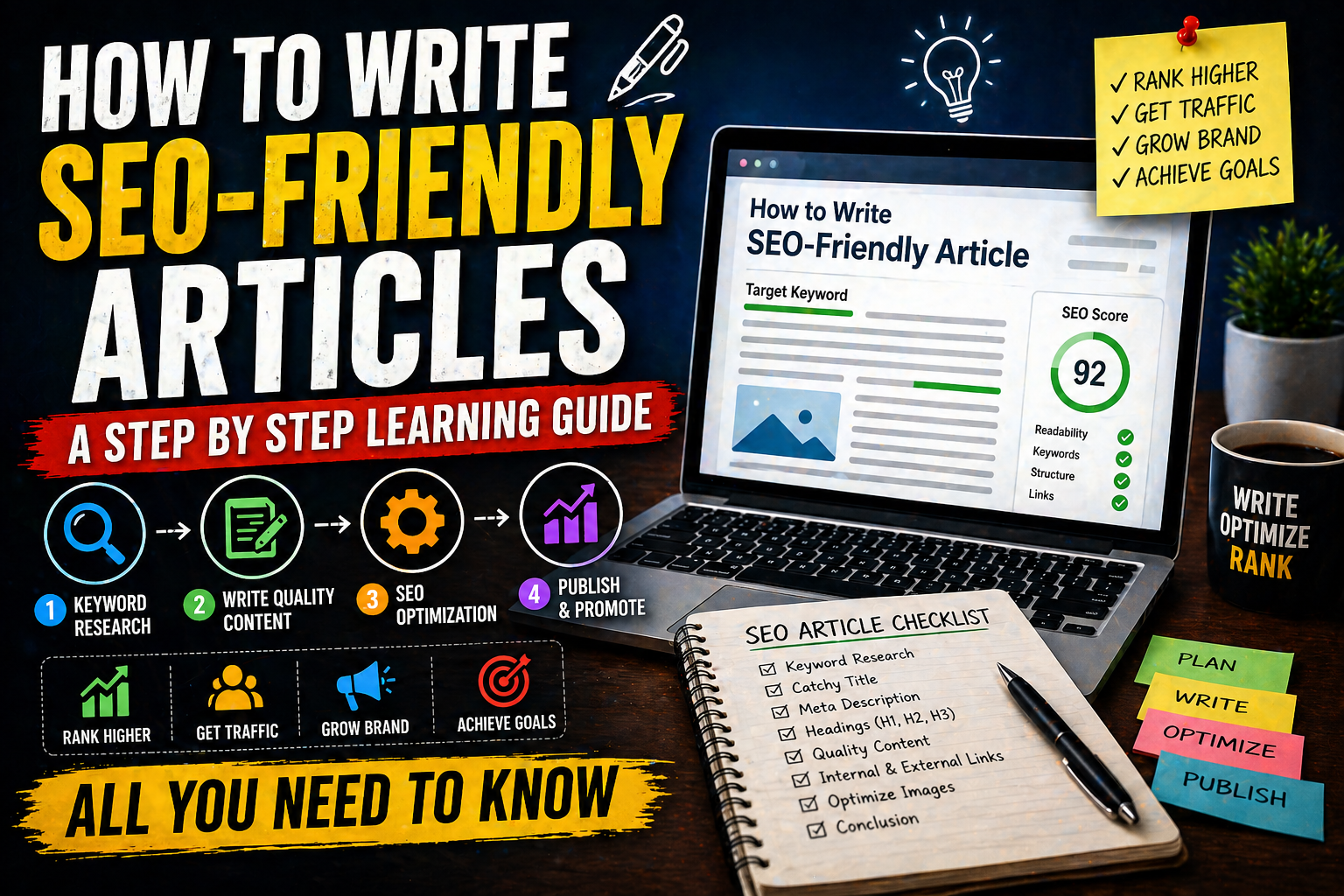
Introduction:
Are you low on search engines? Do you want to attract traffic? Well, a user-friendly SEO article is your ultimate solution. Here is the key to all your concerns. Learn SEO writing with this user-friendly step by step guide. Understand the 5 W’s, tips, and tools of attracting traffic on your landing page and in this Article you will clearly understand about How to Write SEO-Friendly Articles.
What is SEO- Friendly Article?
SFA (SEO-Friendly Article) is a comprehensive, friendly, guide that allows the users to navigate the site easily. It gives an opportunity to satisfy the needs of your potential clients across the globe & also supports the optimization in ranking higher on search engines. This satisfies your potential clients.
This article should include:
- Proper high rated targeted key words
- Descriptive URLs
- Accessible content
- Mobile friendly approach
- Clear structure.
There are 4 main types of SEO’s
- On-Page SEO: (right keywords, content headings, text on the page)
- Off-Page SEO: (link building, online reviews, social media engagement)
- Technical SEO: (focuses on site speed, mobile-friendliness, secure connections-HTTPS, website indexing)
- Local SEO: (helps business stand out by putting it on the digital map)
Why is writing SEO-Friendly Article necessary?
People require information, and this is the time when they head towards google for their queries. The desires towards seeking information and understanding it, brings importance to SFA writing.
This information shows up in multiple formats at a click of your finger, like:
- Articles
- Guides
- eBooks
- Videos
Who uses SEO-Friendly Article?
Content marketers
SEO specialists
Bloggers
Business owners
Where can SEO-Friendly Article be used?
- Corporate & personal blogs: (Educational Content, how to-Guides etc.)
- Website landing pages: (Product service, comparison pages, FAQ’s sections etc.)
- Content marketing outreach: (Case Studies, E-Books etc.)
- E-Commerce websites: (Descriptions, Category pages etc.)
- Digital formats: (Social Media Posts, Video Transcripts etc.)
When can SEO-Friendly Article be used?
- Launching new websites
- Updating old content
- Targeting specific search
Step by Step Guide in writing SAF
Step 1:
Understand your targeted audience:
Identify who your audiences are & what problem do they face.
Step 2:
Build a website:
Show your online presence & make it user friendly
Step 3:
Do Keyword research:
Key words are the foundation of SEO. These are words your customers would search for in the search engines for product services.
Put yourself into the shoes of your customers. What words, phrase would they use and put these into the keyword research tool and explore. It’s simple but you need to do it right. Include:
- Long-tail words: These are three to five words phrases and are highly specific search terms that target one’s niche. E.g. Best walking shoes for ladies.
- Short-tail words: These are one or two words describing a broad topic. These types of keywords target a broader and wider search term. E.g. shoes, markets etc.
Popular tools for searching keywords: Semrush Keyword Magic / Google Keyword Planner / SpyFu: Helps users generate new keywords.
- Grammarly: Best for content quality and structure.
- Yoast SEO: This is best for improving a website’s search engine rankings.
- Google Trends: This helps in gauging/analyzing the popularity of top search queries in Google within a specific timeline.
Step 4:
Understand the Search Intent:
It is highly important to understand what your audience is looking for.
- Informational (are they searching for information)
- Navigational (are they searching for a specific site)
- Commercial (are they searching before buying)
- Transactional (are they purchasing)
Once the above has been catered, then you will have achieved the ultimate goal behind
a user’s search query.
Step 5:
Create a strong title:
The title should be catchy, clear and engaging. This will attract the reader’s attention and increase the chances of clicking on your article. They should be descriptive and relevant to the content on the page.
The 4 types of titles are:
- The Clear Title: Easy to choose, straight to the point, Easy to remember etc.
- The Descriptive Title: Conveys deep meaning, more specific, can attract more people etc.
- The Symbolic Title: Appealing to the readers, often unique, caries a deeper meaning etc.
- The Distinguished Titles: Mostly unique, hard to imitate, easy to remember, applicable to all genres etc.
Step 6:
Structure the article properly:
Structuring the article is important and crucial as it improves search engine rankings and enhances readability. Organize your article by giving proper headings, subheadings and subpoints, lists and bullets & insert links wherever applicable. Use different font size for each e.g.
- H1 – Title (font size 20 bold)
- H2 – Main headings (font size 16)
- H3 – subpoints (font size 14)
Keep your paragraphs short and sweet, use bullet points and keep your text user friendly.
Step 7:
Write high quality content:
Writing quality content should be the key aspect of every SEO strategy. Well-crafted content speaks directly to the needs of your audience but when is your content considered good or of high quality and who determines its quality? This is a million-dollar question.
YOUR USERS! They know what they want and our main goal is to get the them read the content.
It should be carefully researched, well-structured and original.
It should also provide genuine value and satisfy users search intent. Important information must stand out. This is the backbone of a successful content.
The key strategies are:
- Get to the point
- Use short paragraphs
- Use bullet points
- Try to use bold or italics
- Add subheadings to guide your readers through
- Keep your content long enough to get the readers through your content but don’t drag too much.
- Use images and visuals to give a visual break.
- Keep your language easy with standard grammar.
Step 8
Use Keywords naturally:
Before we jump into how, it is important to understand why keywords are so critical for SEO. The keywords are the HEART of your search engine. All search engines employ keywords to identify what your website is about. E.g. If you are producing an article about mobiles, then your content should include words like: mobiles, types of mobiles, mobile comparisons, specifications, display & camera, Connectivity, etc.
How you are using the words also plays an important role. If you overuse the words or use them randomly then your content will lose its ranking.
8 tips for using keywords naturally:
- Have thorough research of your topic and keywords.
- Fit your keywords effectively wherever required.
- Place keywords strategically. Introduce your main keyword in the beginning to clarify the topic.
- Avoid repeating same keywords. Use synonyms instead.
- Write for humans first. Ask questions like, does this make sense? Would someone enjoy reading this? is it of quality?
Step 9
Optimize Meta Title & Description:
What is Meta Title & Description? This is the title which tells google what this page is about and Meta description gives brief summary of what is in this page.
What does a good meta description have?
- Keep it short, The title should not be of more than 50-60 characters and the description should be around 120 -150 characters
- Use active voice and make it actionable
- Include a call to action (learn more, Get it now, Try for free etc.)
- Use your focus keyword /phrase (as shown in the above example: online learning, diaspora, country names, real world experiences etc.)
- Make sure it matches the content of the page
- Make it unique (In the attached example, in just two sentences it conveys
(audience, Geography- names of countries it is focusing, services and teaching style)
The more effective your meta title and description will be the higher chances of increased
CTR (click-through rate) there will be. A high CTR will engage your users with your
content and increase traffic to your site.
Step 10
Use Internal & External Links
In order to have a strong SEO, you will require to use both internal and external links.
This will ultimately improve the search visibility and rank your website high.
Before we get into the details, lets understand the difference between these two links.
- Internal Links: These are hyperlinks which direct the reader to the particular page on your website. It keeps the reader engaged to your website longer and providing a positive user experience will encourage them to become your followers or customers.
- External Links: These are hyperlinks which direct the readers to the particular page on a different website. The quality and quantity of links you are using matters in improving the credibility of your website.
Step 11
Add Images and Optimize them: (A picture is worth a thousand words)
Whether you are writing on your product page or a post, you will definitely feel like adding an image. Because a page without visuals will attract less traffic. Correct images bring life to a page and also contribute to the websites SEO. It helps readers to get a better idea of the product or services it is offering.
- Images should be added to every article
- Use original and high-quality images
- It should reflect your topic
- Check out for restrictions and attribute the original photographer before using it.
Add Alternative (ALT) text to describe your image. This is an essential part of your content. It will not just describe your image but relate to how it fits in your content page.
ALT Text best practices:
- Keep it short. Max 1 or 2 line
- Consider why you choose that particular
Alt Text:
Example 1: A kindle of kittens enjoying the bright sunny morning (purpose of image
Could.
be talking about the vibes of a bright sunny day)
Example 2: Three playful kittens excited to get the flowers from the botanical
garden in South Mumbai (purpose could be just sharing the eye-catching
sight.
- Step 12:
Last but not the least
Proofreading & Editing: This is the final touches? final thoughts before presenting your content. This plays as a safeguard against errors in the content. Both human writers and AI tools are prone to mistakes.
Tips for Proofreading and Editing:
It’s not about scanning through a document or rectifying the grammatical errors or editing punctuations but instead this is a process which requires a keen eye to minute details of your content for better ranking.
- Read before you edit: (Read and understand your content properly)
- Fact checks: (Check and ensure that its free from false information)
- Look out for typos: (Use apps for grammar checks like Grammarly, Language Tool, Ginger etc.)
- Make it clear & concise: (Remove all the unnecessaries and extras)
- Check for style, tone & formatting: (pay attention to the overall tone of your word choice, sentence structure, language, consistency, clarity, alignment, visually appealing, headings, subheading, pointers, spacing etc.)
A keen eye on the above will make your content stand out in the deep ocean of SEO content and increase the search engine rankings and brand reputation.
NEVER SKIP ANY OF THE STEPS AND ITS PROCESS
Common SEO Mistakes to Avoid
- Keyword Stuffing:
Avoid repeating your keywords unnaturally as this will destroy SEO of your content and will frustrate the readers and damage your brands reputation.
- Poor Writing Structure & Format:
Use proper headings and subheadings, bullet points, short paragraphs, proper alignments & visuals to attract readers and increase rankings.
- Ignoring Search Intent:
Understand the audience and ensure that your content matches what they are looking for. If this is ignored, it will lead to low ranking of your page, you will get irrelevant traffic, and this will result to users leaving your page quickly.
- Skipping meta description:
Referring to step 9, It is highly important for homepage, key landing pages, and high-traffic blog posts. If this is skipped then the page will lose its ranking.
| SEO Content Writing Checklist | |
| Keyword in title | |
| Keyword in first 100 words | |
| Keyword in subheadings | |
| Proper headings format (H1, H2, H3) | |
| Meta Description optimized | |
| Internal & External links | |
| Images with ALT Text | |
| Mobile friendly format | |
| Content is clear and readable | |
| Proofreading & Editing | |
| Conclusion |
Conclusion
Every content, matter, blogs need to end in a right way. Writing a strong and effective conclusion serves as the final opportunity to connect with your audience. Summarize the main message focusing on the keywords naturally. Keep it concise & do not add any new information. Encourage and motivate the readers to explore and dive into the ocean of your webpage. Take a call-to-Action and guide them on what to do next.
“Great is the art of beginning, but greater is the art of ending”
(Henry Wadsworth Longfellow)
About Author
Tasneem, a coordinator at Alfaazz Online School is a dedicated Early childhood educationist with over 25 yrs of experience in the academic role.
She has been privileged to wear many hats in her professional life – (Coordinator, Human Resource Manager & a creative content writer.)
Her expertise in the said field has contributed impulsively in the development of structured and effective learning environment.
Along with her leadership key role, Tasneem is a passionate and a creative content writer who loves to craft thoughtful engaging and impactful content.
Her commitment towards her professional life combined with her creative expression has allowed her to create meaningful contributions through her writing.
FAQ’s (Frequently Asked Questions)
1. What is SEO Content Writing?
Ans: This is a high quality and valuable content specifically created as per the Niche of your company.
2. How do beginners write SEO friendly articles?
Ans: As a beginner, one will have to have prior background knowledge in writing and will have to research on what the targeted audiences are searching for.
3. How many keywords should be used in an article?
Ans: The article should have 1 primary keyword and 2-5 secondary keywords.
4. What tools are best for SEO Writing?
Ans: Top tools are: SurferSEO, Semrush Seo Writing Assistanat, Neuron Writer, SEO Writing AI, Clearscope
5. How long should an SEO article be?
Ans: Ideally it should consist of 1000 – 2000 words depending on your Niche.
Ultimately the best marker of high-quality content is that you want to keep reading.
So, if you’ve got this far, I’ve done my job.
Commendable article by Tasneem, a very useful guide
A very useful article on SEOs, a step wise guide . Well done Tasneem
Tasneem ben you did it so well … describing all that in simple steps nailed it 🥰