

Introduction
Drafted by Lord Thomas Macaulay in 1838 and enacted by British Government in 1860, Section 377 of Indian Penal Code (IPC) criminalised all kind of voluntary unnatural sexual intercourse with any man, woman or animal by providing a punishment of life imprisonment or for a long period of 10 years with fine. This section was modeled on Britain’s 16th century Buggery Act of 1533. It severely affected the life and fundamental rights of LGBTQ+ community. Because of this provision, members of this community were exposed to social stigma, harassment, discrimination and criminal prosecution.
As Arthur Schopenhauer, a German poet and philosopher rightly said,
“ I am as I am: take me as I am.”
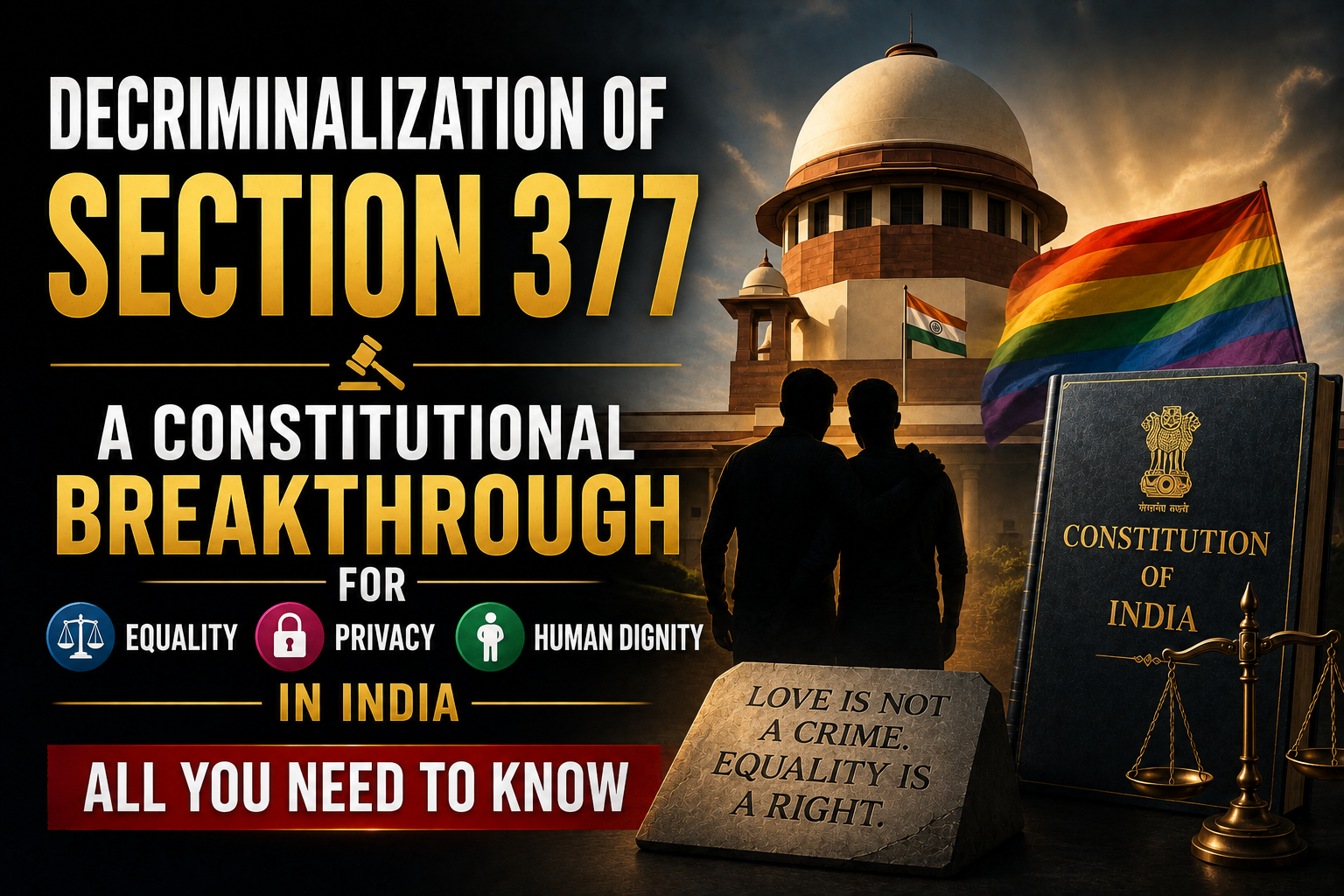
This line perfectly resonates with the idea that every individual has the right to be accepted as who they are, without fear of prejudice or punishment. This very idea found constitutional recognition in the landmark judgment of Navtej Singh Johar v. Union of India (2018), wherein a five judge bench of the Supreme Court held Section 377 was unconstitutional to the extent it criminalised the consensual sexual activities between adults in private. Through this judgment the Supreme Court secured the fundamental right to equality, privacy and human dignity of LGBTQ+ community in India.
This article explores the historical background of section 377, its decriminalisation through judicial pronouncement, its impact on LGBTQ community and challenges that continued even after its decriminalisation.
“History owes an apology to the members of this community and their families, for the delay in providing redressal for the ignominy and ostracism that they suffered over the centuries.”
~ Justice Indu Malhotra
Historical Background of Section 377 of IPC
Origin and Evolution
The section 377 of IPC was enacted during the British colonial period in 1860 under the guidance of Lord Thomas Macaulay as a part of the codification of criminal law in India. It was directly modeled on Britain’s Buggery Act of 1533. This section was enacted to uphold the Victorian morality according to which the sexual acts between persons against the order of nature was immoral. It was considered a crime. This section reflected the moral and religious values prevalent in Victorian England rather than the values of diverse Indian culture and society. The purpose of this section was to criminalise all the sexual acts against order of nature, even if done consensually between adult persons in private.
Impact on LGBTQ community
From a long period of time, section 377 subjected the LGBTQ to criminal liability solely on the basis of their consensual intimate relationships. This provision reinforced social stigma against this community by portraying same sex relationships as criminal and immoral. Members of this community had to face severe criticism and harassment. The law created an atmosphere of fear, insecurity and discouraged them to disclose their identity. It affected their emotional, social, economical and even professional spheres of life. One incident of this harassment was when a young man who considered himself as homosexual given an electric shock to cure his homosexuality. The criminalization of consensual same-sex relations not only infringed the rights to equality, privacy, dignity, and personal liberty but also created discrimination against an already marginalized community.
The 172th Report of the Law Commission in 2000 recommended deleting this section as it severely affected LGBTQ+ community. But the Legislature chose not to remove it.
Judicial Journey towards Decriminalisation of section 377 of IPC
NAZ FOUNDATION v. GOVERNMENT OF NCT OF DELHI (2009)
Court: Delhi High Court
Decided on: 2 July 2009
Facts of the case :
Naz Foundation (India) Trust, a non governmental organisation, started a movement to repeal section 377 of IPC. They filed a lawsuit in Delhi High Court in 2001 seeking the legislation for homosexual intercourse between consenting adults. In 2003, the Delhi High court dismissed the lawsuit on the ground that Naz Foundation has no locus standi in the matter. Naz Foundation appealed to the Supreme Court against the decision of Delhi High Court to dismiss the petition. It was reversed by the Supreme Court and directed the Delhi High Court to hear the petition. In 2006, the National AIDS Control Organisation filed an affidavit stating that enforcement of section 377 of IPC violates the rights of LGBTQ community.
Judgment:
A two judge bench comprising Chief Justice Ajit Prakash Shah and Justice S. Miralidhar held that criminalisation of consensual gay sex violated right to dignity and privacy within the right to life and personal liberty guaranteed by Article 21 of the Constitution of India. The court also held that section 377 offends the guarantee of equality enshrined under Article 14, because it creates an unreasonable classification and targets homosexuals as a class. It also violated Article 15 which provides protection against discrimination on the basis of caste, religion, race, sex and place of birth. It was stated that the term sex under Article 15 does not cover only biological sex but also sexual orientation.
The Court did not strike down Section 377 as a whole. The section was declared unconstitutional insofar it criminalises consensual sexual acts of adults in private.
● SURESH KUMAR KOUSHAL v. NAZ FOUNDATION (2013)
Court: Supreme Court of India
Decided on: 11 December 2013
After the decision of Delhi High Court in the Naz Foundation case, parties opposing decriminalisation of section 377, including Suresh Kumar Koushal appealed the High Court’s decision to the Supreme Court. A two judge bench allowed the appeal and set aside the High Court’s judgment.
The judges stated that “ a miniscule fraction of the country’s population constitutes lesbians, gay, bisexuals or transgenders” and the High Court has erroneously relied upon international precedents “ in its anxiety to protect the so called LGBTQ persons”. It was also said that judicial intervention was not necessary in this matter and it was for the Parliament to determine the legislation in this regard. Thus, the validity of section 377 of IPC was upheld by the Supreme Court.
● Constitutional developments before NAVTEJ SINGH JOHAR case
Before the NAVTEJ SINGH JOHAR case, the Indian Constitutional jurisprudence has undergone significant evolution particularly the Fundamental Rights. Through various progressive judicial pronouncements the Supreme Court has broadened the scope of Fundamental Rights in India.
The Supreme Court in the Case of JUSTICE K.S PUTTASWAMY v. UNION OF INDIA (2017) held right to privacy as an intrinsic part of right to life and liberty guaranteed under Article 21. It includes the individual right to make intimate personal choices without any unwanted interference. Importantly, sexual orientation forms an essential aspect of a person’s identity.
Over time, the Supreme Court further expanded Article 21 to include the right to live with dignity and personal autonomy. The state cannot intrude in the freedom of a person to make decisions about his intimate life.
Further, in the case of NALSA v. U.O.I (2014) while expanding Fundamental Rights, the Supreme Court held that transgender persons have Fundamental Right to self identify their gender and affirmed that “sex” under Article 15 includes gender equality.
● NAVTEJ SINGH JOHAR v. UNION OF INDIA : The Landmark Judgment
Court: Supreme Court of India
Decided on: 6 September 2018
Facts and Issues
The members of LGBTQ+ community challenged the constitutional validity of section 377 of IPC on the ground that it criminalized consensual same-sex relations between adults and violated their fundamental rights. The main issue before the Supreme Court was whether Section 377 was consistent with the guarantees of equality, liberty, privacy, dignity, and freedom under the Constitution.
Constitutional Provisions Involved
The Court examined the constitutional validity of Section 377 in light of the following provisions:
- Article 14: Guarantees equality before the law and equal protection of the laws.
- Article 15: Prohibits discrimination on grounds of religion, race, caste, sex or place of birth.
- Article 19(1)(a): Protects the freedom of expression, including the expression of one’s identity and sexual orientation.
- Article 21: Safeguards the rights to life and personal liberty.
Reasoning of the Supreme Court
The Supreme Court held that constitutional morality must be given preference over prevailing social or popular morality. It emphasized that every individual has the right to make intimate personal choices and that sexual orientation is an inherent aspect of identity. The Court emphasised that the Constitution demands transformative constitutionalism that respects diversity, inclusivity and minority rights.
Decision and Holding
The Supreme Court unanimously struck down section 377 , declaring it unconstitutional only to the extent that it criminalized consensual sexual acts between adults in private. However, the provision continues to apply to non consensual sexual acts, acts involving minors or animals. The judgment marked a historic step towards protecting the constitutional rights of LGBTQ+ persons and reaffirmed the principles of equality, privacy, and human dignity.
Justice D.Y. Chandrachud rightly said, it will be unjust for gender based and sexual minorities to be deprived of equality and equal protection of law guaranteed to every citizen under the Constitution of India. The choice of a partner is a personal matter and the state has no business to interfere with a person’s consensual intimacies.
Impact of decriminalisation of section 377 on Indian society
The judgment made us realise that social acceptance of LGBTQ community would help in breaking the gender stereotypes and predetermined gender structures. Since the judgment there has been a breathing space for this community. The Supreme Court enabled them to stand for themselves and their rights. It is well settled that every person is entitled to equality, dignity, privacy and personal liberty irrespective of their sexual orientation. It also instilled psychological as well as emotional security among homosexuals and other sexual minority groups. Now the members of this community no longer have to live in fear of criminal prosecution. This decriminalisation of section 377 created social awareness and empowered LGBTQ community and it made it clear that constitutional morality always prevails over social prejudices. There seems to be social acceptance to some extent also. Apart from this, by decriminalizing consensual same-sex relations, India joined the growing number of nations recognizing the rights of LGBTQIA+ individuals, reinforcing its commitment to protecting fundamental human rights and contributing to the global discourse on inclusivity and constitutional justice.
Challenges that Continued after Decriminalisation
The decision in Navtej Singh Johar case removed the threat of criminal prosecution, but it did not automatically eliminate social prejudice or guarantee equal legal rights in every sphere of life. The members belonging to LGBTQ+ community still face several challenges. Some of them are discussed below:
Absence of same sex marriage:
Even after 8 years of decriminalisation of section 377, same sex marriages are not given recognition. Same sex couples can not obtain spouse visas, there is no spousal pension or insurance benefits, no automatic inheritance, difficulty in medical decisions as a partner. The Supreme Court in a recent case of SUPRIYO @ SUPRIYA CHAKRABORTY v. UNION OF INDIA (2023) declined to legalise same sex marriages, holding Parliament should decide the issue. However, the court acknowledged that LGBTQ+ persons are entitled to dignity and that such relationships deserve recognition and protection.
Workplace Discrimination
At many workplaces, individuals belonging to LGBTQ community are denied jobs, no promotions affected. They have to face jokes, bullying or even harassment. There should be proper measures to ensure equality and non – discrimination at workplaces.
Social stigma
A judicial decision cannot change the social mindset of society overnight. There are people in many parts of India who still view same sex relationships as immoral or against their cultural values. There is family rejection, bullying continues, several jokes continue to circulate over social media, memes are being made.
No anti-discrimination measure
The government has taken no anti-discrimination measures to protect members of this community. There is no comprehensive law focusing on protection and recognition of LGBTQ+ community. Measures should be taken to prevent discrimination against such persons in education, employment, healthcare, public services etc.
lack of access to healthcare and social welfare programmes
Many LGBTQ+ persons face intensive treatment in hospitals and clinics. There is fear of revealing their sexual identity and there are also mental health concerns that arise from social stigma.
Need for public awareness
The Supreme Court removed the criminal prosecution, but awareness in rural areas is still limited, myths and stereotypes continue, police and public officials may require sensitisation.
The way forward
After the decriminalization of section 377 of IPC, the way forward relies on securing legally protected rights of LGBTQ+ community and enacting anti discrimination policies.
Comprehensive anti discrimination laws
India needs specific legislation to protect the rights of LGBTQ community and to prevent discrimination against them. The law should prohibit discrimination in areas such as education, employment, healthcare, public services, access to goods and services. At present there is no such law specifically covering all these areas.
Legal recognition of same sex relationships
Even today, same sex marriages are not given recognition in India. As a result of this,same sex couples are not entitled to many rights and protections which are ordinarily enjoyed by ordinary couples. These rights are related to inheritance, insurance, pension, medical decision making, adoption and other family rights. The way forward may involve recognition of same sex relationships and providing appropriate rights.
Awareness and Education Programmes
Decriminalisation is not enough to eliminate prejudice and discrimination. Schools, colleges, workplaces, healthcare institutions and police departments require sensitisation and awareness programmes. This may help in breaking stereotypes and discrimination.
Strengthening LGBTQ+ Rights Jurisprudence
The principles established in NAVTEJ SINGH JOHAR CASE should continue to guide future constitutional interpretations. Courts should protect equality, dignity, autonomy, privacy and non discrimination. This may help in ensuring that fundamental rights are actually experienced in everyday life.
Conclusion
The decriminalisation of section 377 marks a significant turning point in the constitutional developments in India. The supreme court in the case of NAVTEJ SINGH JOHAR v. UNION OF INDIA reaffirmed that constitutional morality stands above social morality. The court secured the constitutional rights of LGBTQ+ community. Although several challenges continue to exist, there has been a significant shift in the position of this community. They have been made independent from the fear of prosecution. There is still a long way forward in recognising and protecting the rights of these minor sex communities. The decriminalisation of section 377 remains a vital milestone in India’s ongoing journey towards equality, human dignity and social justice.
FAQs
FAQ 1
What was Section 377 of the Indian Penal Code?
Enacted by the colonial British Government in 1860, Section 377 of Indian Penal Code criminalised all kinds of voluntary sexual intercourse with any man, woman or animal against the natural order. It provided a punishment of either life imprisonment or imprisonment for 10 years with a fine.
FAQ 2
Why is the Navtej Singh Johar judgment considered a constitutional breakthrough?
It is so because the judgment decriminalised consensual same sex relations between adults and affirmed that rights to equality, dignity, privacy and liberty are guaranteed to every individual. It also established that constitutional morality must prevail over social morality.
FAQ 3
Did the Supreme Court completely strike down Section 377?
No, the Supreme Court decriminalised only consensual same sex relations between adults while the non consensual acts or sexual acts involving minors or animals are criminal offences and the related provisions continue to apply.
FAQ 4
What challenges remain for LGBTQ+ rights in India after the decriminalization of Section 377?
Even after decriminalisation of section 377, the LGBTQ+ relationships are not given legal recognition, they are not given many rights and protections which are available for ordinary couples. Social acceptance is still low in many areas of India. There is no anti discrimination policy to protect them.
About Author
Manishveer Kaur, a BALLB student at the Lincoln College of Law and Education, Srihind affiliated with Punjabi University, Patiala is a legal writer and researcher having a particular interest in Constitutional Law, Human Rights and Legal Research. She enjoys researching and writing on contemporary legal issues, and understanding the impact of judicial decisions on society.