

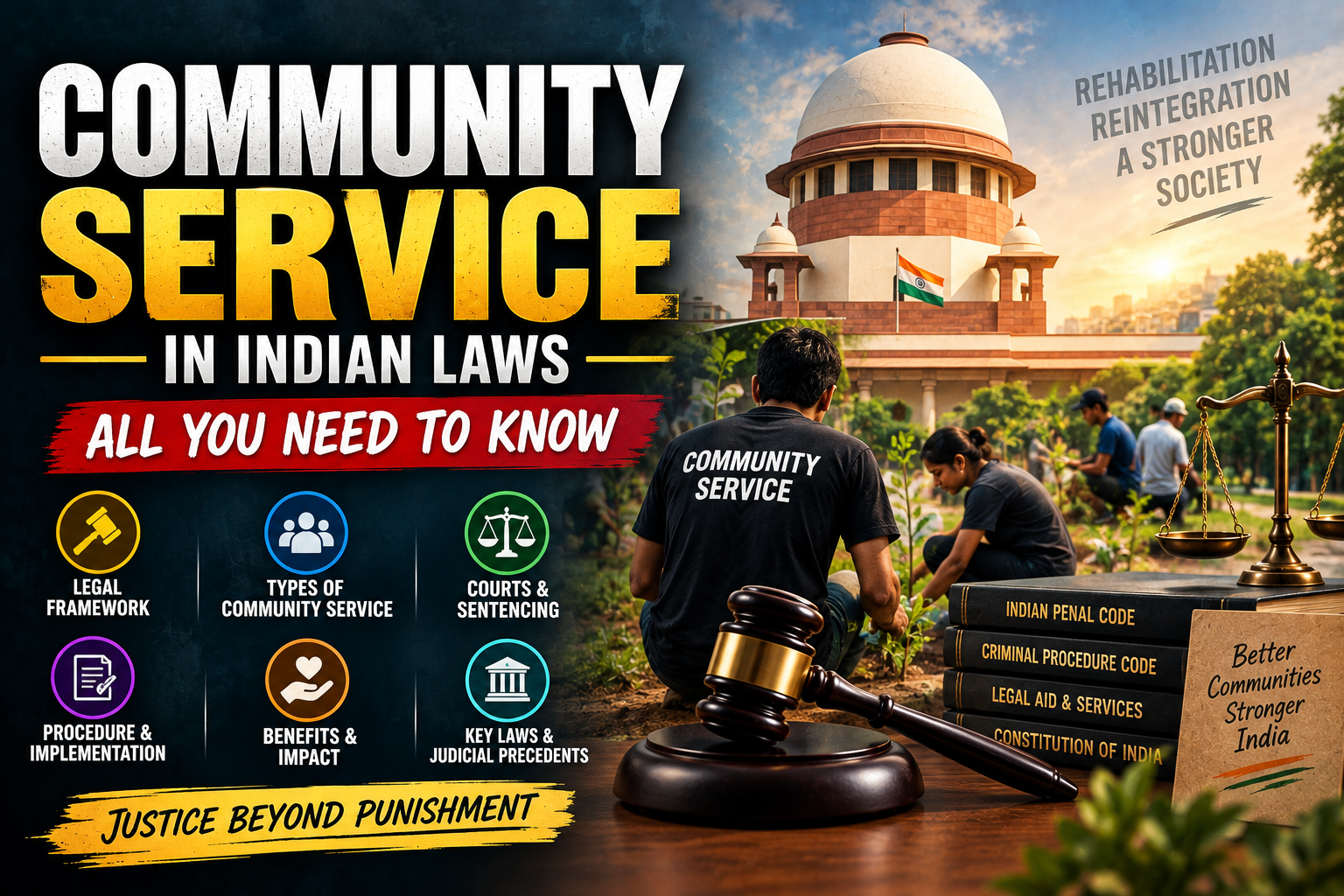
Introduction to Community Service:
Indian criminal jurisprudence has undergone several changes in the past few decades, these gradual changes has transformed from being deterrent in nature to applying retributive methods for criminal justice. Earlier the punishment was aimed at suffering and deterring the potential offenders. Community Service has emerged as a progressive, humane, and practical alternative to imprisonment, balancing accountability with rehabilitation. In the Indian criminal justice system, Community Service has been introduced for the first time in its statutes. Community Service emphasises on reintegration of offenders into the society. This punishment is reserved for first time offenders, Juvenile offenders, and offenders who commit minor offences. This legislative reform has its roots in the Constitutional provision under Article 21, Right to life and liberty, and helps in upholding it.
Community Service as a punishment compels offenders to perform unpaid, socially beneficial work, so that they can repay the society for the harm they have done to society. Community Service was introduced as a punishment in penal laws, so that, instead of giving punishment which affects the offender’s cognitive development, and not serve the outcome of the punishment, they presented Community Service for petty crimes, and offenses which are not serious in nature. Community Service represents a modernised, comprehensive, and proactive approach to criminal law and justice in India. Rehabilitation through social engagement achieves outcomes that punitive isolation rarely produces, Community Service benefits both the offender and the Community.
The Penal Code (Amendment) Bill, 1978 proposed inserting Section 74A to formally recognise Community Service as an alternative punishment; although passed by the Rajya Sabha, it lapsed upon dissolution of the Lok Sabha in 1979. The Law Commission of India, in its 156th report, revisited the idea of introducing Community Service as an alternative punitive measure. Before the enactment of Bhartiya Nyaya Sanhita, the only statutory provision explicitly recognisingCommunity Service in India was Section 18 (1) of Juvenile Justice (Care and Protection of Children) Act, 2015. This provision empowered the Juvenile Justice Board to impose Community Service as a corrective disposition for child offenders.
Meaning and Concept of Community Service:
Under the criminal law, Community Service is a court ordered penalty, requiring a convicted
individual to perform unpaid, socially beneficial work for a specified number of hours. Society is evolving rapidly all over the world, and new forms of punishments are being introduced for the reformation of people who commit crime. Community Service has been officially included in the new criminal laws in India as a non-custodial punishment . It is a shift towards reformative justice, as included in Bhartiya Nyaya Sanhita and Bhartiya Nagrik Suraksha Sanhita.
Community Service aims in Restorative Justice, to repair harm done to society through
Constructive public Labour, rather than complete isolation (imprisonment or solitary
confinement). This punishment rehabilitates the offender, and reduces unnecessary prison
crowding. Community Service impacts the offender, challenging their criminal mindset, and eventually changing it.
Historical and traditional penalties:
Before community service, society and the social justice system had different ways of punishing an offender. A crime is considered to be committed against a society. The punishments we see in the Indian Penal Code, Bhartiya Nyaya Sanhita or other laws are slightly different from the punishments given in earlier times. Ancient punishments were harsh legal measures used to control people. Generally, the punishments used to rely on physical pain.
Deterrent Theory:
Deterrent Theory of punishment states that the punishments were severely harsh to prevent crime, and to create fear in the public, by treating the offenders cruelly. It stops an individual offender from repeating a crime, and sets an example for other people to not commit similar acts.
Banishment and Public Shaming:
Earlier, the justice system used to observe degrading tactics for offenders like public shaming and banishing. These are informal social punishments that lays its emphasis on humiliation of the offender, rather than rehabilitation, or structured reparation.
Banishment involves forcibly removing or exiling an individual from a group, town, or society to isolate them completely.
Corporal and Capital Punishment:
Corporal and Capital Punishment are methods of penalising wrongdoers, both Corporal and capital punishments observe different levels of suffering, and are given according to the severity of the crime. Corporal punishment involves inflicting physical pain or injury to the body, while Capital punishment is the legal execution of an offender.
Corporal Punishment: Corporal punishment is less severe than Capital Punishment. It inflicts physical pain, or discomfort on a person’s body. Corporal punishment includes whipping, caning, beating, flogging, branding and mutilation. It is applied across several judicial systems. Most Western Nations abolished Corporal Punishment. Corporal punishment was observed in Schools, but the new laws strictly prohibit Corporal punishment on students. Corporal Punishment is illegal under International Human Rights law and most national legal systems.
Capital Punishment: Capital Punishment is considered as one of the most brutal punishment, it is reserved for heinous crimes, like murder or rape. This punishment was frequently observed in the earlier times, it included beheading, electric shock, Hanging etc. It was believed that offenders who committed heinous offences should suffer like the victims, although capital punishment was also executed in some crimes which were not heinous in nature, like, espionage, treason, economic and financial crimes. The criminal justice system worked in a manner so that punishments will be given to offenders according to the severity of their crime.
In today’s world, capital punishment is only given in the rarest of rare cases, as established in the case of Bachan Singh vs. State of Punjab.
Changing philosophies of punishment from Retribution to Reformation:
A drastic fundamental change in the criminal justice system could be seen nowadays, a shift from retribution to reformation is visible to rehabilitate offenders, and an attempt to change the criminal mindset through giving such punishments, which focuses on changing the person who did wrong. Reformation gives the offender a chance to heal, and learn. The general assumption for reformation is that the offender grows, and fits back into the society with help.
Retribution:
The theory of retribution involves punishing an offender for their wrong-doing. In this theory, criminals only get punished strictly because they committed a wrongful act, not for social benefits. Retributive theory punishes on the basis of severity of crime, it evaluates past behaviour, rather than trying to prevent future crimes. Treating the offenders on the basis of their criminal background doesn’t leave any ground for rehabilitation of the offender. Retribution relies on set legal rules, limits, and fairness, unlike personal and emotional damage.
Reformation:
Reformation of offenders focuses on changing the criminal behaviour, and rehabilitating individuals so they can return to society as law-abiding citizens. This theory recognizes the potential of the offender, and treats them in various possible ways. The mental condition of an offender progressively shifts to positive behaviour, habits, values, and insights also. By helping the offender in reformation, it actually helps the society and Community as well. The process of reformation is entirely different from preventive, and deterrent Theory. Reformative Theory’s main objective is the growth of human civilization, in terms of criminal justice administration, and to make amends in the society on criminal reformative grounds, this theory works as a tool for public Protection.
Community Service as a modern sentencing tool:
Over several centuries, the punishments given to offenders were of deterrent and preventive nature, these punishments and its effects were analyzed by the society, there are many offenders who can change themselves, and shall be given a chance to do so. Community service is observed as a prominent tool of punishment in today’s time. Rehabilitation is emphasised for the offenders. Rather than punishing in a deterrent or preventive manner, it focuses on fixing the behaviour of criminals, and teaching them their responsibility towards the society as a citizen. As a modern-sentencing tool, this helps in keeping young or minor offenders from staying out of the criminal system, which stops them from developing the criminal mentality.
Human Rights oriented criminal justice: Human Rights oriented criminal justice system uses Community Service as a non-custodial punishment to protect offender’s dignity, reduce prison overcrowding, and focus on healing over punishment.
Preserves human dignity: Keeps first-time petty offenders out of prison, and gives them a chance to rectify their mistakes, and bring change in their life, saving them from psychological harm.
Encourages accountability: Community Service lets offenders repair the societal damage done by them, and give back to local communities while acquiring useful skills.
Offences punishable with Community Service under Bharitya Nyaya Sanhita:
New criminal laws were introduced in 2023, namely Bharitya Nyaya Sanhita, Bhartiya Nagrik Suraksha Sanhita and Bhartiya Sakshya Adhiniyam, it took effect on July 1st, 2024, replacing colonial-era legislation to modernize the country’s justice system. These laws shifted from a colonial approach of justice to a modernised approach to the country’s justice system, and a more citizen-centric approach. Bharitya Nyaya Sanhita introduces Community Service as a statutory form of punishment in India, shifting focus towards reformative justice. Section 4(f) of Bharitya Nyaya Sanhita lists Community Service as the 6th category of punishment alongside capital punishment, imprisonment, forfeiture of property, and fines. It is majorly for first time offenders, and minors in which the exact nature and duration of the unpaid work are decided by the magistrate.
Section 202: Public Servant unlawfully engaging in trade- Any public servant, who is legally bound, not to engage in trade, but does so anyway, commits an offence punishable with Community Service.
Section 226: Attempt to committ suicide to compel or restrain exercise of lawful power- Makes it a crime to commit suicide specifically to pressure, force, or stop a public servant, from doing their legal job.
Section 303 (2): Theft– When the value of stolen property is less than ₹5000, and the person is a first time offender, shall when the property is restored, or return of the value of property, be punished with Community Service.
Section 209: Non appearance in response to a proclamation u/s 84 of Bharitya Nagrik Suraksha Sanhita- Any person who fails to appear at the specified place and specified time required by a proclamation published under sub-section (1) of Section 84 of Bharitya Nagrik Surkasha Sanhita can be punished with either imprisonment or Community Service.
Section 355: Misconduct in public by a drunken person- if any person, in the state of intoxication, and acts in such a manner which causes annoyance to any person, shall be punished with either imprisonment or Community Service. Misconduct by a drunken person is considered a public nuisance and hence, Community Service can repair the damage done to the society and the offender is not confined unnecessarily in the prison.
Section 356: Defamation- Whoever defames someone, shall be punished with either imprisonment or Community Service under BNS, as explicitly provided in the provisions of the act. BNS deals with criminal defamation, and the harm done to the reputation of a person is compensated through the offender by providing service to the community.
As provided in the provisions of Bharitya Nyaya Sanhita, the court determines the number of hours of Community Service based on the severity of the offence. Community Service was presented in the criminal justice system to reintegrate offenders into the society. It can be seen that, petty offences or any offences as mentioned in Bhartiya Nyaya Sanhita with punishment of Community Service is being dealt by the courts, and justice is being provided by the application of the new criminal laws. Profound changes are visible in the society connecting with the people of different communities generates empathy in the person. Offenders understand the gravity of their crime, and contribute to society with Community Service. This drastic shift in the punishment was necessary to prevent the offenders who commit petty crimes, from the arbitrary nature of punishment for offences which are not heinous in nature. Community Service clearly draws a line between offences of different nature, and several case laws regarding Community Service, explains the importance of this nature of punishment.
Difference between imprisonment and Community Service:
Imprisonment: Imprisonment is confinement of an offender in a jail or prison facility, this type of punishment of an offender is observed in almost every country. Imprisonment deprives a person from their freedom, and isolates the offender from society. This is considered as one of the most crucial ways to penalize an offender.
Imprisonment heavily focuses on deterrence, strict punishment, and Public incapacitation. It is reserved for serious or violent crimes, where it is necessary to detain the offender. In some cases, the offenders are punished with solitary confinement. It is a type of imprisonment where a person is kept in a single cell, usually for 22 to 24 hours a day, with little to no human contact. But solitary confinement affects a prisoner psychologically, and physically, after which it destroys the social skills of the offender, if kept for an unnecessarily longer period, many people develop fear of crowds, open spaces.
Community Service: Community Service is a new form of punishment, Bharitya Nyaya Sanhita observes Community Service in several crimes. Community Service is distinct from imprisonment, it is necessary to impose penalties such as imprisonment, but the nature of each crime is distinct from one another. Community Service does not separate a person from society, rather, the offender’s work for the public, to compensate for the harm they have done. In Community Service, a person stays in their respective homes, and they have to complete court-ordered hours while being supervised by authorities. Community Service working hours can typically range from 40 to 240 hours, which is up to court’s discretion. Any rigid number of hours is not fixed for any crime. The magistrate or judge decides the exact duration, based on the severity of the offense.
Rise of alternative sentencing models:
Alternative sentencing models are rising at a fast rate, and gaining popularity worldwide. These alternative sentencing models lays emphasis on reformation, the main objective of these sentencing models is to reduce overcrowding in prisons, regulate the cost being invested in maintenance of the offenders. It has been observed, putting prisoners behind bars often fails to stop people from committing crimes after their release. Now, there is the need to address the root causes of crime, such as mental illness, poverty, or substance abuse. The need to introduce these alternatives was to protect the future of the offenders as well as of the society. People in Community programs are often less likely to commit crimes again, compared to those in harsh prisons. Due to these alternatives, the offenders get to understand the value of their family, and their own life, as they contribute their work to society, their understanding for the need to change expands, and they imply the learnings from the sentencing like Community Service, in their lives.
Alternatives may include- Probation, parole, Community Service, Restorative Justice.
Probation: There are several offences which are not of heinous nature, and people may commit these crimes for multiple reasons, including- circumstances, family background, poverty etc. When any person commits these crimes, they are not sentenced for imprisonment.
The crimes may include- Petty Theft, shoplifting, low level grand larceny.
It aims to reform first time or minor offenders by keeping them away from hardened criminals inside prison. The offenders must follow the instructions provided to them by court, such as staying employed, avoiding drugs, and meeting regularly with a Probation officer. If the person successfully completes the punishment, they avoid prison hours. If they break any instruction, the court may send them to prison. As part of Probation, a judge, or court can order a specific number of unpaid Community Service hours as part of their probation agreement.
Parole: The modern law includes parole in its justice system; plenty of offenders might tend to commit crime due to personal, social, economic pressures. Many offenders may get involved in criminal activities, when they do not even intend to, due to these reasons. The intensity and gravity of the crime also matters for the execution of one’s punishment. Yet, there ought to be some offenders who are willing to change, for society, and themselves. When offenders are kept in the prison as their punishment, in the course of their imprisonment, if they ‘behave well’, they are released early from the prison, given the condition that they have to follow the rules as prescribed by the court, and shall be supervised in the Community, on condition that if they break the rules, they go back to prison.
Community Service: Community Service is considered as a paradigm shift in the criminal justice system, the new laws introduced in 2023 includes the punishment Community Service. Community Service means the work which is directed by an order from a court to the offender, for their wrongdoing. Before these laws, Community Service as a punishment was a part of Juvenile Justice (Care and Protection of Children) Act, 2015 and Motor Vehicles Act, 1988. Providing Community Service does not include any monetary benefit to the offender, it helps in reducing the burden from prisons, and the offenders contribute positively to the Community. It shows the offenders the reality of how the society got affected by their crime, or how the society might have been affected by the crime they have committed. This punishment gives every offender enough time duration to reconsider their actions, and makes them understand their duty towards the Community. Community Service has turned out to be an effective way to influence young offenders into working for their society and Community, and makes them acknowledge their precious lives, and encourages them to take responsibility for their actions.
During the course of the punishment, courts also mandate that the offenders should be getting help with a psychologist.
Both Community Service, and the sessions with psychologists shows them the value of their lives. ‘Restorative Justice’ is the soul of this sanction. It repairs the harm done to society, rather than just punishing the offender. It helps the offenders learn Empathy, Discipline and a sense of responsibility towards the society. Community Service is observed in petty offences, to retain the young and first-time offenders from prison and its atmosphere.
In recent years, the judiciary has been observing Community Service as a penalising tool, the judicial interpretation of every judge is distinct. Community Service is a non-custodial sentencing tool. Judges weigh specific operational, moral and systemic factors when handing down this penalty. When judges believe imprisonment might do more social harm than good, they sentence the offender with Community Service. The objectives of Community Service are defined by the judges, whenever in question.
This new sanction has turned out to be a solution, a cure for the society to rehabilitate offenders. While imposing the punishment, the Court must explain that the convict will not receive any remuneration for their work, the punishment aims to reinstate the offender in the society and connect with their family members as well.
Community Service might include:
Cleaning public spaces- Sweeping streets, cleaning parks, picking up litter.
Environmental projects- Projects which help in enhancing the condition of the environment with the help of offenders like Planting trees, maintaining Community Gardens, or caring for public green areas.
Social Support Work- This includes assisting staff at local Community Centres, food banks, or non-profit organization’s, where these offenders get assigned with various tasks, and they get involved in serving the people of society.
Educational Support- Helping out with public social programs or Community education drives, where the offenders meet various people of the society, connect with people from different age groups and acknowledge the interaction with them.
An example of Community Service through a Motion Picture:
The film ‘Sitaare Zameen Par’ is considered as a great example of Community Service with a fictional story directed towards it. Rather than facing immediate imprisonment, the protagonist is sentenced with Community Service due to Driving under Influence (DUI). The film captures how Community based mandates force offenders to confront their personal biases and integrate positively with marginalized segments of society. Instead of imprisonment they criminal justice implied enforced empathy, the protagonist required to manage and mentor a basketball team of neurodivergent adults. The offender works with the neurodivergent team as a coach, and understands and teaches those people- unlearning prejudice, mutual respect, ways of behavioural reformation of the mentally challenged people. If the person has been given a rigid form of punishment in spite of Community Service in this petty crime, he might not have understood the nature of crime committed by the offender, Driving under Influence (DUI) is a petty offence.
Case laws related to Community Service:
- Manoj Kumar vs State (NCT of Delhi) 2023: In this case, the Delhi High Court observed that the offender has committed the crime, mentioned in section 74 of Bharitya Nyaya Sanhita. The court sentenced the offender with Community Service, so that he can repent his deeds, he had to perform the work under Lok Nayak Jai Prakash Narayan (LNJP). This punishment’s aim was to encourage empathy for people of society, and reformation of the offender.
- Aparna Bhat vs State of Madhya Pradesh: The Supreme Court of India ruled that Community Service in sexual violence cases should be strictly prohibited, courts cannot force an accused person in sexual violence case to perform Community Service as a condition for getting bail. Sexual violence is a henious crime, not a minor dispute that can be fixed by doing good deeds or Community work. Community Service in heinous crimes treats the offence as a social misunderstanding rather than a grave violation of the law.
- Vishal Awtani vs. State of Gujarat: High Court directed the state government to make non-medical Community Service mandatory for individuals caught not wearing face masks in the public during the COVID-19 pandemic. Vishal Awtani, an advocate filed a Public Interest Litigation pointing out that a monetary fine alone was not enough to deter people from violating mask mandates . He suggested that violators should perform 10 to 15 days of non-medical Community Service at COVID-19 care centers alongside paying penalties. The Gujarat High Court agreed ruling that people who put public health at risk should provide their service to society through Community Service.
- Vishal Surendra Kumar Agarwal vs State of Maharashtra: On May 19, 2024, a speeding Porsche driven by Vishal Agarwal’s 17 year old son, fatally struck two IT professionals in Pune. Following the incident, public outrage erupted after the Juvenile Justice Board granted the minor bail under highly lenient corrective conditions, which included~ Writing a 300 words essay on road safety, Working with the traffic police for 15 days as a form of Community Service, Undergoing treatment and counselling for alcohol consumption.
The punishment given to the 17 years old offender was rehabilitation centric, the court ordered him to work with the traffic police for 15 days to understand the crime he has committed, and why it is necessary for every citizen to follow rules, and abide by the Law. It is mandatory to provide a psychologist to a Juvenile offender. Providing a psychologist to young offenders identifies hidden trauma, learning disabilities or mental illness. Psychologists helps the young offenders to improve self-control and anger management. They understand the real impact of their actions on victims, and promote healthy conflict-resolution habits.
Legislative intent behind Community Service:
A practical low cost alternative for minor infractions like petty theft, public intoxication, while maintaining public accountability. The person gets no pay, and the work aims to fix the harm done and help them learn. Skipping Community Service can lead to imprisonment, if these alternative measures are being provided by courts, and the offender does not obey the punishment, the punishment’s severity can be changed by the court.
Judicial discretion and implementation:
Judicial discretion in Community Service relies on the judicial power of a judge, Community Service is a non-custodial sentence for minor offences, if the judge deem fit, they may punish any offender with Community Service in petty offences for the reformation of the offender in various offences, like, defamation, non-appearance in court etc. A judge may after understanding the nature and intensity of the crime, committed by the offender will either be punished with Community Service or in any other form of punishment, seeing the nature of crime. In several cases if the offender is a first time offender, and the crime committed by him/her, is not a heinous offender, can be either fined or be punished with Community Service. Statutes do not specify the exact duration, minimum/maximum hours, or types of permissible work, leaving wide room for interpretation during sentencing. Uncontrolled discretion can lead to disparate punishments for similar offences, reducing public trust.
Absence of Provision: There is a lack of authorities, and proper mechanisms to monitor complete execution of the provisions, such as the probation and parole framework.
Monitoring Mechanisms: The supervision for the punishments such as Community Service is often given to the local entities, such as Municipal Commissioners, departmental heads, so that they can supervise the tasks assigned to the offenders. In some regions, people use digital means to oversee the tasks, which includes geo-tagged or GPS labeled photographs, videos, and attendance records. The collected data of daily work must be submitted by the authorities directly to the court.
Determination of suitability: Determining the suitability of Community Service under judicial discretion involves a magistrate or judge weighing specific case factors, offender background, and statutory provisions like those in the BNS to choose a reformative, non-custodial penalty instead of Imprisonment.
Significance of the Reform:
This reform in the criminal justice system makes it more progressive, shifting from harsh prison punishment to healing and personal growth. Crowded jails can increase worse habits in petty, young, or first time offenders, instead of learning from their mistakes, it might tamper their cognitive understanding for empathy, the necessity of being a responsible citizen in the society. It keeps the non-violent offenders out of jail. The system directly targets to understand the causes of crime, like poverty or lack of education and make amends through various punishments. This approach of punishment is significantly practical for first time offenders. Imprisonment as a punishment should only be preserved for heinous offences. Putting first time offenders with offenders who have committed heinous crimes may not turn out to be effective. The courts observe the minds of the criminal to impose the most suitable punishment for them.
Community Service observed by various nations:
Community Service is observed as a criminal justice non-custodial alternative for minor, and non-violent offenders to pave their ways towards empathy. It executes Community work instead of incarceration.
United Kingdom: Community Service as a legal punishment in the United Kingdom is a well-established decades old institutional practice with rigid national standards. In England, it was formally established through the Criminal Justice Act, 1972. It functions as a structured mainstream alternative to short-term custody for minor offences. It is highly organised through the Probation Service, featuring mandatory unpaid work requirements categorised into environmental cleanups, charity work, and Public space restoration, scheduled carefully around an offender’s employment.
United States: Community Service as a legal punishment is a long standing practice in the United States, ordered by judges as a part of Probation or minor offences utilized across federal states, and local courts. Judges hold broad discretion to assign unpaid work for felonies.
Norway: Norway serves Community Service as a direct alternative to various non-violent and moderate crimes. Courts ensure that the offenders have access to public housing, healthcare, and job training to prevent offenders from committing the crime again. It is handled by probation officers.
Australia: In Australia Community Service requires up to 500 hours of unpaid work, these are Community Correction orders, as directed by the Court, it can be given in any kind of offence, whether it be minor offences, or offences of a little heinous nature. It is focused on rehabilitation, and reparation of offenders, this also saves prison crowding, heals the offender, protects the victim, and restore Community Service balance.
Conclusion: By including Community Service, it completely changed the former legal system, it is necessary to heal the offender, protect the victim, and to bring back the balance in Community. Community Service is a big shift in penal laws, Bhartiya Nyaya Sanhita institutes Community Service under Section 4(f) as a punishment for offences that are not heinous in nature. This positive move towards criminal justice fulfills the goals of punishment, with incarceration of the offender, the punishment always matches with the severity of the offense. Engaging in Community Service provides offenders with an opportunity for reflection, and it can lead to a re-evaluation of self-identity. This punishment encourages the offenders to provide service to the society, and they may begin to see themselves as valuable members of society, capable of positive change. Implementation of Community Service as punishment must be guided by principles of equality and fairness. The absence of detailed provisions or guidelines, lack of authorities to monitor the daily work done by the offenders, may affect its effectiveness in the Penal system. Therefore it is essential for the government and the judiciary to ensure that Community Service is being implemented in a fair transparent manner.
About author:
Vatsla Singh is a law student at Shri Ramswaroop Memorial University. She has completed her internships at District Court and Tax Tribunal, which helped her in gaining practical legal exposure and knowledge of the legal system. She is committed to understanding the constantly evolving system of law, and applying the legal knowledge in her work.
References:
- Bhartiya Nyaya Sanhita
FAQs:
- What is Community Service?
Community Service is a punishment given in Bhartiya Nyaya Sanhita, for offences which are not heinous in nature.
- Provisions regarding Community Service in Bhartiya Nyaya Sanhita?
Sections 202, 226, 303(2), 209, 355, 356 of Bharitya Nyaya Sanhita include Community Service as a punishment.
- What can be included in Community service?
Community Service may include, cleaning of public places, working in Non-profit organizations, and local Community Centres.
- Can courts punish an offender with Community Service in heinous crimes?
No, the Courts must punish the heinous offenders with imprisonment, or the provision provided for the crime.