

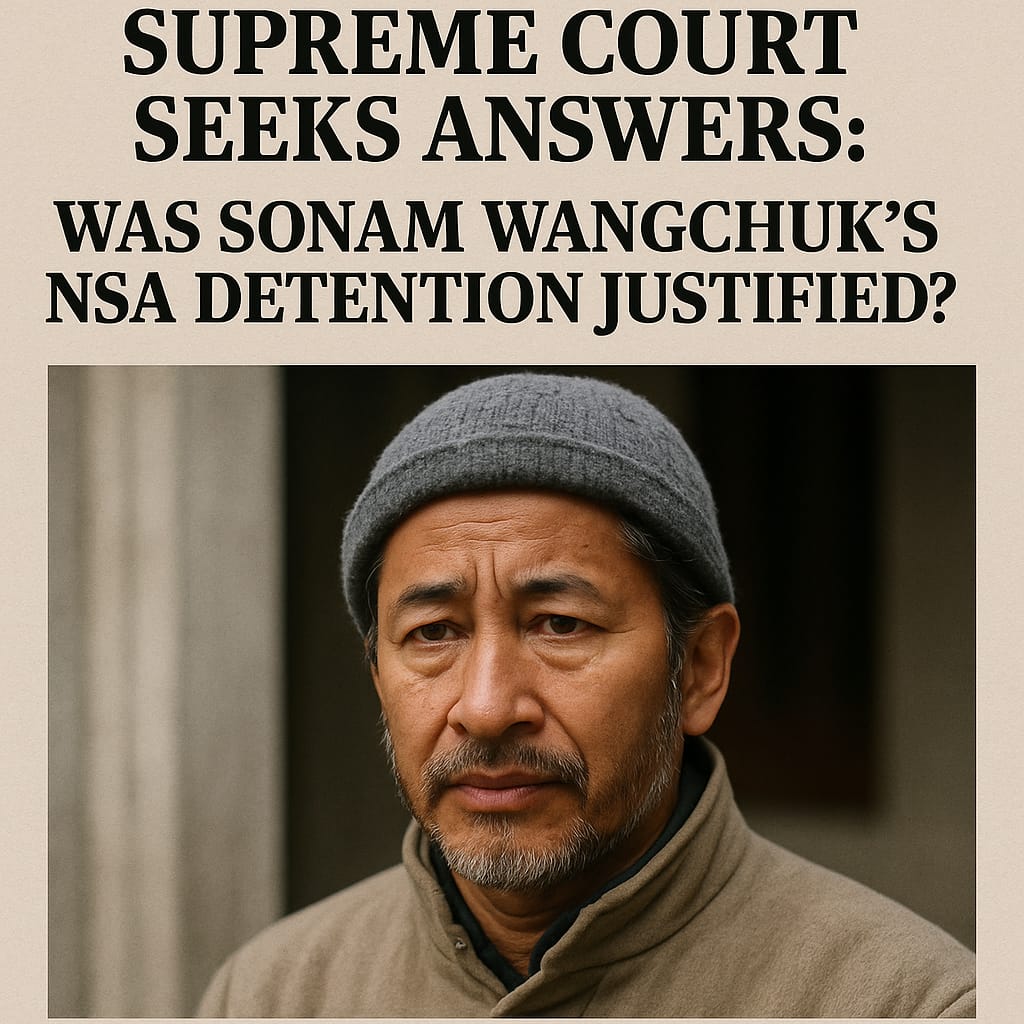
Supreme Court Demands Answers from Centre and Ladakh
Sonam Wangchuk’s NSA Detention: Supreme Court Seeks Centre & Ladakh’s Reply
The Supreme Court of India has taken a serious look at the detention of Sonam Wangchuk, a well-known environmentalist, innovator, and education reformer from Ladakh. The Court has asked both the Central Government and the Ladakh administration to explain the reasons behind detaining him under the National Security Act (NSA).
Who is Sonam Wangchuk?
Sonam Wangchuk is known for his great work in improving education and protecting the environment in Ladakh. The famous movie 3 Idiots character “Phunsukh Wangdu” was based on him. He has been actively raising concerns about climate change, ecological damage, and governance issues in Ladakh. Recently, he also spoke about giving constitutional safeguards to Ladakh, which might have caused tension with the administration.
Why Was He Detained?
The government detained Sonam Wangchuk under the National Security Act (NSA) because a law called that lets them keep someone in custody without a normal court trial if they think that person might harm the country’s security or peace.
However, many people believe this action was politically motivated and meant to stop his peaceful protests and criticism of the authorities.
What Did the Supreme Court Say?
Wangchuk’s supporters filed a habeas corpus petition in the Supreme Court which is a legal remedy to protect a person’s right to liberty and challenge unlawful detention.
The Supreme Court has asked for replies from the Centre and Ladakh administration, for explaining why Wangchuk was detained.
In the habeas corpus petition a court allowed amendments, meaning the petitioner can add more facts or legal points to strengthen the case. So that the Court’s decision to hear the case and seek answers gives hope that justice and constitutional rights will be protected indicated that the Court will closely examine whether the detention followed the law and respected constitutional rights.
Why Is This Case Important?
This case raises big questions about freedom and government power:
Can peaceful activism be treated as a threat to national security?
Are laws like the NSA, which allow preventive detention, being used in a fair way?
As I conclude that the Supreme Court’s action shows the need to balance national security with personal freedom and ensure laws like the NSA are not misused to silence peaceful voices.
About the Author :-
Aditi Anil Bhoyar is a final-year B.A.LL.B. student at Manikchand Pahade Law College, Chhatrapati Sambhajinagar, Maharashtra. Deeply passionate about law and its impact on society, she aims to bridge legal knowledge with real-life issues. Through her writing and future work, she hopes to contribute meaningfully to justice, fairness, and public awareness.