

Introduction
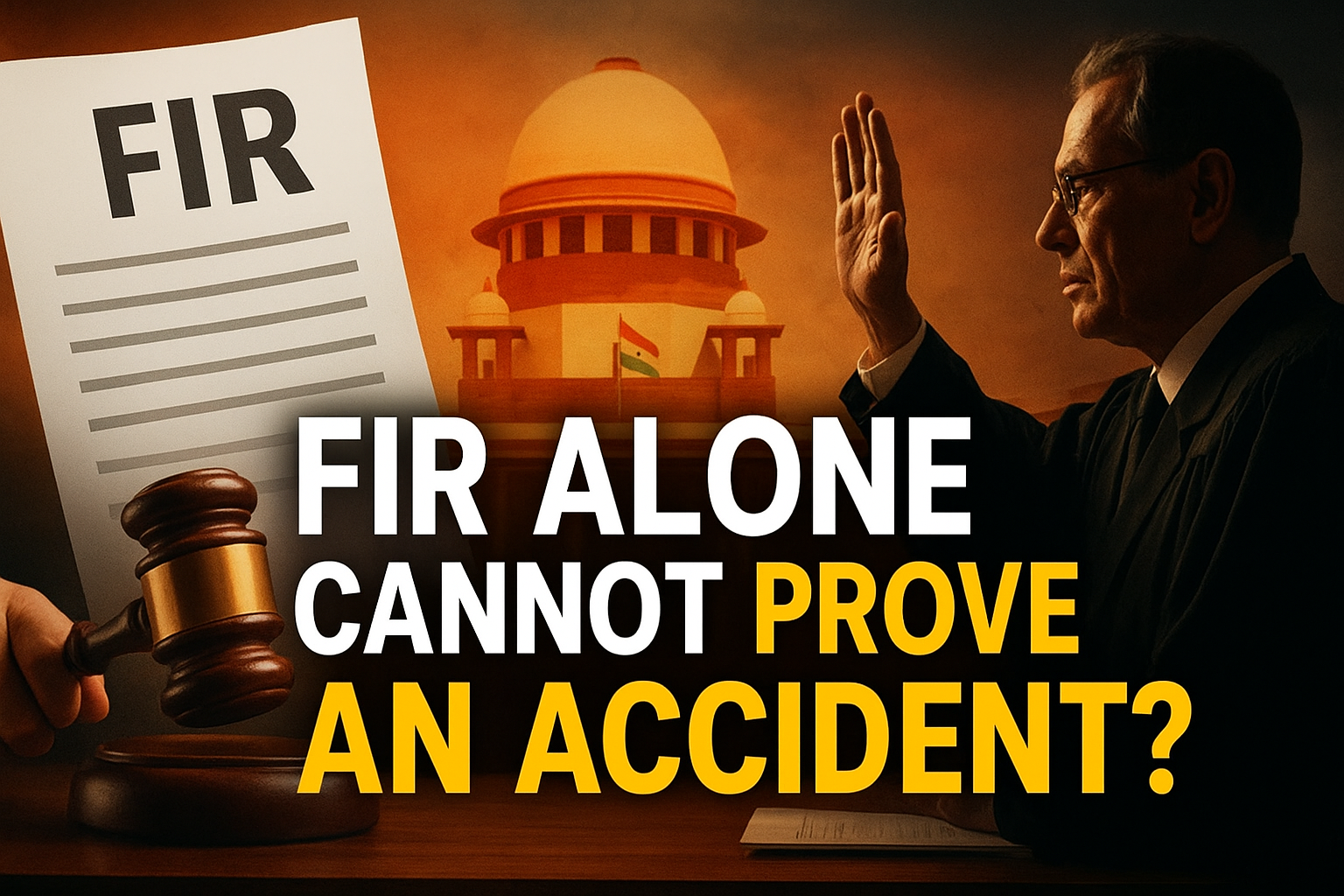
In judgments that significantly have lasting implications for motor accident compensation cases, the Supreme Court of India has held that FIR alone cannot prove an accident. The Rajamma &Ors v. Reliance General Insurance Co. Ltd & Anr, where the court clarified that an FIR (First Information Report) is only a starting point in reporting an alleged incident and cannot, by itself establish the occurrence of an accident or determine liability. The court highlighted that the justice system values consistent, corroborated and credible evidence over procedural formality. While the FIR remains an important document, its reliability on how and where it was lodged, as well as whether supporting evidence is available confirm its content.
Background of the Case
This came into focus when Rajamma and her children had filed a compensation claim after the tragic death of the family member in a hit and run accident that occurred on June 18,2014. The family alleged that the driver was responsible for the incident and fled the scene afterwards. Their claim was supported by a woman who had witnessed the accident and noticed that the number of the vehicle involved, later based on her testimony and the FIR filed soon after , the Motor Accident Claims Tribunal (MACT) initially granted the family compensation of ₹16,02,000. However, the decision did not stand for long. The High Court, upon appeal, reversed the award concluding that the accident itself had not been conclusively proved. The Claimants then approached the supreme court, hoping for relief.
There are various irregularities which suffered during the case. The FIR had been filed at Hebbogodi Police Station, which did not have jurisdiction over the location where the accident reportedly took place. Furthermore, it was only transferred to the appropriate traffic police station after an unexplained delay of 117 days. Such a long delay in transferring the case record raised serious questions about the authenticity and reliability of the FIR. The eyewitness testimony is also inconsistent with the claims.
What the Supreme Court Said
The Supreme Court of India made it clear that the FIR alone cannot be treated as conclusive evidence of an accident or the involvement of a particular vehicle. The bench also explained that the FIR is meant to set the criminal law in motion and serve as preliminary information for the investigation. Also that the FIR did not prove that the described event actually occurred. The FIR registration in an out of jurisdiction police station and transferring it back to the police station of correct jurisdiction takes around 4 months which led to procedural lapse and weakened the credibility of the entire claim. Also the inconsistencies in the witness’s statement coupled with the lack of supporting documents or corroboration from other individuals, led the court to doubt her account. However under these relaxed standards the claimants failed to proceed with a consistent and credible narrative. As a result, the Supreme Court upheld the High Court’s decision to deny compensation.
Conclusion
The Supreme Court declaration that FIR alone cannot prove an accident stands as a critical precedent in India tort law. It reminds both the court and the claimants that justice in motor accident cases must rest on a complete and reliable evidentiary foundation and the filing of FIR is necessary but not sufficient, corroboration from the credible witnesses and documents in indispensable also the court will aim to prevent fraudulent claims. The ruling sets a clear benchmark for fairness and truth in accident compensation jurisprudence.
About the Author
Tushar Kumar is a final-year BBA-LLB student at Guru Gobind Singh Indraprastha University. With a strong interest in Intellectual Property Rights, he enjoys exploring how law interacts with innovation and creativity. He’s equally passionate about legal writing, Research and believes in making complex legal ideas easier to understand through clear articles. Tushar continues to deepen his understanding of the law while contributing thoughtful pieces on contemporary legal issues.