

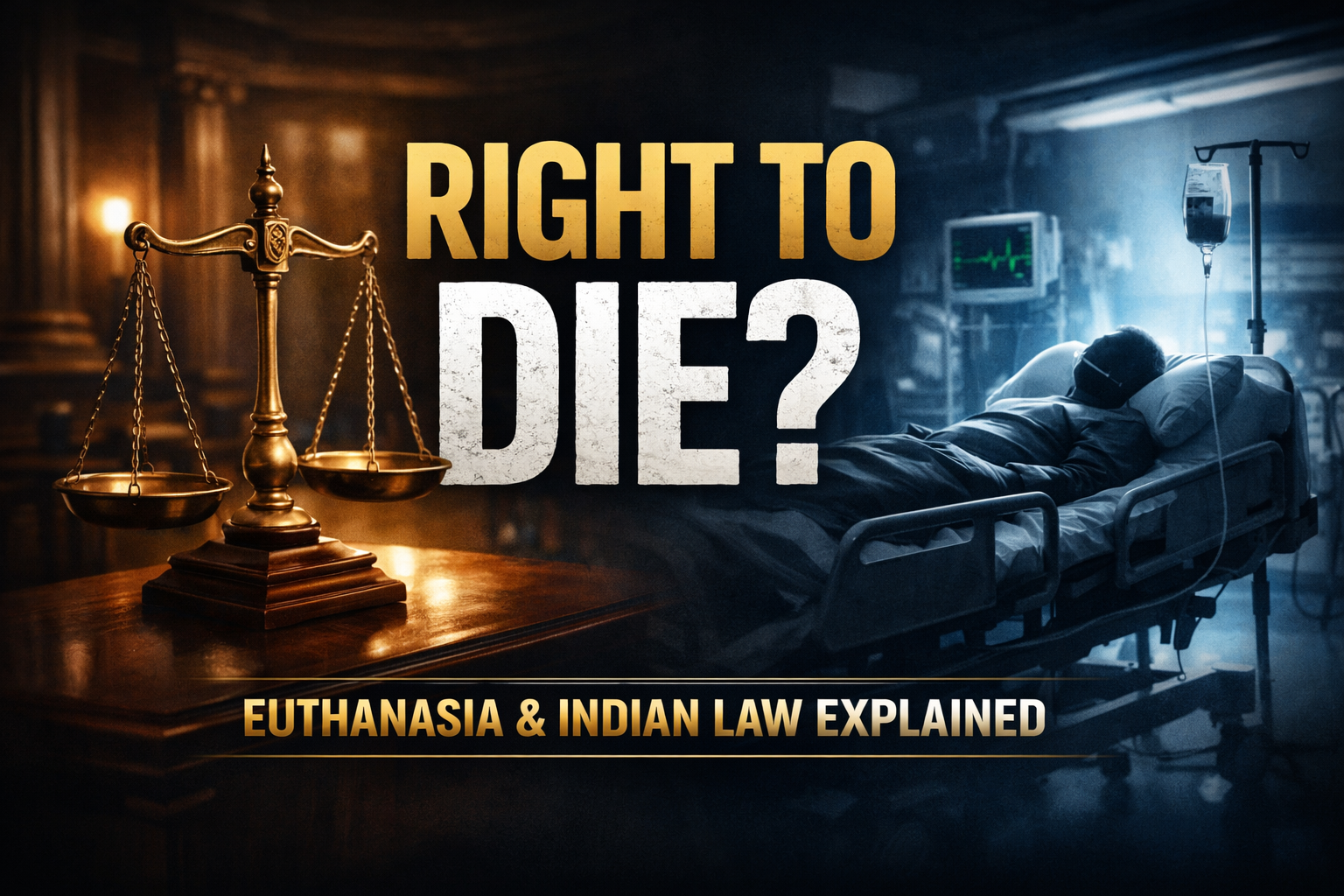
Introduction
Every person on this earth always wants to live his life to the fullest and would never want to put an end to his life. However, there can be exceptional circumstances wherein he actually desires the death. This can occur when he himself commits suicide, which is illegal in India, or he can apply for mercy killing through a petition. This is also known as euthanasia. Whether euthanasia is legal or not is a topic of debate.
Meaning of the Term Euthanasia
Euthanasia means voluntarily opting for death. If a person is suffering from a terminal illness where there is absolutely no chance of a recovery, then either such a patient or anyone on his behalf can make an application before the court or competent legal authority to allow such a person to die naturally. This can be done by withdrawing the life support, like a ventilator or feeding tubes, etc. The purpose of allowing this is to allow the person to die with dignity. So that he will be relieved from the endless pain.
Legal Meaning of Euthanasia:
The word Euthanasia has its origin in Greek words “eu” means good and “thanatos” means death, meaning “good death.”
Now the question arises: how can death be good? Just like we have a right to life, there is a provision for the right to die with dignity. In the leading case of Common Cause v. Union of India and ors., it was held by the Supreme Court that it is a fundamental right under Article 21 of the Indian Constitution. So it is relevant in case of a person who is suffering from terminal illness or irreversible medical condition, he can request competent legal authority to allow Euthanasia.
A euthanasia plea is a legal request made before a court or competent legal authority for taking permission to allow euthanasia, most commonly passive euthanasia, for a patient who is terminally ill or in a permanent vegetative state. It is often called as Mercy Killing Petition. Now the question arises: who can make such a request if the person is suffering from such a disease?
Who Can Make a Euthanasia Request?
As per Supreme Court guidelines (Common Cause v. Union of India, 2018 and subsequent clarifications)
1. The Patient: A patience can make a request if he is conscious and is capable of taking own decisions. A request can be made for withdrawal or withholding of life-sustaining treatment like a ventilator. The patient can either make a verbal or written request or make a will to that effect.
2. Family Members: A request can be made by family members if the patient is unconscious or is in a coma, or in a permanent vegetative state; then close family members such as spouse, parents, or adult children can make the request on the patient’s behalf.
3. Legal Guardian or Next Friend: – There is a possibility that patient is orphan and has no immediate relatives. In that case, a legal guardian or next friend can also apply for euthanasia.
4. Medical practitioner/hospital giving treatment: The hospital authorities can also request mercy killing if continuing treatment does not show any results and there are absolutely no chances of survival without life-supporting equipment. However, it is subject to approval by the prescribed medical boards and authorities.
5. Executor: If the patient has executed a valid living will/advance medical directive, the person named in it may approach the hospital to enforce the patient’s wishes.
Types of Euthanasia
Euthanasia is generally classified on the basis of method and consent. The main types are explained below:
1. Active Euthanasia
This involves deliberately causing the death of a patient, such as administering a lethal injection or medication. It is illegal and punishable under criminal law.
2. Passive Euthanasia
This involves withholding or withdrawing life-sustaining treatment, such as ventilators, feeding tubes, or life-support systems. This will lead to the patient’s natural death. It is legal under strict guidelines laid down by the Supreme Court.
3. Voluntary Euthanasia
Voluntary euthanasia, as the name suggests, is with the consent of the patient. The patient must be competent to give free consent and express it. In India, only voluntary passive euthanasia is permitted.
4. Non-Voluntary Euthanasia
Non-voluntary euthanasia involves when the patient is not able to give consent, such as in cases of coma or permanent vegetative state. In that case, the decision is taken by family members or legal guardians. This is permitted in India only in passive form, and they have to follow the set legal procedure.
Euthanasia and religious practices
Jainism: Sallekhana is a practice followed in the Jain community in which a person voluntarily gives up food and water to put an end to life. It is usually undertaken by a person at the end of life if suffering from old age or terminal illness. The aim is to attain moksha, not escape from suffering.
Nikhil Soni v. Union of India (Rajasthan High Court, 2015)
The Rajasthan High Court held that Sallekhana amounts to suicide under Section 309 IPC (Now BNS, 2023).
It is considered illegal and violates Art 21 of the Indian Constitution.
Notable cases on Euthanasia in India
Harish Rana Passive Euthanasia Case (2025)
Background:
Harish Rana is a 31-year-old man who has been in a permanent vegetative state for over 12–13 years as he met with a serious accident. The Supreme Court of India is hearing a plea filed by his parents.
The parents approached the Supreme Court and requested permission for passive Euthanasia. It means withdrawal of artificial life support because there is no chance of the patient’s recovery.
The Supreme Court has acknowledged the gravity of the situation and is preparing to make a final decision on the matter. The Supreme Court has directed a secondary medical board at AIMS Delhi to reassess Mr. Rana’s condition as part of the procedure laid down for passive euthanasia under Indian law.
The court has also taken the step of consulting directly with his parents and family before taking a decisive order, showing the sensitive nature of the plea.
Significance:
This is a significant case that will receive judicial sanction for passive euthanasia in India under the current legal framework. It tests how the Supreme Court applies the passive Euthanasia guidelines (including living wills and medical board assessments) in real difficult life-and-death situations today.
Current Stage: The matter is ongoing in the Supreme Court, and the final outcome is awaited.
Ethical Concerns in Euthanasia
1. The basic life and death cycle is challenged—human life is considered sacred as per ethical and religious traditions. Euthanasia application challenges the basic principle by putting an end to life intentionally. Even though it is to relieve pain
2. Consent: It creates ethical uncertainty as patients suffering from terminal illness may not be able to give free consent.
3. Corruption: Corruption is present in almost all the fields. The treating doctors may be compelled by giving bribe to apply for Euthanasia by relatives to gain financial advantages.
4. Possibility of Misuse or Coercion: – Family members or caretakers might force the patient to request euthanasia. There is also a risk of economic or social gain if the patient has a large amount of insurance coverage.
5. Slippery Slope Argument: If euthanasia is permitted in the regular course, it may gradually extend to non-terminal cases. The elderly without illness or disabled individuals will be forced to end their lives by putting undue pressure.
6. Medical Ethics and Professional Role: Doctors have taken an oath to save the lives of patients by every possible means. It will be difficult for the doctors as they may fear professional, legal, or moral consequences.
7. Impact on Society and Families: Families applying for euthanasia may experience guilt or emotional distress, and society may be reluctant to take care of the elderly people who are suffering from illness and prefer approaching for a mercy killing petition instead.
8. Equity and Access: Only those people will be able to approach the court that has sufficient financial resources or access to medical care. It raises concern about equity and ethical fairness.
FAQ on Euthanasia Plea
1. What is euthanasia?
Euthanasia refers to voluntarily ending the life of a person who is suffering from a terminal illness with the permission of the competent legal authority.
2. What is a euthanasia plea?
It is a mercy killing petition made before the competent legal authority seeking permission to withdraw or withhold life-sustaining treatment like ventilators, feeding tubes, etc.
3. Is euthanasia legal in India?
Active euthanasia is illegal. Passive euthanasia is permitted under Supreme Court guidelines.
4. What is the legal basis?
The right to die with dignity is recognized as a fundamental right under Article 21 of the Constitution of India by the Supreme Court.
5. Who can file the petition?
The patient, the family members of such patient, or legal guardians.
6. What is a living will?
A living will (advance directive) records a person’s wishes regarding medical treatment if they become incapable of consent.
About the Author
Ashwini Patil-Raulo is a legal researcher and writer who believes that law must speak for dignity, compassion, and justice. With a deep interest in end-of-life legal issues, she is committed to using legal research as a means to bring meaningful social change. Her work explores sensitive and evolving areas such as prisoners’ rights, the constitutional understanding of the ‘Right to Die’, and the growing role of artificial intelligence in the judiciary. Through her writing, she seeks to make law more accessible and to contribute to a more humane and equitable legal system.