

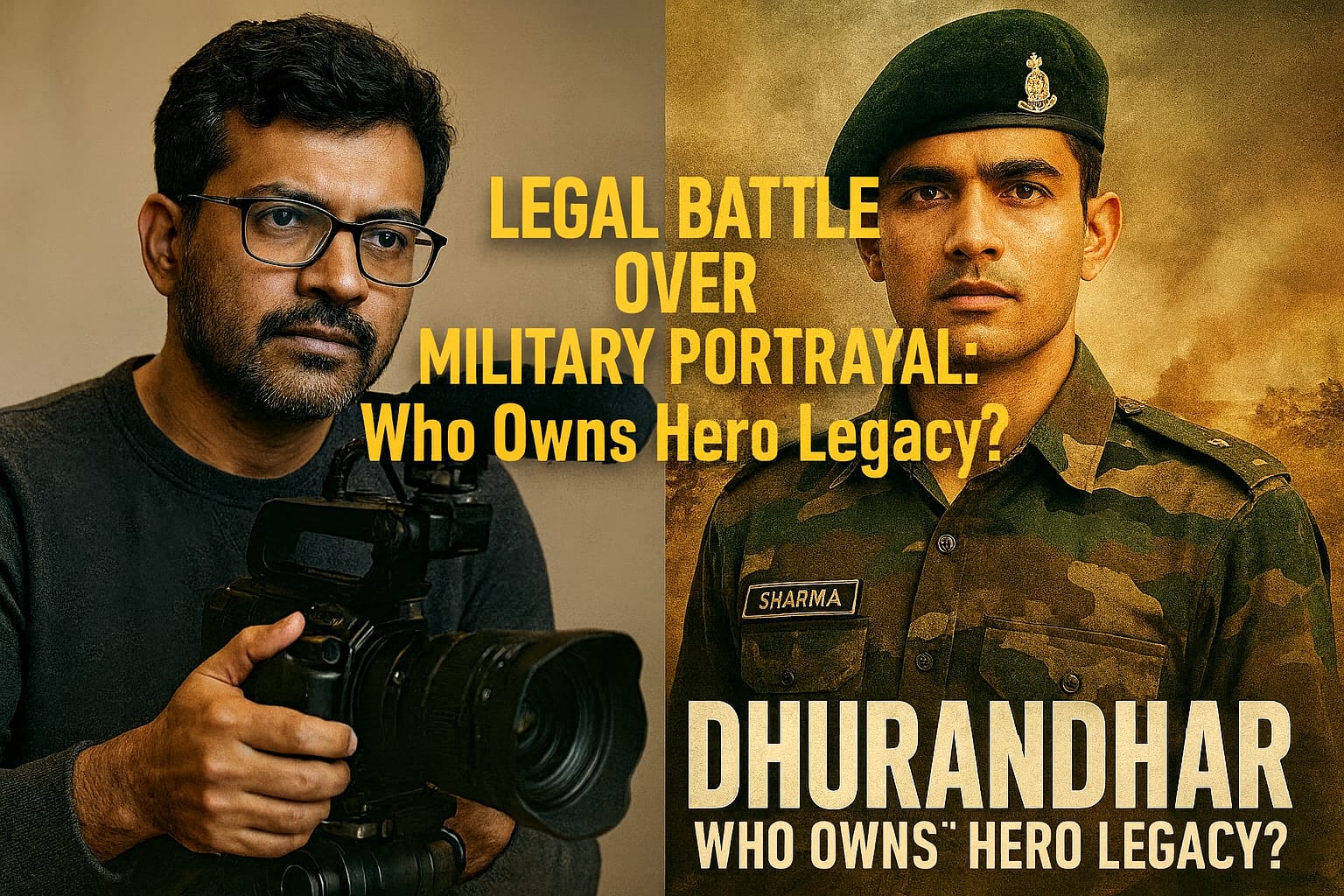
Late Major Mohit Sharma, a renowned Indian Army Officer and the Ashoka Chakra Awardee, is the subject of an upcoming film titled “Dhurandhar”. The family of the Major approached the high court seeking stay or restrain he release of the film, raising the questions on personal rights, Right to privacy, free speech and artistic freedom of filmmakers and dignity of martyrs and public interest. Now a days, Indian courts are rapidly facing disputes about the biopics and portrayals regarding the historical or public figures. The result of which is this case will contribute significantly to define the ethical boundaries of artistic freedom as well as personal dignity, especially for national heroes.
This issue raised some questions which are as follows:-
- Does the family of a deceased national hero retain enforceable privacy rights?
- Can the film be restrained before release on grounds of unauthorized depiction?
- After Restrain, when will court pass the order to pre- release such movies?
- Filmmakers need consent from family for portraying a deceased person?
- Whether military-sensitive details are improperly disclosed
- Public interest in stories on public heroes.
- Fictionalization permissible in biopics?
The Major Family asked for certain Reliefs before the High Court are as follows:
- Interim injunction for restraining the release and publicity of the film.
- To direct to remove or alter portions that present Major Sharma inaccurately.
- To Mandate for filmmakers to obtain prior consent or clearance before any portrayal.
- Review of the film by the family
- Addition of disclaimers
Grounds Raised by the Petitioners
- Violation of Personality Rights: Major is a national hero, his legacy cannot be commercialized without authorization as the filmmakers have used the name, likeness, persona and life incidents, constituting the misappropriation of personality rights.
- Posthumous privacy and dignity (Article 21) principles.
- Family has a “legitimate expectation” to ensure accurate and respectful depiction.
- Unauthorized films may distort facts and mislead the public.
The Judicial precedents supporting petitioners:
- Phantom Films v. Union of India –for pre-release screening.
- Subramanian Swamy v. Union of India – for protection of deceased reputation.
- Puttaswamy – for privacy tied to dignity and autonomy.
Respondents’ Arguments:
- Major Sharma is a public figure matters relating to him are in public domain.
- Films which are biographical or inspired, fall under the protective ambit of creative speech. The SC judgment in S. Rangarajan, K.A. Abbas, and F.A. Picture International has emphasized minimal judicial interference. “Article 19(1)(a) protects creative expression, including films based on real events.”
- Depictions based on public records, published details, news do not require Prior consent of the family unless defamatory or misleading.
The Judicial precedingSupporting Respondents
- R. Rajagopal v. State of Tamil Nadu – for privacy rights for public figures.
- S. Rangarajan v. P. Jagjivan Ram – for high threshold for censorship.
- Injunctions denied in biopic disputes where content was broadly factual.
Conclusion
The dispute revolved around the constitutional balance between the Article 19(1)(a) (freedom of expression) of filmmakers and Article 21 (dignity, privacy, posthumous respect) of the deceased and his family. The petitioners expressed the concern for the family of Major Sharma may rely on the dignity aspect, not purely commercial exploitation. The filmmakers argued that story is based on public domain material, no defamatory and malicious content or commercial exploitation is there. Movie has artistic and social value nothing else. The case talks about the intersection of creative freedom and dignitary protection, and this judgment will further shape India’s jurisprudence on biographical representation. Indian courts are rapidly facing disputes about the biopics and portrayals regarding the historical or public figures. The result of which is this case will contribute significantly to define the ethical boundaries of artistic freedom as well as personal dignity, especially for national heroes and ethical responsibilities in filmmaking. India lacks a clear statutory framework. If Dhurandhar have personal anecdotes, confidential military details, or dramatization this will distorts reality, privacy/dignity claims gain strength.
ABOUT AUTHOR
Adv. Pallavi Sharma, Delhi based Advocate, who is a legal practitioner and researcher with a growing interest in cyber law, IPR, constitutional law, and women’s and child rights. She recently started to contribute through analytical writing and awareness initiatives on contemporary legal issues.