

INTRODUCTION
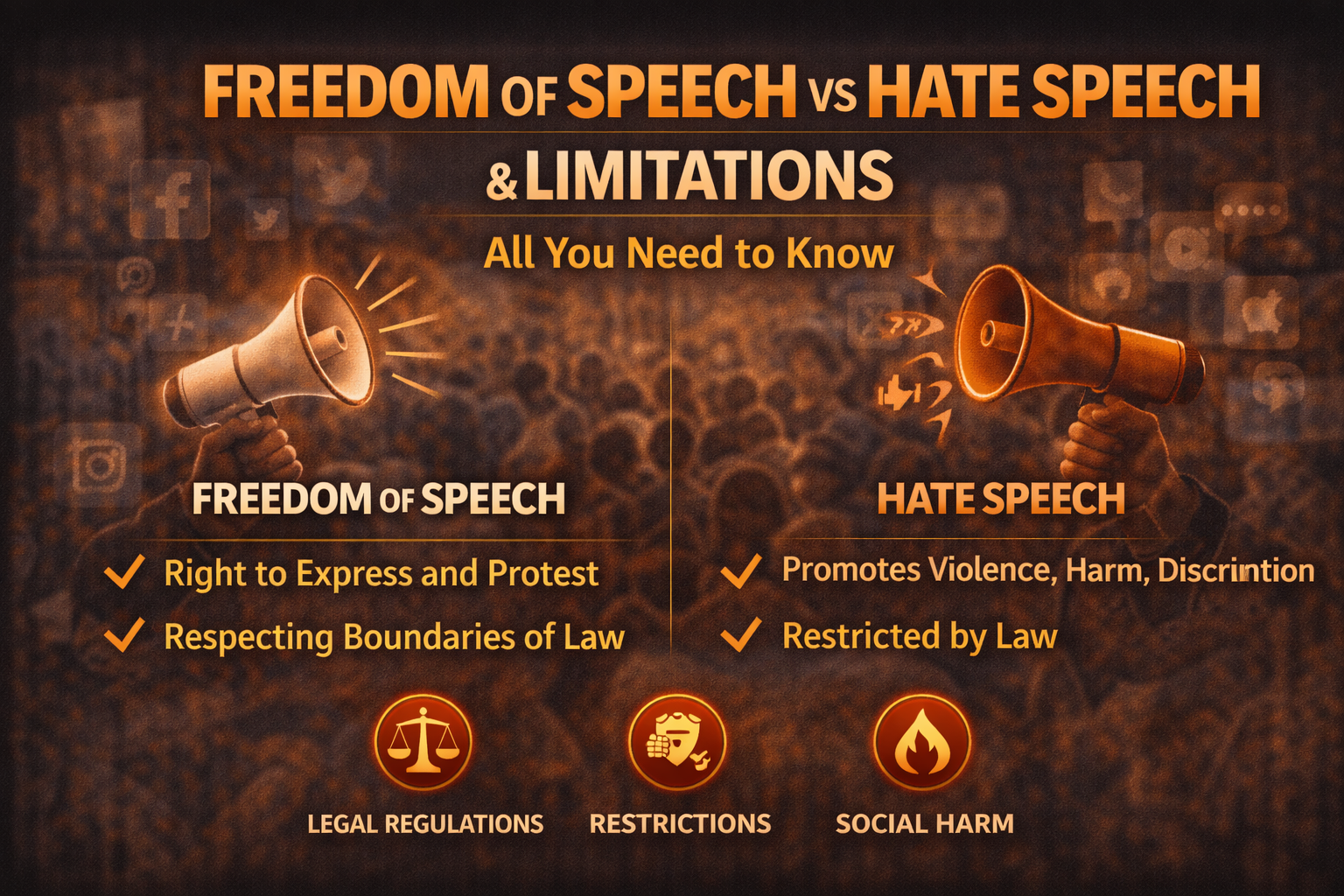
In India Freedom of speech is one of the most important Fundamental rights for the citizens. As, It not only gives individuals to express opinions, beliefs and ideas but also protects the peace and harmony of the nation. In India this right is constitutionally guaranteed under Article 19(1)(a) of the Indian Constitution. However, this freedom is not absolute. It operates within certain boundaries to ensure that it does not disrupt public order or harmony. In this phenomenon, the concept of hate speech emerges as a significant limitation referring to expressions that lead to violence against individuals and groups. The Framework of Constitution of India attempts to carefully balance the protection of free speech , with the prevention of its abuse. This equilibrium states that the idea of freedom of speech is seen as a duty and a right in India. Hence signalling to be used in a way that upholds the integrity and unity of the nation while also respecting the rights of others and in this article the author has explained everything about Freedom of Speech vs Hate Speech.
UNDERSTANDING FREEDOM OF SPEECH
The basic idea of Freedom of speech states that the citizens have the right to express their ideas, opinions and beliefs without any constraints. Democratic participation , political transparency , social and intellectual progress is encouraged by freedom of speech , also allowing the people to question those in power, criticise government policies and take active part in public discussion.
IMPORTANCE OF FREEDOM OF SPEECH IN DEMOCRACY
- Democratic Control
Freedom of speech and expression ensures active public participation . It provides a forum for public discussion and empowers people to debate and condemn unfavourable enactments. By making the government receptive to public opinion , it enhances its legitimacy .
- Accountability
Free speech acts as a check on the misuse of power. Citizens or the media can question the government for all the wrongdoing. Public criticism helps in uncovering corruption and maladministration.
- Personal Liberty
Personal dignity and individuality are directly related to freedom of speech. It allows citizens to express their beliefs, thoughts and ideas. Suppressing them can lead to incompatibility in society. Freedom of speech gives people a voice to be heard and respected.
- Open Debate
It encourages discussions, disagreement and testing of different viewpoints. It helps society to outgrow or evolve by allowing outdated and unjust ideas to be challenged.
UNDERSTANDING HATE SPEECH
Any form of expression that promotes hatred, discrimination or violence against citizens based on religion, race, caste, gender, etc comes under the idea of hate speech. Such speech threatens social harmony and can disturb public peace.
According to the 267th Report of the Law Commission of India, it is stated: “Hate speech is an expression which is likely to cause distress or offend other individuals on the basis of their association with a particular group or incite hostility towards them.”
As per the report, six broad categories are taken into account in deciding whether the speech amounts to hate speech or not. These include,
- the extremity of speech
- incitement
- status of the author of the speech
- status of victims of the speech
- potential of the speech to cause harm
- context of the speech.
CONSTITUTIONAL FRAMEWORK
Right Of Freedom Of Speech And Expression
Article 19(1)(a) of the Indian Constitution provides the right to free speech and expression. This guarantees people to openly express their opinions and take part in the political process without being unduly scrutinized by the government. It serves as a defence against capricious and irrational limitations on speech. Although the right of free speech and expression is fundamental, the state may apply certain restrictions under Article 19(2) of the Constitution in order to protect the interests of society. These limitations guarantee that this kind of free expression doesn’t violate the rights of other individuals and disturb harmony.
Reasonable Restriction
Article 19(2) of the Constitution permits the state to impose reasonable restrictions on the freedom in the interest of-
- Sovereignty
- Integrity
- Public Order
- Decency
- Morality
- National Security
The legal foundation for regulating hate speech and other expressions are restricted by these regulations keeping the balance between harmony and peace assisted , ultimately safeguarding individual freedom of expression by establishing boundaries.
LEGAL MANDATES OF HATE SPEECH IN INDIA
Criminal Laws Addressing Hate Speech
Several laws in India modulate hate speech which incites enimity, creates violence and disturbs public peace. Such conduct is expressly addressed under various sections of Bharatiya Nyaya Sanhita 2023.
Statutory Reference
- Section 152- Acts endangering Sovereignty and Integrity of India
This section penalises people who do any act that hampers the sovereignty and integrity of the country and disturbs the peace of society by uttering words or visible representation.
- Section 196- Promoting enmity between different groups on the ground of religion, race, place of birth, residence, language, etc and doing act prejudicial to maintenance of harmony
This section criminalises the acts of a person if he by his words provokes people or incites them or promotes any kind of disturbance in society or tries to disturb public tranquillity.
- Section 299- Deliberate and malicious acts intended to outrage religious feelings of any class by insulting its religion or beliefs
This section penalises people who insult others about their religious beliefs or feelings or whose statements promote disturbance among different communities.
- Section 353- Statement conducing to public mischief
This section was created for the people who publish statements and rumours that cause breach of peace within the class or community. Promoting hatred or enmity among classes by uttering a statement.
The above-mentioned provisions penalise speech that goes beyond mere expression and enters the realm of harm by targeting communities. The primary objective of these laws is to prevent social disturbance and maintain peace and harmony in society. By penalising hate speech and expressions, the Bharatiya Nyaya Sanhita,2023 act as a safeguard against violence ,ensuring that freedom of speech is exercised reasonably and within constitutional limits.
JUDICIAL INTERPRETATION
The judiciary has played a cardinal role in balancing fundamental rights with the necessity of restricting free speech. The interpretations led the courts to ensure individual freedom is protected under 19(1)(a) of the Constitution of India , it does not extend to speech that harms public order and peace. Some of the interpretations are:
- Shaheen Abdulla Vs Union Of India And Ors AIR 2022
In this case the Supreme Court stated that fraternity cannot exist unless various religious communities are willing to coexist peacefully. Concerned about the increasing number of hate speech incidents in the nation, the Supreme Court has instructed governments and law enforcement agencies to act on their own initiative without waiting for formal complaints to be filed.
- Pravasi Bhalai Sangathan Vs Union Of India AIR 2014 SC 1591
Since hate speech is not covered by any of India’s previous laws, the Supreme Court did not punish it. Rather than entering the realm of judicial overreach, the Supreme Court asked the Law Commission to deal with this matter.
- Shreya Singhal Vs Union Of India AIR 2015 SC 1523
Regarding the fundamental right to free speech and expression protected by Article 19(1)(a) of the Constitution questions were raised regarding Section 66A of the Information Technology Act, 2000. The Supreme Court distinguished between discussion , advocacy and incitement and determined that the first two were the essence of Article 19(1).
FINDING A BALANCE BETWEEN FREEDOM OF SPEECH AND HATE SPEECH
Challenges
- Criticism Frequently Regarded as Hate Speech
In a democratic nation like India , citizens have the right to criticise government policies and practices which is somehow considered hate speech because the line between the two is blurred. Harsh language is frequently regarded as offensive in social and political spheres and authorities try to suppress the opposite viewpoint because they are viewed as hate speech.
- Cultural And Social Aspect
There is no such definition of Hate speech that is universally accepted. It often depends on cultural and social aspects. India is so diverse that the expression that is acceptable in one community is offensive in another community. It is very difficult to apply a uniform standard to determine whether such speech crosses the line into hate speech.
- Excessive Restrictions Cause Fear Of Free Speech
Restrictions should be reasonable not excessive, as they not only create fear but also discourage individuals from speaking freely. This may lead to undermining political debate and criticism.
The government should formulate such policies that maintain a balance between the two i.e, freedom of speech and hate speech. To prevent laws prohibiting hate speech from being used as a means of suppressing lawful criticism, a careful, focused strategy is required
THE EFFECT OF DIGITAL MEDIA ON HATE SPEECH
As we are living in a digital era, where every one of us is dependent on digital media for various purposes like commercial transactions, entertainment, shopping, etc, and platforms like Facebook, X(Twitter), WhatsApp have reached almost every household. While all of this on one hand strengthened connectivity and amplified the hate speech on the other hand.
How does it spread?
- Viral Misinformation
Fake news and misinformation has fuelled hate speech. False and misleading content targeting a specific community goes viral at light speed , especially on platforms like Instagram, Youtube and WhatsApp. This not only provokes anger or fear but also leads to obstruction of public tranquillity.
- Online Harassment
Individuals especially women and people of deprived classes, face harassment through hate campaigns , online trolling , abusive comments and threats. This discourages people’s participation and thus affects freedom of expression.
- Anonymity On Social Media
Some people create fake profiles on various social networking sites in order to post harmful content without immediate accountability. As there is a lack of accountability, this encourages extreme or offensive speech.
Digital media in today’s world acts as a boon and a bane. On one hand it promotes connectivity and communication and on the other hand it intensifies the spread of hate speech. A balanced approach is needed involving regulation and increased digital literacy among people.
NEED FOR RESPONSIBLE ONLINE EXPRESSION
In the digital age, it is very easy to connect with people with the help of any networking site. Responsible online expression is exercised without causing harm to individuals or communities.
Significance Of Responsible Online Expression
Online platforms have blurred out the difference between private and public communication. The public opinion can be influenced and incited by a single post , comment or any forwarded post . Social harmony can be disrupted by abusive content which can lead to severe consequences. Hence, its the users duty to verify the information before sharing and should avoid offensive posts or content.
Role Of Digital Platforms
Digital platforms like Facebook, Instagram and Youtube must create community guidelines to curb hate speech and harmful content. Moreover , they must use certain tools and artificial intelligence for removing objectionable content.
Role Of Government Policies
The Government plays an important role in addressing the regulation regarding hate speech and freedom of speech. Laws framed under the Information Technology Act 2000 aim to address online harassment and hate speech .To curb this, the government needs to focus on regulatory measures which ensure the removal of content that doesn’t fall within the guidelines. Such policies or regulations must be reasonable and avoid excessive control over free speech.
Role Of Public Awareness
Public awareness and digital literacy are the most important things responsible for promoting responsible online behaviour. Users must be so capable that they must be aware of the consequences of sharing harmful content. An Awareness campaign can always help in encouraging critical thinking and respectful communication.
CONCLUSION
One of the most essential pillars of democracy that is Freedom of Speech which is protected under Article 19(1)(a) of the Constitution of India. It ensures the citizens to freely exchange their ideas, beliefs, thoughts and allows citizens to participate in public discourse. At the same time, hate speech posed significant dangers. It can incite violence, breach peace and disturb harmony. To reconcile these concerns, the constitution provides reasonable restrictions under Article 19(2). These limitations are intended to prevent harm while at the same time preserving the expression of free speech. The Supreme Court of India has played a major role in interpreting these provisions through various legal works , ensuring legitimate dissent is not repressed by these restrictions. The balance between freedom of speech and regulation of speech is indispensable. A designated constitutional framework is required to protect both democratic freedom and the values of equality and social harmony.
Frequently Asked Questions (FAQs)
- What is freedom of speech ?
Freedom of speech refers to the fundamental right of citizens of India to voice their opinions, ideas, beliefs, and thoughts without any constraints. This idea has been enshrined under Article 19(1)(a) of the Indian Constitution.
- What is hate speech ?
Any form of expression that incites or disturbs the peace and harmony of society by hampering the sovereignty and integrity of the nation comes under the umbrella of hate speech.
- How does the Constitution regulate hate speech?
The Constitution allows states to impose restrictions under Article 19(2) in the interest of :
- Public order
- Decency
- Morality
- Security of State
- Why is it difficult to regulate hate speech ?
It is difficult to regulate hate speech because it involves balancing between fundamental rights, social discourse and practical enforcement.
- How can hate speech be prevented in digital spaces ?
Hate speech in digital spaces can be prevented by the continuous efforts of the government and policymakers. By enacting such a legal framework that, without hampering individuals’ rights, can curb the misuse of hate speech.
About Author
Sugandha is an advocate and a law graduate with an LL.M from Damodaram Sanjivayya National Law University. Her academic interests encompass criminal law, gender-neutral legal framework, and security laws. Through her writings, she seeks to critically analyse legal frameworks and contribute to discussions aimed at ensuring justice, equality, and effective legal protection.
REFERENCES
https://www.barandbench.com/columns/when-hate-speech-becomes-routine-constitutional-questions-raised-by-the-india-hate-labs-2025-data When hate speech becomes routine: Constitutional questions raised by India Hate Lab’s 2025 data
https://www.drishtiias.com/daily-updates/daily-news-analysis/hate-speech-and-hate-crime Hate Speech and Hate Crime
https://vajiramandravi.com/current-affairs/hate-speech-in-india/ Hate speech in India