

Introduction
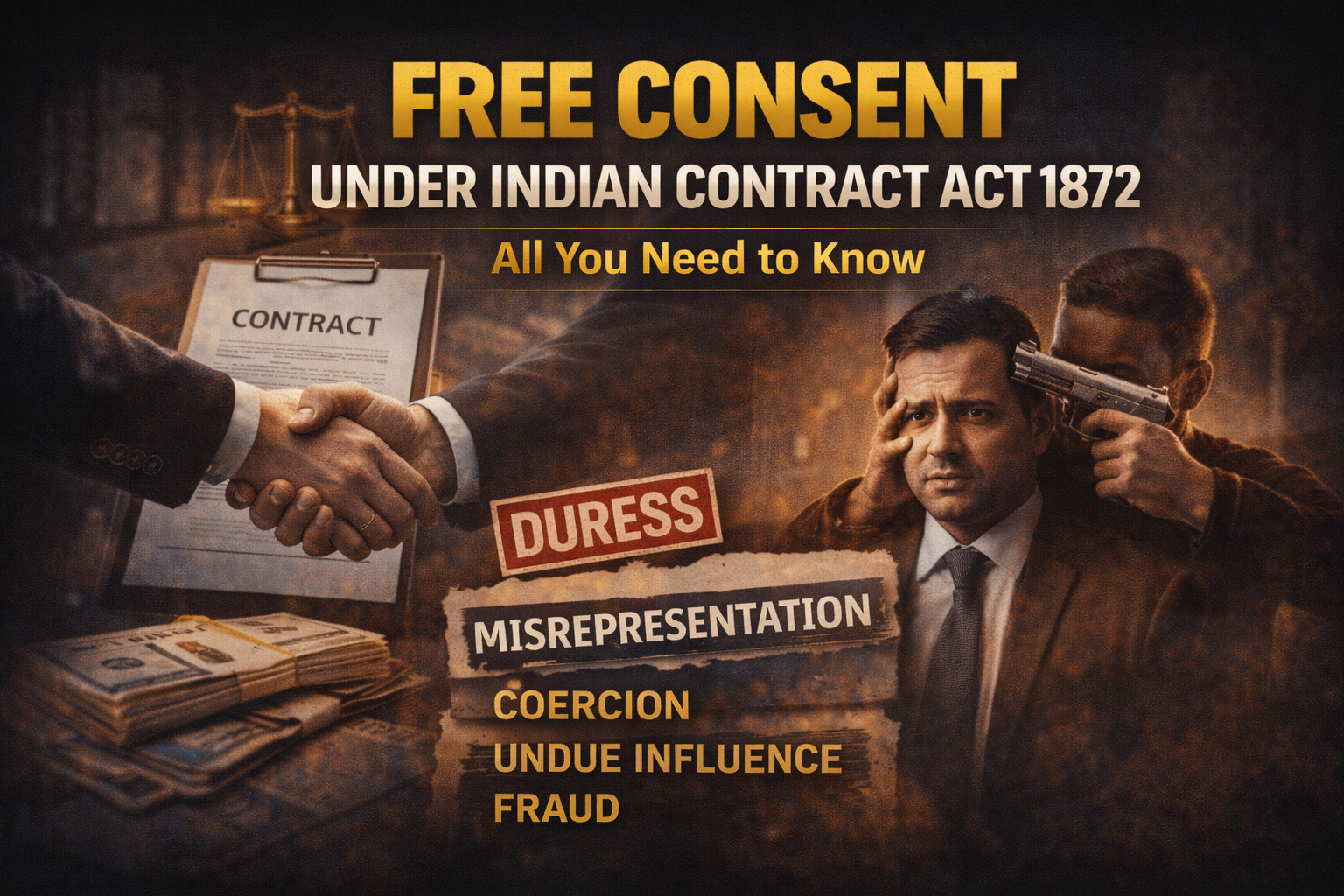
In Indian contract law free consent stands as one of the most essential element that describes whether the agreement is valid and enforceable. an contract is made with mutual agreement of two or more parties, and agreement is agreed upon their consent. Yet not all consent are legally recognized. For a legal consent to be valid, it should be voluntarily, freely and with clear understanding of terms of contract. Free consent assures that the contract made between both the parties are free from deception, fear or understanding. If any person agrees to the contract conditions under pressure or undue influence, the law considers it to be defective. In such cases the Party is free to cancel the contract anytime, as it is not binding. The concept of fairness and justice in contractual relationship is closely connected to free consent. It protects an individual or weaker parties from other party who is stronger in nature, influence who may exploit the weaker party. The law promotes trust, confidence and stability in transactional relations and in this article i have explained everythingabout Free Consent under Indian Contract act 1872.
Meaning of Free consent Free Consent under Indian Contract act
Free consent is a consent that is given voluntarily without any misunderstanding or under pressure. In simple terms Free consent is considered to be free when it is given with free mind and genuine intention.
Free consent exists when both party agree to the terms of the contract in the same sense to the same thing, and not influenced by force, threats, fraud, misrepresentations, undue influence or mistake. So free consent is just not about agreement but it is about the fair and voluntarily agreement based on honest understanding.
Free consent under The Indian Contract Act 1872
Free consent is governed under section 13 and section 14 under the Indian Contract Act 1872
Consent is defined under section 13 of the Indian contract act 1872. It states that two or more persons agree upon the same thing at the same sense
Section 14 defines consent is free. Consent is said to be free when it is not impacted by :
1. coercion
2. Undue Influence
3. Fraud
4. Misrepresentation
5. Mistake
If any of these factors affects the free consent, it is not considered to be free and the contract may become voidable or void depending upon the circumstances.
Elements affecting the free consent under Indian Contract act
1) Mistake: When an incorrect belief is made by both the parties about an essential fact of the contract, the agreement may be void due lack of meeting of minds.
2) Misrepresentation: when one party misrepresents the fact to another party which might not be true as required, and if found later it is considered as misrepresentation.
3) Coercion: The use of force or threats to make someone enter into the contract, act forbidden by law is coercion.
4) Undue influence: Undue influence occurs when one party uses its power authority over another party to enter into a contract.
some relation that describes undue influence is
• Parents with their child
• Doctor with patient
• Employer and employee.
5) Fraud: When one party makes knowingly false statement to deceive another party to enter into an contract is said to be intentional fraud.
Importance of Free consent
1. Validity of Contracts:- A contract is said to be valid based on the free consent which is essential for the contract.
2. Fair commercial dealings:- It promotes transparency, trust and honesty business transactions. thus free consent becomes the backbone.
3. Protection of weaker parties:-It safeguards weaker parties from threats force exploitation.
Legal Consequences of absence of Free consent
When an free consent is absent, the contract generally becomes void at the option of aggrieved party.
This means:
The affected party can terminate the contract.
Remedies Available
• Cancellation of contract
• Compensation or damages ( in certain cases like fraud especially)
This rule ensures fairness by giving control to the affected party.
Judicial Interpretation of the contract
Court Examines :
• The position and bargaining power of each party
• The conduct of the party
• The nature of transaction
• Evidence of Threats, pressure or deception
Based upon the given facts the court determines whether the given consent was free voluntarily given. Judicial interpretation plays an important role in protection fairness in contractual dealings.
Case Law Analysis
Courts have played an important role in explaining free consent through real life disputes. These judicial decisions help us understand how the law protects individual when their agreement is obtained unfairly.
In the leading case of Chikkam Ammiraju v. Chikkam Seshamma , a husband threatened to commit suicide unless his family members signed the property document. Court held that this situation lead to coercion because it created mental pressure on the family. The consent obtained was not free, this case clearly shows consent must be given voluntarily without any force or coercion.
Another well known decision was Derry v. Peek which helped understand the meaning of fraud in contract law. The court said that any false statement purposely made by an individual to fraud the another person or speaks the statement without believing it to be true I said to be an intentional deception and cannot be considered as valid agreement.
In the case of Central Inland Water Transport Corporation v. Brojo Nath Ganguly ,the employer forced employee to accept unfair termination clauses. The court observed that one party is pressuring another party to enter into contract, the consent of another party may not be truly free. Such contracts are declared invalid as it violates principles of justice and fairness.
These examples tell us that the concept of free concept is not theoretical but also enforced by courts to ensure fairness and honesty.
Free consent in digital age
In today’s progressive era, the concept of free consent has gained paramount importance. Many agreements today are entered via online through websites, mobile applications and electronic platforms. Users often “I agree” to the lengthy terms and conditions without fully reading and understanding properly.
This raises concern on whether the consent was given free and informed. Though the law considers clicking “I agree” as valid consent given by the consumer, deceptive subscription model, hidden clauses and unclear cancellation policies may create issues if they unfairly exploit consumers.
Digital service providers, online platforms, marketplaces must ensure that their terms and conditions are clearly presented, and are transparent and honest. Also using simple language, displaying payment terms and providing transparent policies help assure that users give free and genuine consent rather than only mechanical acceptance.
Therefore the doctrine of free consent continuous to evolve along with the technology and remains as an essential element for consumer rights in modern economy.
Free Consent and Consumer Protection
The principle of free consent is closely related to consumer protection in todays market. In the current world every individual indulges into contracts in to their day to day life while purchasing goods, subscribing to online services, booking, travel or accepting financial products. In many such scenarios consumer do not get equal bargaining power when compared to large corporations. Thus ensuring that the consent is free becomes very important.
Business sometimes uses complicated legal language, hidden charges or misleading advertisements that may put an impact on consumers decision making. If a person gives consent based on believing the false statements, the consent may not be considered truly informed. Consumer protection and regulatory authorities seek to prevent such unfair practices by keeping transparency, honest disclosure and clear contractual terms.
Practical Significance of free consent
Free consent is substantially connected in day to day life.
1. Consumer transaction: Buyers should not be misguided by false advertisements or deceptive practices.
2. Employment contracts: Employees must accede without coercion or exploitation.
3. Business agreements: Negotiations must be fair and clear.
Conclusion
Free consent is one the fundamentals of contract law, which ensures agreement are fair and are voluntarily. As per Indian Contract act 1872 consent must be free from these 5 elements that is coercion, fraud, misrepresentation, mistake, or undue influence.
If free consent is absent, the contract becomes void at the option of the affected party.
By protecting ones right, it avoids unfair practices; the principle of free consent promotes honesty, fairness, justice and stability in contractual relations.
About Author
Samiksha Chinchole, a final-year BA LL.B. student at Dr. D Y Patil Law college Pune, is an aspiring legal writer, having a keen interest in Corporate Law, Contract Drafting, and Legal Compliance. Samiksha is passionate about legal research and explores contemporary legal developments through writing, with a focus on practical and evolving regulatory frameworks.
https://brainkulo.org/blog/free-consent-in-contracts-understanding
Frequently Asked Questions (FAQ)
1) What is free consent in contract law?
Free consent means consent which is given voluntarily without coercion, undue influence, mistake, fraud or misrepresentation.
2) Why is free consent important?
It ensures contracts are valid, fair, and also based on genuine agreement.
3) What happens if free consent is absent?
The agreement becomes void at the option of aggrieved party.
4) Is free consent compulsory for every contract?
Yes free consent is mandatory for every contract to be legally valid.