

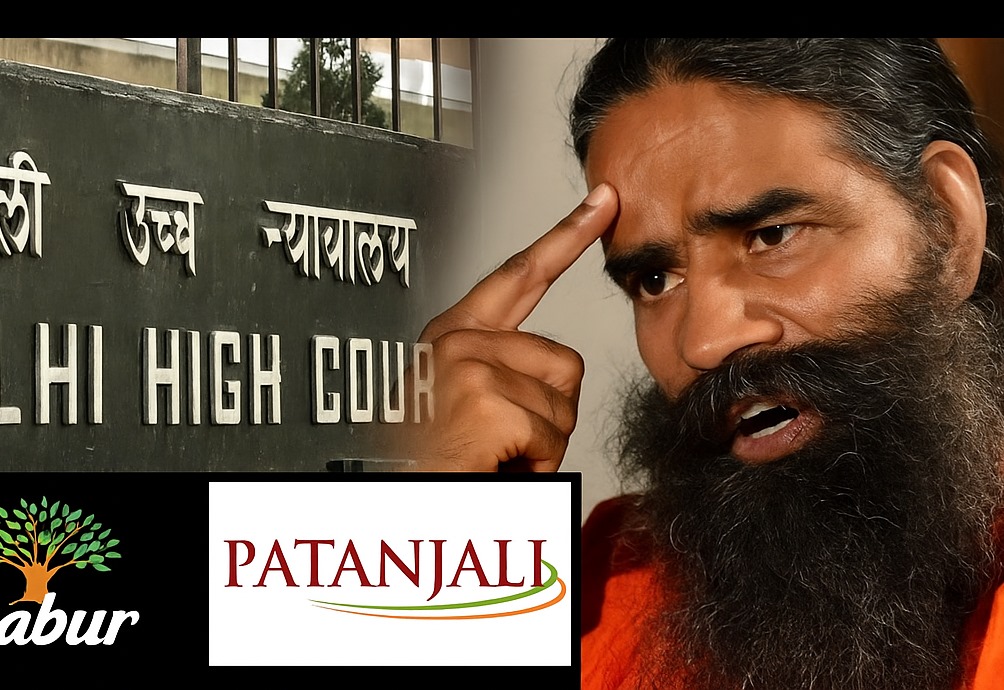
“In a new twist in the ongoing corporate tussle between two Ayurvedic giants, the Delhi High Court has pulled up Patanjali Ayurved for allegedly running a misleading advertisement that discredits rival brand Dabur’s Chyawanprash. The Court expressed serious concern over Patanjali’s claims that implied its product was “pure” while others in the market, particularly Dabur’s, were not.”
New Delhi: The long-running rivalry between two FMCG giants, Patanjali and Dabur, has landed back in the Delhi High Court, this time over Patanjali’s latest advertisement for its ‘Special Chyawanprash’. The core issue? The repeated use of the Hindi word “dhoka”—meaning fraud or deception—to describe competing Chyawanprash products.
The Court, led by Justice Tejas Karia, did not mince words while hearing Dabur India’s plea, which seeks an immediate stop (interim injunction) to the Patanjali commercial. The judge sharply questioned Patanjali’s counsel on the legality of such a strong term.
“How can you call all other chyawanprash ‘dhoka’? You can say inferior, but you can’t call them fraud. Is there no other word available in the dictionary…?” the court observed.
The Case That Stirred the Pot
The controversy began when Dabur India Ltd. The Consumer Protection Act and Trade Marks Act filed a complaint against Patanjali for misleading advertising and unfair trade practices. Dabur argued that the advertising had not only insulted its brand but also misled consumers and claimed that other Chyawanprash brands had “chemicals” and were dangerous for everyday consumption. After reviewing the advertisement and Dabur’s plea, the High Court questioned Patanjali’s marketing policy stating that comparative advertising can not cross the border into defamation or misrepresentation.
Court’s Strong Remarks
The Bench, while issuing notice to Patanjali, reportedly remarked that “truthful comparison is allowed, but one cannot call the competitor’s product inferior or harmful without evidence.”
The Court further noted that Patanjali’s recent pattern of provocative advertising—already under scrutiny after its misleading claims about curing diseases—shows a “concerning trend of commercial sensationalism” in the Ayurvedic sector.
What Dabur Said
Dabur’s counsel argued that such advertisements “deceive consumers and tarnish decades of brand trust”, stressing that their Chyawanprash follows Ayurvedic formulations approved by regulatory authorities. The counsel also sought interim relief to restrain Patanjali from airing the advertisement further until the matter is adjudicated.
Patanjali’s Defense
The other side, Patanjali had defended the campaign as a “comparative awareness advertisement” stating that it aimed to educate consumers about the difference between “natural” and “chemical-laden” products. But the company told the company it never meant to name it Dabur, but meant to tell the story of “purity of its own product”. “Hobutthe Bench seemed agnostic, suggesting that indirect disparagement is equally problematic if it creates negative impression of competitors.
The Bigger Picture:
Ayurveda and Advertising Ethics This case raises bigger questions about advertising ethics in India’s growing Ayurvedic and FMCG sectors. As health products are undergoing increased consumer scrutiny, the Court’s intervention might help to make broader distinctions in comparative marketing – between competition and consumer protection. The court ruling could become a landmark for the way brands make “purity” or “natural” claims without breaking into a false illusion.
What’s Next
The Court has redirected Patanjali to send its response to its advertisement and to produce the evidence to support the claims in its advertisement. Further analyses will be made of whether such advertisements constitute unfair trade practice or defamation.
“ As a result, dabur and patanjali continue to be seen as the dominant heavyweights – both of them being under legal and moral pressure to conceive truth in advertisement .”
ABOUT:
Swapnil Mishra is a student at The Legal School and a law graduate of LNCT University in Bhopal. studies corporate and commercial law with a strong interest. Through his writing, he hopes to simplify, make practical, and make difficult legal concepts understandable. has experience in paralegal work, contract preparation, and legal research.