

Introduction
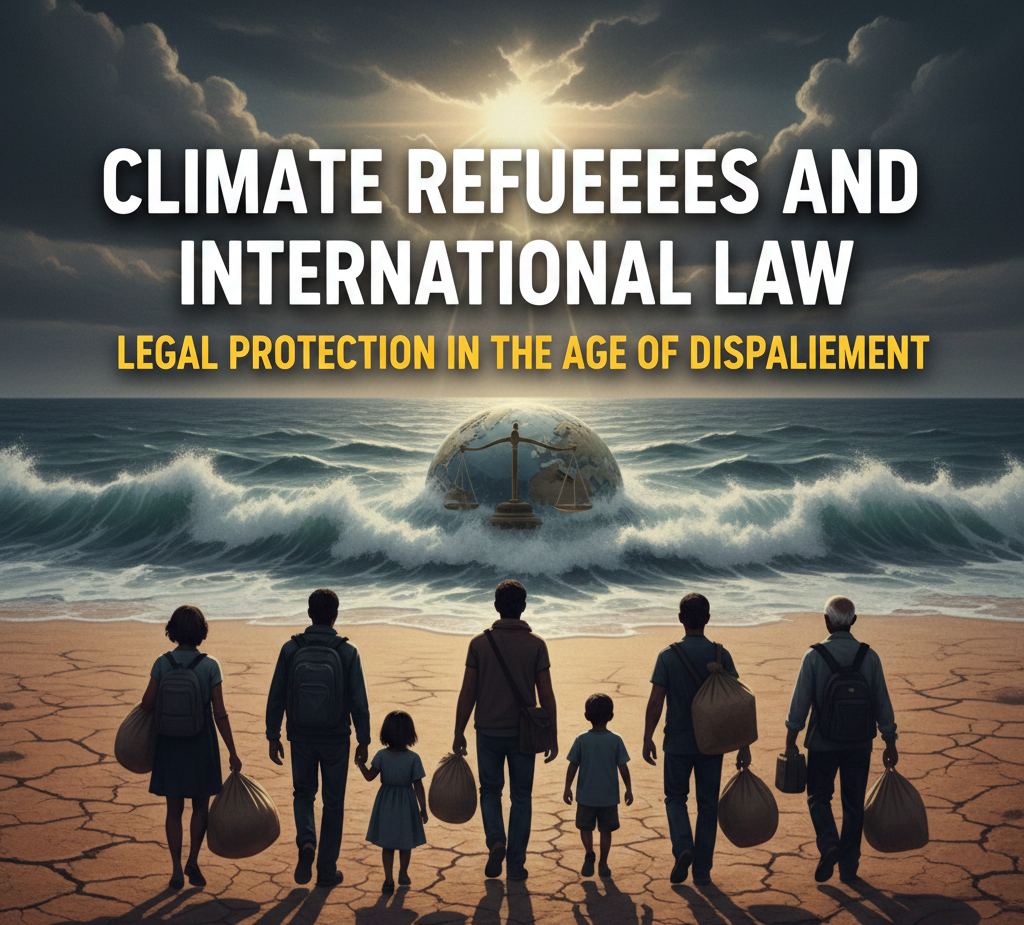
Climate refugees and international law are the fastest-growing debates in today’s legal era. Millions of people are displaced from their own place because of floods, rises in sea levels, storms, and prolonged droughts.
The reason for climate refugees began because of floods, rising sea levels, thunderstorms, uncontrolled water, and uncertain rain, as these are the reasons for displacing millions of people from their home countries and, in some areas, because of droughts. However, international law still has no law made by any country for the protection of such people, and they unwillingly have to leave their place. And in the 1951 Refugee Convention, there’s no specific clause for what we call climate refugee, I mean but this act is an energy to be granted rights of people who have suffered because of changes related to the alteration of climate that facilitates having displaced any country’s citizens. By the latest stats of 2024, more than 83.4 million people were evacuated due to flood, earthquake and windstorms. Climate change is not only an environmental issue; it affects human rights.
It is not just a climate thing, it is the human rights crisis, because people have no other option but to leave everything behind them and move to other countries, and they are treated as refugees, and they have to seek asylum for that. Climate change has played a very significant role in the environment, as it affects the human rights infrastructure but also food insecurity due to the farmable land being flooded, economic loss, and others, depending on the disasters. In the Mozambique cyclone in 2019, 1.85 million people were displaced as over 240,000 houses, around 30% of road network and other critical infrastructure including hospitals and telecommunications was destroyed. Communities like low-lying island nations, densely populated deltas and desert areas are disproportionately affected by the most powerful driver of climate change-induced migration worldwide.
In 2022 alone, because of climate, over 32 million people have been displaced, and as per studies, by 2050, this number could rise by 1.2 billion, and international law is failing these people to get them their rights. And As per the internal research displacement data of 2024 is 38 billion people around the world. It is increasing every season. Also, as per 2025 data, there were 42.5 million refugees globally, the most recent reporting data. As this has become a serious issue for the people who live on the island or near to it. However, these displaced people were not recognized or protected by any international law. The convention related to the refugee law of 1951 does not address or give any light to these people displaced by the environment.
Refugees have not always been defined in the way they are today. They also were not always protected under international law. The 1951 Refugee Convention, a significant piece of international law, was drafted in Geneva, Switzerland, in response to the growing global refugee crisis after World War II. Aiming to establish a legal framework for the protection of individuals who were displaced across international borders, the Convention was ratified by 146 states. Its creation was a crucial step in acknowledging the international community’s duty to refugees and laid the groundwork for subsequent legal and policy developments in refugee protection.
Climate refugees are those who are afraid of being persecuted for the reason of race, religion, nationality, political opinion, and membership in a particular social group or those who have more than one nationality and the country does not protect such people. Also, “climate refugees” defines such people who are being displaced for the reason of floods, storms, rising sea levels, and droughts. As defined under the International Organization for Migration (IOM), environmental migrants refer to those who are compelled to leave their home country due to the sudden change in environment that affects human lives adversely.
The United Nations High Commissioner for Refugees (UNHCR) safeguards their rights and provides them those rights for the longer term to help find employment so that they can protect themselves and do not see them as climate refugees. Many of them migrate across borders or are internally displaced in order to survive, further complicating their legal classification.
Why international law struggles to protect climate refugees
Most climate harms are caused by the environment. According to UNHCR, some Palestinian refugees in Gaza have been internally displaced: 1.2 million people in 2023 and 1.4 million in 2024. During the Sudan crises, the world’s largest displacement was made with a total of 14.3 million people in 2024. The existing 1951 convention and its protocol have been proven inadequate when we talk about addressing the modern patterns of displacement. The persecution-based definition of refugee ignores the reality of people displaced by severe drought, rising temperatures, or hurricanes. Human rights treaties that safeguard rights like life, housing, and health—all of which are affected by climate change—include the International Covenant on Civil and Political Rights (ICCPR) and the International Covenant on Economic, Social, and Cultural Rights (ICESCR).However, in the context of climate displacement, these instruments are not directly enforceable.
While they offer suggestions, soft law documents like the Sendai Framework for Disaster Risk Reduction and the UN Guiding Principles on Internal Displacement are not legally binding.
Heard by the UN Human Rights Committee Ioane Teitiota v. New Zealand was a landmark case. Teitiota, a citizen of Kiribati, had argued that his life was at risk due to rising sea levels under the non-refoulement provisions of the ICCPR. The committee declined to accept his claim for asylum, but recognized that extreme environmental degradation would trigger a nonrefoulement obligation.
While conflict can result in mass movements due to violence and instability, climate change can cause unpredictable disasters that force millions of people to flee their homes. Conflict change can cause immediate displacement. During the cross-border, human rights are infringed, violations happened with the refugees, trafficking and assault of women and children, death, torture, and abuse of human rights while crossing the border.
Existing frameworks & soft-law responses
The Platform on Disaster Displacement of PDD is a state-led initiative to address the challenges of displacement caused by disasters and climate change.The PDD was established to implement the Nansen Initiative, and its main objective is to protect people who have been impacted by climate change as well as those who travel across international borders. Since the start, UNHCR has provided the most assistance; its primary goals are to create new policies and assist those in need.
A key working principle is strategic engagement with existing coordination mechanisms and strong partnerships between states (policymakers and practitioners), international organizations, civil society representatives, and researchers in order to work towards collective outcomes.
The PDD works closely with IOM and UNHCR, who are both standing invitees to its Steering Group as well as Advisory Committee members and key partners regarding the implementation of the PDD Strategy and Workplan, in particular regarding the coordination and promotion of policy work globally and supporting initiatives at the regional and national level.
GCM is the first intergovernmental organization that supports the migrants. It was accepted at an intergovernmental conference on migration in Marrakech, Morocco, on December 10, 2018.
This policy supports immigrants regardless of their status. Addressing and reducing vulnerabilities and human rights violations in the context of migration; ensuring migrants’ rights to information and to a legal identity, safeguarding the freedom and right to liberty from arbitrary detention, including by giving preference to alternatives to immigration detention.
The fact that there will be more than 120 million displaced people worldwide by May 2024 is a clear indication of the need for modern legal frameworks and international collaboration. Marred by conflict, persecution and more frequently climate reasons, this historic displacement requires a redefinition of existing that is generally awarded to refugees. In the meantime, although it did not find a violation, the case of Ioane Teitiota v. New Zealand set an important precedent regarding the forcible removal of persons to climate-threatened countries. But such protection against expulsion is not enough.The 1951 Refugee Convention does not address those who are displaced due to climate change and is primarily focused on persecution-based displacement. The 2022 floods in Pakistan, which forced millions of people to flee their homes, serve as a stark reminder of the severe effects of climate change. While some nations have taken action to assist those impacted by climate change, a global solution is imperative. We should expand the definition of “refugee” to include these climate migrants in order to fairly and effectively assist those who are compelled to relocate due to climate-related issues. This necessitates a global effort that is cohesive and progressive. Rising sea levels are posing a major threat to the low-lying islands of Kiribati in the central Pacific Ocean.
The nation’s economy, culture, and land are at risk due to this issue, which is linked to global climate change. As the sea gets closer, it erodes coastlines, mixes freshwater and saltwater, and makes coastal flooding worse. Farming suffers, people are compelled to relocate, and expensive adaptations are required.
The potential for Kiribati to sink emphasizes how crucial it is for nations to cooperate in order to lower greenhouse gas emissions and assist at-risk island nations. The circumstances in Kiribati serve as a reminder of the significant expenses small island nations bear as a result of the continuous problems caused by climate change.
Regions and states address climate refugees and international law
Pacific Island: The nation of Kiribati faces serious threats from rising sea levels. Because of such issues, they acquire land in Fiji. However, under refugee law, it still does not give recognition or protection under this law.
Australia: Regional organizations have played a very significant role in developing regional responses to critical issues.
New Zealand’s cooperation development helps in protecting fisheries through making the fisheries Pacific communities. And making the Pacific Island fisheries forums. These platforms have been made to promote cooperation.
Temporary protected status (TPS)
TPS plays a very vital humanitarian role in U.S. immigration law; it is made to protect people from such tragedies and give shelter to the needy, as it also provides legal work to live their life and fulfill their potential, as returning back to their home is unsafe. This has been made for all people across the world.
Humanitarian visas, planned relocation agreements, adaptation finance with migration components:
Humanitarian visas play a crucial role in helping the climate refugees who got displaced. These visas help for relocating wherever they want to relocate as per their needs, and those have genuine reasons why they may apply for seeking help and apply for asylum. Planned relocation of people is important because if they are facing problems in adapting to the climate, these pathways are provided for the safer side and for sustainable relocation.
Adaptation finance with migration is for those who lost all their valuable things during the climate hit, and these are in the form of remittances, as gifts to get their lives settled again. The integration of migration into national adaptation plans is vital to making sure to give all the needy ones who get affected by climate change and the communities a way to get in a changing environment.
Conclusion
Environmental refugees emerging as one of the casualties of environmental degradation comprise a new category of displaced people, conspicuous by its absence from international funded law. They are in a particularly vulnerable position because of their socio-economic disempowerment, and there far is no single worldwide legal system to cater for them. The moral, legal and compassionate arguments for acknowledging climate refugees are strong. And as we continue our journey through the twenty-first century, the international community should take a serious look at, update and strengthen refugee protection systems to meet the needs of this new generation. Failure to do so represents a significant lacuna in the international community’s commitment to human rights and global stability.
About Author
Komal Singh, law graduate, has a strong interest in international law, immigration law, property law, human rights, and matters pertaining to the safety of women and children. Through writing and research, I am actively participating in current legal developments, legal research and dedication to expanding knowledge and promoting justice in these domains.
References:
1Global Report on Internal Displacement 2023 (May 2023), Internal Displacement Monitoring Center, https://www.internal-displacement.org.
2.Migration, Climate Change, and the Environment, International Organization for Migration (IOM), https://www.iom.int.
3.UNHCR, “Climate Change and Disaster Displacement,” UNHCR (2023), https://www.unhcr.org/climate-change.