

Introduction
In recent landmark judgment by the Delhi High Court, ruled that the “attendance rule” cannot be used as a ground to deny law students right to appear for examinations. The Court made it clear that no law student enrolled in any recognized law college or university can be barred from writing exams solely because of a shortfall in attendance.
The Delhi High Court, while examining the impact of the “attendance rule” on students’ academic progression and mental well-being, held that education must be flexible and humane. The Court observed that legal education needs more than classroom attendance. It involves moots, research, internships, court visits, and experiential learning. Hence, the “attendance rule”, if applied rigidly, fails to capture the true nature of learning in law schools.
The Court directed the Bar Council of India (BCI) to review the existing “attendance rule” for both three-year and five-year LL.B. programmes and make it more student-centric. Until the BCI completes this exercise, all law institutions across India have been instructed not to enforce the “attendance rule” in a way that prevents students from appearing in examinations. Institutions may deduct limited marks or grades to account for absenteeism but cannot withhold exam permissions or results solely based on attendance shortages.
Students are suffering from anxiety, depression, and academic pressure because of the ‘attendance rule’. The bench emphasised that the objective of the “attendance rule” should be to encourage participation, not to bar them from giving examinations. The judgment is a progressive step towards reforming legal education in India. It ensures that the “attendance rule” should be used in the good faith of students and not to bar them from educational opportunities.
Background
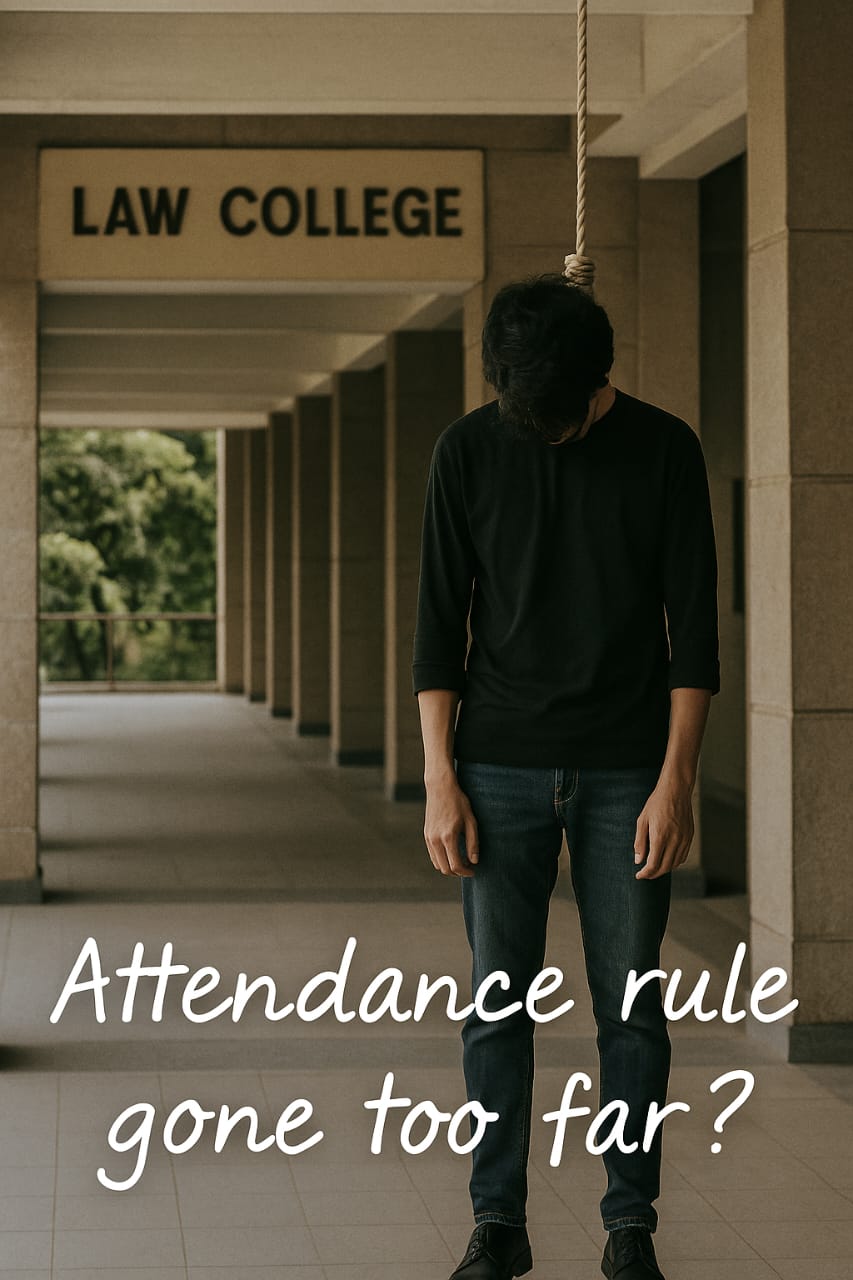
The case has its roots in the heartbreaking story of Sushant Rohilla, a third-year student of Amity Law School, Delhi. He died by suicide in August 2016 because he was barred from appearing in exams due to low attendance. His death sparked outrage across campuses.The Supreme Court of India has taken up the matter suo motu. The case was later transferred to the Delhi High Court in 2017 for further examination.
The Delhi High Court looked into the matter and observed the enforcement of “attendance rule” in law colleges. It also examined the psychological impact it has on students. It noted that ‘attendance rule’ is necessary to maintain discipline in law colleges, but the rigid application of the “attendance rule” may lead to unnecessary academic stress among students which may cause fatal results. The Court observed that law students need a multi-dimensional approach, including internships, moot courts, seminars, and practical training apart from the classroom attendance.
The Delhi High Court also criticised law colleges for going beyond the Bar Council of India’s “attendance rule”, imposing stricter conditions and detaining students who fall short by even a few percentage points. The bench clarified that no institution is allowed to impose an “attendance rule” stricter than what the BCI prescribes under its Legal Education Rules, 2008.
In its detailed directions, the Court laid down new measures to ensure that the “attendance rule” is implemented transparently and fairly:
- All law colleges must upload weekly attendance records on their websites or mobile applications.
- Monthly alerts must be sent to parents or guardians when students fall short of attendance requirements.
- Institutions should conduct remedial or extra classes to help students make up for attendance shortages rather than penalising them.
The Delhi High Court further instructed the University Grants Commission (UGC) to review its grievance redressal system and take protective measures for students’ mental health and the stress caused by the rigid “attendance rule.” The High court acknowledges that the “attendance rule”, was originally designed to promote discipline but it is now becoming a barrier to learning or a reason to deny a student’s future.
How the Case Reached the Delhi High Court
Against university officials the Sushant’s family lodged a police complaint for abetment to suicide, the consequent police investigation filed a closure report in October 2024, citing a lack of evidence, a magistrate accepted this finding, effectively ending the criminal case.
But the family fought on. They approached the Delhi High Court, asking it to reopen the investigation. The court took the matter seriously. On its own (called a “Suo motu” action), it turned the case into a broader review of attendance policies in law colleges. This was in response to a petition titled Courts on Its Own Motion in Re: Suicide Committed by Sushant Rohilla, Law Student of I.P. University.
The bench, made up of Justice Prathiba M. Singh and Justice Amit Sharma, heard arguments from lawyers, educators, and experts. They looked at rules from the Bar Council of India (BCI), which oversees legal education. The hearings, which dragged on for years, encompassed testimony from witnesses describing how other students faced similar pressures due to the BCI’s mandatory 75% attendance rule. Thus testimony, along with input from mental health experts on how such stress can cause anxiety and depression, led the court, in august 2024, to suggest forming a committee to rethink attendance norms across all higher education. The court finally delivered its final erode in November 2025 through a detailed 122-page judgement.
Key points of Delhi High Court judgement –
The court’s ruling is a game-changer. Written in clear, compassionate language, it puts student well-being first. Here are the simply explained takeaways;
- No Banning from Exams for Low Attendance: The biggest change is this—no law college can stop a student from taking exams just because they missed too many classes. The court called barring students an “extreme and unacceptable measure.” Instead, colleges must look for ways to help, like extra classes, online sessions, or condoning (forgiving) some shortages for valid reasons.
- Attendance Rules Should Not Cause Harm: The judges said attendance norms “cannot be so stringent that they lead to mental trauma, let alone the death of a student.” They stressed that education today isn’t just about sitting in classrooms. Rules must adapt the online learning, internships and real-life experiences, etc. learning ways.
- Reconsideration Mandatory Attendance Crosswise Courses: The ruling goes beyond law schools. It asks for a fresh look at attendance requirements in all undergraduate and postgraduate programs. The court wants institutions to balance discipline with empathy. For example, colleges should consider health issues, family emergencies, or even participation in moot courts (mock trials) as part of “attendance.”
- Directions to the Bar Council of India (BCI): The BCI must revise its guidelines within six months. The new rules should include steps to support students’ mental health. The court mandates that colleges must establish counselling centers and grievance systems. Furthermore, it specially ordered IP University to allow Sushant’s batchmates and other affected students to complete their exams without being penalized for attendance.
- A Broader Call for Change: The judgment quotes famous educators and psychologists. It reminds everyone that “the purpose of education is to nurture, not to punish.” It even links this to India’s constitutional right to education under Article 21, which includes the right to live with dignity.
In short, the court didn’t just rule on one case. The central message conveyed was that policies must serve to protect lives, rather than posing a threat to them.
Few questions naturally arise from the judgment of Delhi high court on Attendance norms on November 2025 that Judgment affect the institutional autonomy, does right to appear in examinations now part of the right to education (Article 21A or Article 21), regulatory still mandate strict attendance after this decision, will this judgment affect the other professional courses and many other Questions?
KEY OBSERVATIONS OF THE COURT
The ruling passed by the Justice Pratibha M. Singh and Justice Amit Sharma, is progressive and necessary reform that prioritize the student wellbeing and modern education philosophy over rigid and outdated rules as these rules cause extreme mental stress, fear and anxiety. The judgment states that “Attendance norms cannot be so stringent as to cause mental trauma, let alone the death of a student”. The student often face genuine difficulties like financial distress, family responsibilities and part time work. The institution right to enforce minimum standard of participation to ensure students are adequately prepared and the quality of degree is maintained. This ruling attempts to balance by shifting penalty from exclusion to grade reduction by the effectiveness of this moderate penalty in ensuring discipline remains the central point to contention.
ATTENDANCE RULE AS PARTICIPATION NOT PUNISHMENT
The Delhi High Court ruling on Attendance Rule marked a transformative relationship between student welfare, Education and Policy Makers. By holding an important decision that “NO STUDENT SHALL BE BARRED FROM EXAMINATION MERELY ON THE GROUND OF ATTENDANCE SHORTAGE”. The decision states that education is not confined to physical presence, it involves overall academic participation, digital learning and intellectual participation. In this Court not only addressed the tragic consequences of such issues but also reaffirmed the constitutional values of fairness and right to education under Article 21. This Judgment marks as a victory for the students, ensuring that attendance rules serves as an education not punishment, So that it don’t affect the student’s mental health and maintains the flexibility.
The judgment not abolish attendance rule entirely it only states that students cannot be punished for short attendance and educational institutions should provide remedial support and ensure fairness. The Court ordered institutions for weekly attendance updates on online portal, inform guardians for shortage of attendance and offer remedial support. These rules should be more flexible and transparent for future. The students will not lose the semester or year due to short attendance.
CONCLUSION
However it also leaves education on the institutional autonomy, does right to appear in examinations now part of the right to education (Article 21A or Article 21), regulatory still mandate strict attendance after this decision, will this judgment affect the other professional courses and Institutions. Its long term impact on how the Bar Council of India and Education regulators transform the norms to reflect the new flexible vision.
So, this judgment shifts the focus from mere attendance to meaningful learning, reminding educational intuitions that “discipline must never overshadow compassion” and academic regulations must serve students growth.
About Author:
Ruchi Dalmia, LL.M. in Corporate Law and is building her career in the corporate legal field. She possesses strong skills in contract drafting, paralegal work, and legal research. Passionate about Corporate and Commercial Laws, she enjoys exploring how legal principles operate within real-world business contexts. She strives to make complex legal topics clear, practical, and accessible for readers.
Adv. Pallavi Sharma, Delhi based Advocate, who is a legal practitioner and researcher with a growing interest in cyber law, IPR, constitutional law, and women’s and child rights. She recently started to contribute through analytical writing and awareness initiatives on contemporary legal issues.
Adv. Nishu Lamba, a law graduate and a growing legal writer. I am building my career as a corporate lawyer with my skills in contract drafting and legal research. Through my writing, I aim to make legal topics clear and easy to understand for readers.