

Introduction
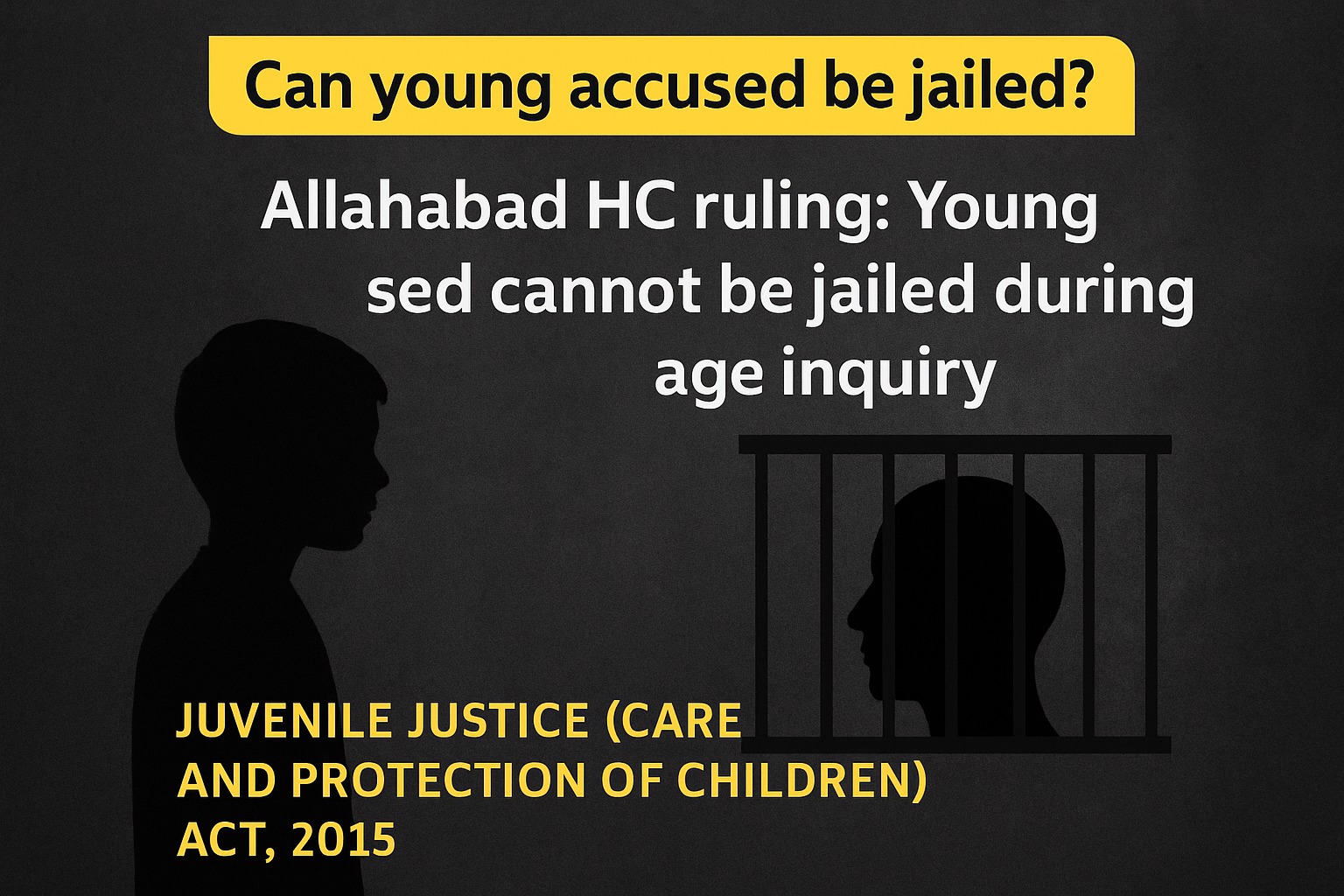
In a landmark judgment, the Allahabad High Court has ruled that a person who claims to have been a minor at the time of the offence cannot be lodged in jail or police lock-up while an inquiry is on to determine their age under the ‘Juvenile Justice Act, 2015’. The Court clarified that under section 10 of the Act, a “child in conflict with law or alleged to be so” may not be placed in conventional custody until they complete 21 years of age, unless very specific conditions are met.
Factual Background
The case arose when the petitioner, arrested in connection with a serious offence, claimed that he was born on 13 December 2002. According to his school’s principal, he was 14 years, 3 months and 19 days old at the date of the alleged offence. Following this, the case was referred to a Juvenile Justice Board which held him to be a minor at that time. Despite that, he remained in prison from 2017 onward.
The Court’s Key Legal Findings
The Court held that the provisions of the Juvenile Justice Act override other laws when dealing with persons claiming minority rights. In particular,
- Section 9(2)(4) of the Act requires that when a claim of juvenility is made before a court, it must be inquired into.
- Section 10(1) provides that a “child in conflict with law” cannot be situated in a jail or lock-up even during the age-determination process.
- The Court stated that until the inquiry is complete and final decision taken, the accused must be placed in a “place of safety” rather than conventional prison.
The bench emphasised that mechanical transfers of a juvenile accused into jail without following the juvenile law’s procedure infringe the fundamental right to life and liberty (Article 21).
Implications of the Ruling
This judgment carries major implications for the handling of young offenders:
- Any person claiming minority status before a court must not be treated like an adult in custody until the claim is determined.
- Detention beyond 21 years of age, while the person still has a claim pending under the Act, would be unlawful.
- Trial courts, Juvenile Boards and counsel must strictly adhere to the procedural safeguards laid down by the Juvenile Justice Act.
Balancing Justice & Protection
While it may seem that the judicial process is made more complex, the Court underscored that the objective is to protect minors from the harshness of the criminal-justice system. Even in serious offences, if the accused was below 18 at the time of the offence, the juvenile law’s safeguards must apply, including limitation of detention periods and requirement of “place of safety”.
Conclusion
The Allahabad High Court’s decision reaffirms the legal principle that once a minority claim is lodged, the offender is to be treated under the ‘juvenile regime’ until proper inquiry is conducted under the Juvenile Justice Act. This ensures that the rights of young persons in conflict with law are protected and lawful custodial treatment maintained. The judgment sends a clear message: procedure matters, age-inquiry cannot be bypassed, and detention cannot continue as though a juvenile is an adult simply because time has passed.