

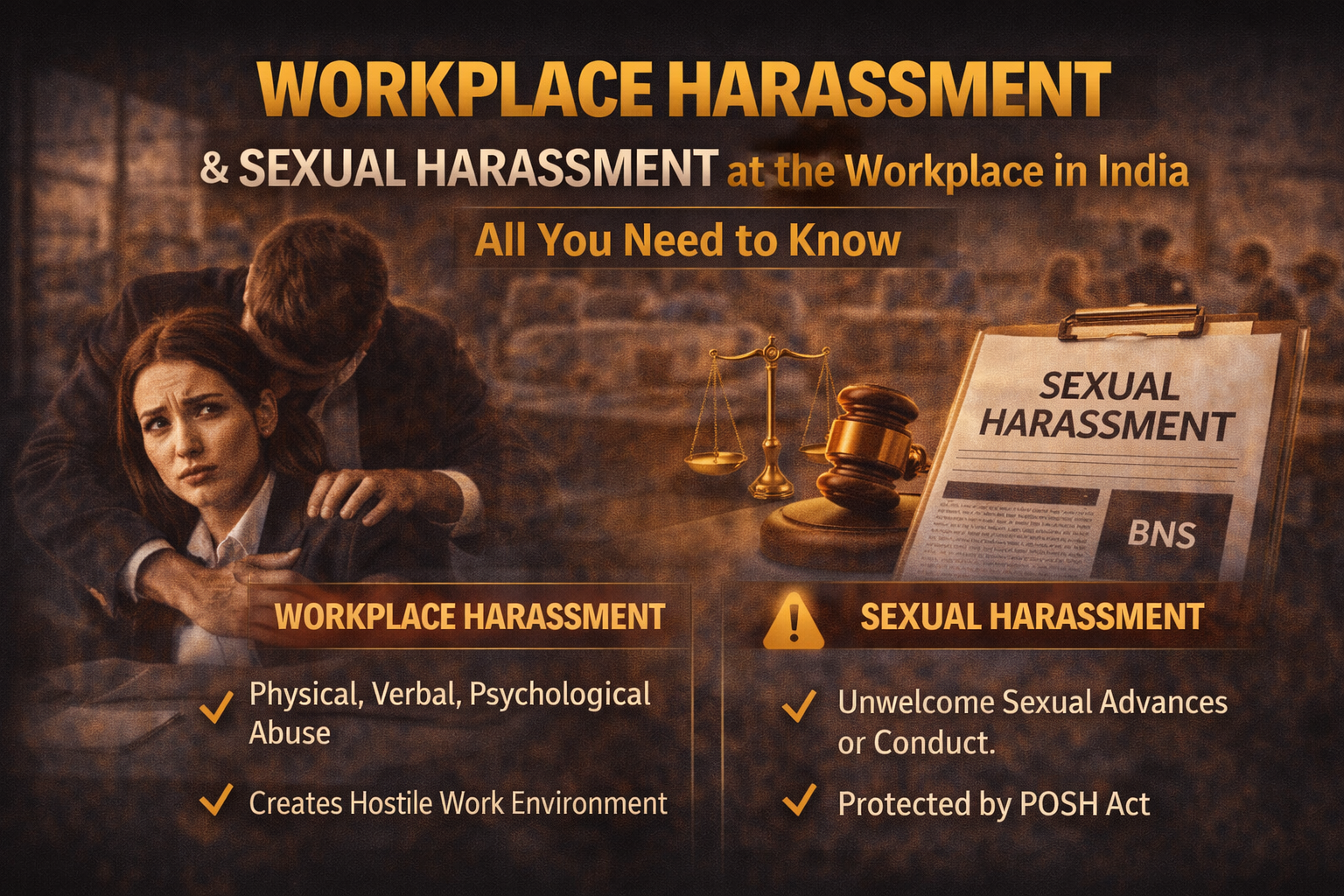
Introduction: What is Workplace Harassment in India?
There are several rising cases in India related to workplace harassment. When we delve into it, we learn that the employees are harassed based on race, gender, age, religion, and disability, which creates a negative environment for them. There are types of workplace harassment, such as sexual harassment, racial/ethnic harassment, psychological harassment, physical harassment, visual harassment, cyber harassment, and discriminatory harassment. Workplace harassment occurs when someone in the workplace harasses, alarms or distresses another person with his or her behaviour. Even though all sort of workplace harassment is strictly disregarded, sexual harassment is regarded as one of the most significant types of misconduct in the workplace, with the POSH Act being its main legal support in the form of the Sexual Harassment of Women at Workplace (Prevention, Prohibition and Redressal) Act, 2013 and in this Article I have explained everything about Workplace Harassment and Sexual Harassment.
Understanding Workplace Harassment in India
Meaning
Workplace harassment occurs when someone in the workplace harasses, alarms or distresses another person with his or her behaviour.
There are types of workplace harassment; let’s look into it
- Sexual harassment: It is an unwanted behaviour that is directed towards a gender or sex. The unwanted behaviour is of a sexual nature, such as obscene remarks, gestures, stalking, and unwelcome physical touch (Section 2(n), POSH Act, 2013). Sexual harassment can be verbal, non-verbal, and discriminatory.
- Racial/ethnic harassment: it is an incident that is intended to intimidate, harm or offend based on their ethnic origin, colour, race, religion or nationality. It may include racist jokes, banter, ridicule or taunts, racially derogatory remarks or insults.
- Psychological Harassment: A form of mistreatment in the workplace that is characterised by continuous and intentional psychological abuse. The main point is that it includes bullying, constant criticism, intimidation, isolation, verbal abuse, unreasonable demands, or spreading rumours and that it creates a toxic environment where the victim might suffer from anxiety or depression.
- Physical harassment: It is referred to as violence in the workplace and is the case when the harassment involves physical assaults or threats. It goes to the extent of listing all possible forms of unwanted physical contact or behaviour that can be considered as threatening, intimidating or causing discomfort to the employee.
- Visual harassment: It is the display of offensive pictures, videos or gestures that make someone feel uncomfortable at work, especially sexually.
- Cyber harassment: It is utilising the internet or digital devices to do the acts of bullying, threatening, stalking or embarrassing someone repetitively by sending messages, making posts, sharing emails or content.
- Discriminatory harassment: It unfairly targets you because of who you are, like your gender, caste, religion, or age, making work uncomfortable.
- Verbal harassment: This uses hurtful words, such as insults, yelling, jokes, threats, or gossip that attack or scare you, often spoken or shouted.
It negatively impacts the mental health of an Individual, causes stress, anxiety, depression and isolation, which directly impacts their work performance. Overall, it leads to burnout, weakened immunity, isolation, and career-ending productivity loss.
Types of Workplace Harassment – India
- Verbal Harassment at Workplace in India
Verbal harassment involves hurtful words, such as insults, yelling, jokes, threats, or gossip, that attack or scare you, often spoken or shouted.
Example: A manager yelling at their staff in front his/her colleagues, calling them incompetent.
- Workplace Bullying and Mental Harassment in India
In India, workplace bullying and mental harassment are significant problems that involve several kinds of abuse, such as verbal attacks, threats, social isolation, or embarrassment, and these problems have a negative impact not only on the workers’ mental and physical health but also on their productivity.
Example: A manager constantly criticising your work, or putting extra workload despite having other employees.
- Discrimination-based Workplace Harassment in India
Discrimination-based workplace harassment occurs when an employee faces unfair treatment, hostility, or abuse due to protected traits like caste, gender, religion, disability, age, or region.
Example: An employee receives lower pay than a colleague of the opposite sex who performs the same or equivalent work.
- Sexual Harassment at Workplace in India – A Major Concern
Sexual harassment is far from being “innocent fun” or “merely a joke.” It covers all manners of sexual conduct that, even if not directly by the person, create an uncomfortable, insecure, or disrespectful feeling in her/his case at the workplace.
It could be said that sexual harassment in the office is simply a matter of wrongdoing; however, it is not only a crime but also a violation of the person’s right to equal treatment, to be respected and to work in a safe environment.
Sexual Harassment at Workplace in India – Legal Meaning
Sexual harassment is not about “harmless fun” or “just a joke.” It refers to
any unwelcome behaviour of a sexual nature that makes a person feel
uncomfortable, unsafe, or disrespected at work.
POSH Act, 2013 (Sexual Harassment of Women at Workplace Act) gives statutory recognition to workplace sexual harassment as a violation of women’s right to equality and dignity, making it a punishable offence with clear procedures.
According to Section 2(n) of the POSH Act, sexual harassment consists of one or more of the following acts:
- Unwanted physical contact or advances
- Requesting sexual favours or asking for them
- Sex-related comments
- Circulating pornographic or other explicit materials
- Any form of sexual, physical, verbal or non-verbal actions that are considered unwelcome
Quid Pro Quo
Quid pro quo sexual harassment, which is a Latin term that translates to “something for something,” takes place when an authority figure (like a supervisor or a higher rank person) makes certain decisions regarding the employee such as promotions, salary increases, job security, or training opportunities only if the employee accepts, to some extent, the demands, advances, or favors of a sexual nature. Resisting the act will result in the person being threatened with negative consequences such as demotion, loss of benefits, bad reviews, or even dismissal.
Hostile Work Environment
When sexual behaviour that is not desired is repeated, an intimidating and offensive atmosphere is created, which interferes with working. There is no need for a threat of power; it is just so bad and widespread that the workplace gets poisoned.
POSH Act, 2013 – Laws Against Sexual Harassment at Workplace in India
- Objectives of the POSH Act in India
The Sexual Harassment of Women at Workplace (Prevention, Prohibition and Redressal) Act, 2013 is commonly known as the POSH Act. The POSH Act was passed in 2013 to stop, punish and provide remedies for sexual harassment of women at work. The Indian government passed a very important law. This law’s goal is to safeguard women’s rights at work.
- Stop Sexual Harassment: To prevent any unwanted behaviour or actions that make a woman feel uncomfortable at work.
- Protect Women at Work: To keep women safe and secure while working, no matter what job they do or where they work.
- Provide a Way to Complain: To set up a simple and clear system (Internal Committee) where women can report issues and get help.
- Create a Safe Workplace: To make the office or workplace free from fear and friendly for everyone.
- Make Employers Responsible: To ensure bosses and companies take steps to follow the rules and support affected employees.
- Spread Awareness: To teach all employees about what sexual harassment is and how to stop it.
- Cover All Workplaces: To apply the rules not just in offices, but also in factories, schools, shops, homes, and more.
While the Act itself is written for the protection of women, many organisations today go one step further and make their workplace policies gender-neutral, protecting men and gender-diverse persons as well. The POSH Act is therefore the minimum legal standard, and organisations are free to make their rules even more inclusive.
- Who is Protected Under the POSH Act?
The POSH Act (Sexual Harassment of Women at Workplace Act, 2013) is designed primarily for the protection of women who report sexual harassment at the workplace in India, irrespective of their age or employment status such as permanent, temporary, daily wage employees, trainees, volunteers, and interns and even visitors while prompting organizations to adopt more general, gender-neutral policies covering all. Though only women are legally defined as “aggrieved parties” under POSH, some organisations create internal codes of conduct to protect men and others of different genders as well.
- What Constitutes Sexual Harassment as per the POSH Act?
The POSH Act of 2013 gives a wide-ranging interpretation of sexual harassment in its second section (n) as any unfriendly act or behaviour—direct or indirect—consisting of physical touch, asking for sexual favours, sexually suggestive conversation, showing obscenity, or actions that belittle women’s dignity or make the workplace unfriendly/intimidating.
- Duties of Employers Under the POSH Act
The POSH Act, 2013 (Section 19) defines the obligations of the employers with regard to sexual harassment actions in a very clear manner. They are required to establish an Internal Complaints Committee (ICC) comprising a senior woman as the chairperson, in every office or branch with 10 employees or above, conducive to the gender-sensitive workplace removal of the hostile factors, and the provision of a safe environment that includes proper lighting, security, safe transport, and easy access to grievance redressal. In addition to that, the employers need to develop and distribute a memorandum of internal policy that prohibits sexual harassment and outlines the redressal process, put up notices about the ban, penalties, and ICC details in prominent places, and make the names and contacts of the ICC members available on the notice boards or intranets. Amongst the other duties, they must supply the ICC with all the necessary resources and support, freedom to investigate fairly, training of employees and active participation of ICC members in the regular trainings as well as special ones for them, providing legal support to complainants under IPC or other laws without fear of retaliation, and treating harassment as misconduct under service rules and taking appropriate disciplinary actions like warnings or termination. Lastly, the employers have to act quickly on the ICC’s reports by putting into practice the recommendations made and by passing the findings to the District Officer, who will also receive an annual compliance report outlining the complaints lodged and resolved by the end of January 31. Non-compliance could mean fines of up to ₹50,000 (which will be doubled for subsequent cases), cancellation of the license, or holding the manager responsible.
- Internal Complaints Committee (ICC): Composition & Powers
According to the POSH Act Section 4, the Internal Complaints Committee (ICC) must consist of a Presiding Officer—a woman of senior-level employee—and a minimum of two other workers (preferably those with legal or NGO backgrounds on women’s issues). Along with this, one more member from an NGO working against the harassment of women should be added in such a way that at least half of the committee comprises women. No close relatives of the accused are allowed.
The authority exercised is similar to a civil court: call witnesses/documents, take evidence, maintain confidentiality, and complete inquiries within 90 days. They can impose disciplinary actions such as giving warnings, changing postings, suspending, firing, or even reclaiming the amount paid as compensation from the harasser’s salary—the employer has to implement the action immediately.
Complaint Process for Workplace Harassment in India
- Where and How to File a Complaint?
An aggrieved employee may file a written complaint of sexual harassment to the ICC or the LCC within three months from the date of the incident (extendable by another three months if justified). The ICC/LCC must then send a copy of the complaint to the respondent within seven days and require a reply within ten days. Before initiating an inquiry, the ICC/LCC may, at the request of the aggrieved woman, attempt conciliation between the parties (without
monetary settlement as a basis). If conciliation is not opted for or fails, the ICC/LCC must proceed to conduct an inquiry in accordance with the principles of natural justice.
- Written Complaint Requirements
Must detail: your name/address/contact, the accused’s name/designation, incident description (date, time, place), witnesses, and any prior complaints. Attach evidence. Keep it factual, under 500 words if possible. ICC helps if you can’t write it yourself.
- ICC Inquiry Procedure
Day 1-7: ICC gets a complaint, sends a copy to the accused (30-day response time), and conciliates if you want (no force).
Inquiry: Hears both sides like a mini-court—summons witnesses/docs, visits site if needed, finishes in 90 days max. Confidential; no legal aid needed.
Report: To the employer in 10 days with findings/recommendations. Employer acts within 60 days. Appeal within 90 days if you wish to reopen the case.
- Possible Compensation & Penalties
Compensation: Deducted from harasser’s salary—covers medical costs, lost income, emotional distress (no fixed amount, case-based).
Penalties: Warning to termination for misconduct. Employer non-compliance: ₹50,000 fine (double for repeat), license cancellation. Criminal link? IPC charges alongside.
Criminal Liability in Cases of Sexual Harassment at the Workplace
The POSH Act is a redressal mechanism that has been put in place at the workplace, and that deals with sexual harassment complaints through the Internal Complaints Committee (ICC)/Local Complaints Committee (LC). It mainly concerns the inquiry, remedies, and prevention. The sections of the Indian Penal Code (IPC) offer the route for criminal prosecution with police action, where the punishment could be either imprisonment or fines, and the complaint can be filed either together or separately.
Compensation & Penalties: The victim receives compensation deducted from his/her salary for medical/loss/distress. The harasser will face disciplinary action in the workplace (firing/warning). Criminal escalation will be as follows:
IPC 354A: Sexual harassment (demand for favours, sexually colored talk)— maximum of 3 years’ imprisonment + fine.
IPC 354D: Stalking (following/monitoring)—maximum of 3 years’ imprisonment + fine.
IPC 509: Insulting a woman’s modesty (words/gestures)—1-3 years simple/cog imprisonment + fine.
Challenges in Enforcing Workplace Harassment Laws in India
- Victim Fear & Job Insecurity
Victims remain silent most of the time because they are afraid of retaliation using various means such as demotion, transfer, isolation, or even dismissal after they have made a complaint, so that the POSH protection will not apply to them. Many of them, unfortunately, choose to quit their jobs and end up losing their income in the process.
- Lack of Awareness
The very low level of knowledge about POSH among employees means that the employees do not know about the existence of the ICC (Internal Complaints Committee) and the process of filing complaints. In the case of small firms, the management will just skip training, and the workers will remain clueless about their rights.
- Bias within Committees
ICC members (often from HR or management) sometimes get accused of bias—favouring higher-ranking employees, turning the victim’s position into an accusation, or conducting a quick investigation. When the credible and impartial presence of the NGO representatives is lacking, the trust in the process diminishes significantly.
- Under-reporting in the Informal Sector
Workers in the gig/domestic/unorganised sector (who constitute 90% of India’s workforce) not only do not have access to an ICC but also suffer from stigma, poverty-driven silence, and lack of formal contracts—their complaints drop to almost zero.
Employee Rights & Employer Responsibilities
- Right to a safe & harassment-free workplace:
The POSH Act 2013, along with the constitutional articulation of the very essence of life, i.e. Article 21 give every employee, no matter what the sex, job or sector is, the right to work without any fear of sexual harassment, bullying, discrimination, or any other action that violates the personal dignity or creates a hostile environment. The employers are responsible for the conduct of their employees, and they must take positive measures to eliminate the risks through policies, security measures, and the creation of a culture of zero tolerance, which ensures that no one is subjected to unwanted advances, pressures in the form of quid pro quo, or mental stress from the toxic behaviour of co-workers.
- Right to fair inquiry & confidentiality:
The POSH Act requires an unprejudiced Internal Complaints Committee (ICC) inquiry that is similar to a civil court process where the victims are treated fairly, evidence is assessed without bias, and results are drawn only from the facts. Very strict rules of confidentiality are in place to protect the identities, and the particulars—no leaking to co-workers or the press—while the prohibition of retaliation in the forms of demotions or ostracism is in place, and appeals are offered if the decision is not favourable.
- Employers must conduct awareness workshops annually:
As per Section 19, there is a requirement to hold training sessions for company staff who are to be instructed in recognising the various types of harassment (quid pro quo, hostile environment), POSH procedures, roles within the ICC, and the rights of victims. New hires are given orientations; ICC members receive specialised programs. As a result, legal literacy is being developed, empowering the act of reporting, and ensuring compliance—the firms that do not comply with this regulation get through the fine of up to ₹50,000.
- Encourage empowerment & legal literacy:
Employers should not only comply but also promote “speak-up” cultures through campaigns, posters, anonymous hotlines, women leadership training, and quizzes on torts/POSH/IPC rights. Legal literacy training helps in identifying subtle bias (caste/gender), collecting evidence (screenshots/witnesses), creating complaints and utilising remedies like compensation, thereby turning a passive victim
Suggestions to Prevent Workplace Harassment in India
- Training & gender sensitivity programs:
Each person right from interns to top management, would have to attend annual workshops, which would teach them the techniques of identifying harassment (for example, quid pro quo or even rude jokes), respecting each other’s privacy, and reporting complaints in a just manner. Besides, there would be role-plays on torts like battery or nuisance at the workplace and discussions on caste/gender bias to support fortifying both empathy and legal know-how.
- Anonymous complaint channels:
Create untraceable hotlines, apps, or drop boxes through which anyone can report bullying or POSH situations anonymously and without upfront disclosure. Direct links to the ICC have no traces back to you, thus eliminating the fear of retaliation in small firms or law offices.
Strict disciplinary policy: Explicit guidelines in manuals:
First violation incurs a warning + training; onboarding means suspension, pay cuts, or dismissal. Relate to service regulations so that harassers (even those in senior positions) suffer real consequences, no “boys club” justifications.
- Zero-tolerance culture:
Announce loud and clear the policy of “one strike, swift action” from day one through posters, emails, and vows taken during onboarding. Managers are to set the pace (by not telling off-colour jokes), ensure that whistleblowers are always celebrated (but in a secure way), and statistics are to be used to demonstrate that a clean workplace has been created for placements and audits.
Conclusion: Importance of Addressing Workplace Harassment and Sexual Harassment in India
The Sexual Harassment of Women at Workplace Act 2013 establishes fundamental workplace protections against sexual harassment, which defines the offence as any unwelcome behaviour that includes physical contact and inappropriate remarks and actions which make the work environment unsafe for others. The law requires that all companies which employ ten or more workers must establish an Internal Complaints Committee (ICC), which will handle confidential investigations and provide solutions through worker transfers or financial compensation.
Employees have rights to file complaints within 3 months via ICC or Local Committee, ensuring fair hearings and no retaliation. Although POSH provides primary protection to women, numerous organisations implement gender-neutral policies which extend protection to all employees while complying with wider legal requirements that include IPC Sections 354 and 509.
Workplace harassment cases can result in criminal charges, which provide victims with assistance while imposing penalties on individuals who make false accusations. Organisations need to implement staff training programs which display their policies and create safe spaces for employees to share information.
All stakeholders need to work together to make sure that India will fight against workplace harassment and sexual harassment at workplace so that all people can stay safe and their rights will be protected. You should report any harassment incidents which you experience because your voice has power.
Frequently Asked Questions (FAQs)
What is considered sexual harassment at workplace in India as per the POSH Act?
Sexual harassment is not about “harmless fun” or “just a joke.” It refers to any unwelcome behaviour of a sexual nature that makes a person feel uncomfortable, unsafe, or disrespected at work. POSH Act, 2013 (Sexual Harassment of Women at Workplace Act) gives statutory recognition to workplace sexual harassment as a violation of women’s right to equality and dignity, making it a punishable offence with clear procedures.
How can an employee file a complaint about workplace harassment in India?
You must submit your written complaint to the Internal Complaints Committee (ICC) within three months after the incident, which you can extend if you provide valid reasons. The ICC investigates cases within 90 days after receiving all details about the incident, its witnesses and relevant documents. The Local Complaints Committee (LCC) handles cases when no ICC exists.
Does the POSH Act protect male employees in India? (yes, gender-neutral for complainants in many institutions except Section 2(m) against male offenders as per the Act)
The POSH Act protects only women as complainants; men cannot file under it, but may use gender-neutral company policies or other laws like IPC Sections 354/509. It is not gender-neutral for victims.
What is ICC, and why is it mandatory in workplaces?
The Internal Complaints Committee (ICC) investigates complaints while maintaining confidentiality and recommending actions which all workplaces with 10 or more employees must implement to avoid non-compliance penalties that range from Rs. 50,000 to 1 lakh.
Can workplace harassment complaints lead to criminal charges in India?
The complaints process enables both criminal charges through IPC sections 354 and 509 and police first information reports through POSH investigations. The law imposes identical penalties for false complaints and harassment offences.
About the Author
I am Aastha R.Y., 18, pursuing a BBA LLB (Hons) at the University of Mumbai, a five-year integrated programme that is a combination of management and law. I am developing my foundation in corporate and business law through my published research which includes two written articles that demonstrate my legal research interests and academic writing skills.