

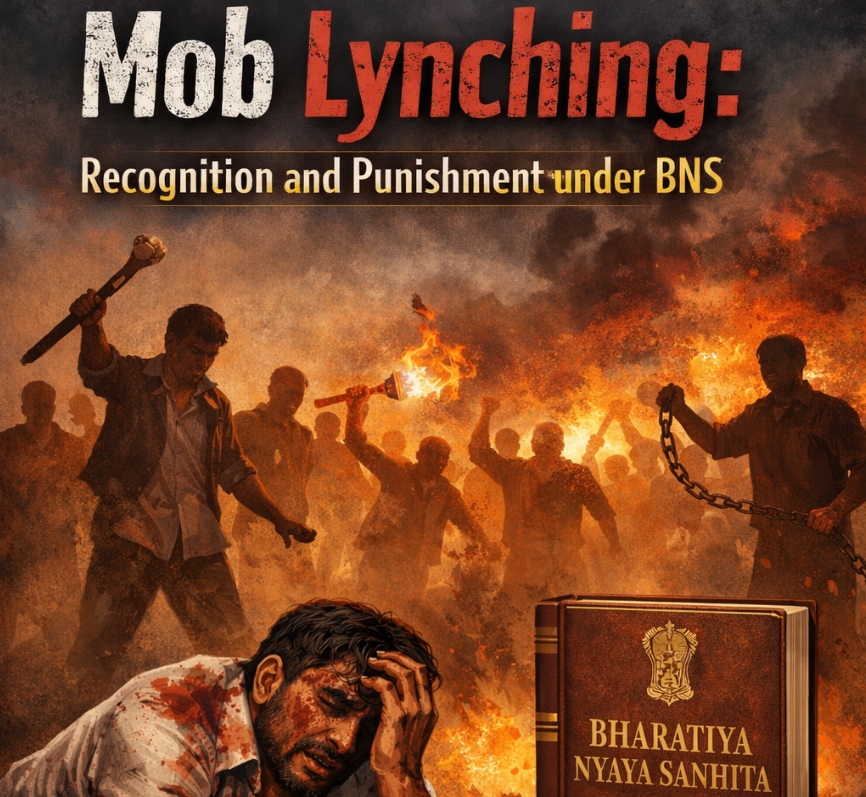
Introduction to Mob Lynching under BNS
Mob lynching represents a grave violation of the rule of law and fundamental human rights,India has been seeing an alarming increase in mob violence cases in the last few years. They have been mostly caused by circulating rumours, spread of false information, or inter, community issues, which clearly point at the insufficiency of the already existing law provisions. The culprit take the law into their own hands, not only to punish but to torture and kill the victim. These acts infringed upon the victim’s rights under Articles 14, 19, and 21 of the Indian Constitution, making the culprit liable for their criminal act.The term Mob Lynching was not included in any separate section in the Indian Penal Code nor it was defined separately which acts are included in mob lynching in the Bhartiya Nyaya Sanhita (BNS)- replaced the Indian Penal Code on 1st July 2024, Union Home Minister Amit Shah said in the parliament at the time of Introducing the Bhartiya Nyaya Sanhita (BNS) Bill, 2023: “There has been a lot of talk about mob lynching. We have carefully ensured that the punishment for mob lynching is seven years, imprisonment for life, or even death. All three provisions are there in cases of mob lynching.”This article examines the recognition, punishment, and broader legal and social significance of mob lynching under BNS the Bharatiya Nyaya Sanhita.
Meaning and Concept of Mob Lynching
What is Mob Lynching ?
Mob Lynching is a act done by group of people i.e. mob.They kill or hurt victims by taking the law into their own hands believing that they performed something wrong.The violence is aganist the human body on the belief or sometimes suspicion of doing any wrongful act by bypassing the legal procedures.For example cow vigilantism is violence in the name of the cow protection, therating social harmony and secularism.
Causes of Mob Lynching
Mob Lynching occurred when it had perceived threat to culture,traditional values,religious,fake news & rumors or spred via social media,socio-political tension between different religious groups and most important due to lack of law enforcement give rise to mob violence. As earlier in IPC there is no provision that define mob lynching.But now new criminal law that came into enforcement that is BNS define mob lynching under section 103(2) – Mob lynching refers to a crime or violent act that is committed by a gang, mob or group of individuals that shell out their own “mob justice” by neglecting proper judicial processes. A mob lynching, thus involves physical violence inflicted on a singular victim with the intent to ultimately kill the victim, predominantly based on information received or that the victim has performed an immoral act. Cow vigilance entails killing the alleged guilty party under the guise of Liberty to Protect Cows – Cow Vigilante gangs cause tremendous harm to social and secular harmony, and their actions have caused substantial disruption to both.
Mob lynching has numerous complex causes, many of which arise from people feeling that their cultural, traditional, or religious values are being threatened. The reasons for mob lynching include social media facilitating the rapid spread of fake news and rumour, as well as ongoing tensions between two or more different religious or ethnic groups. Undoubtedly, the significant lack of effective policing in India contributes greatly to mob-related violence.Mob lynching was not defined by the Indian Penal Code (IPC), but a new criminal statute has created an explicit definition of mob lynching in Section 103(2) of the Bharatiya Nyaya Sanhita (BNS).
Mob lynching is a collective crime that committed by group of individuals not an single individual unlike where individual Criminal liability based on individual conduct. Each member who are committed the crime are being liable it can either direct or indirect.For example Someone only provide resources to mob like guns provided to commit crime also being liable The collective nature of mob violence amplifies the harm caused and marks identification of indentification of individuals roles difficult, which is the reason modern criminal law increasingly emphasis group liability in case of mob lynching.
Legal Position of Mob Lynching Before BNS
Treatment of Mob Lynching under IPC
The term Mob Lynching was not included in any separate section in the Indian Penal Code nor it was defined separately.But it deals with some other sections of IPC such as section 153A deals with promoting enmity between the different groups on the basis of caste, sex, place of birth, etc as a result it creates disharmony among groups. Another section covering the mob lynching is section 120A. This section is regarded the criminal conspiracy. A criminal conspiracy occurs when two or more people agree to commit an illegal act or any legal act by illegal means. Section 34 also deals with mob lynching. Its section is regarded as when a criminal act is done by several persons with the common intention of all then all persons are equally responsible for the entire act.
Mob Lynching as Murder under IPC
Where mob lynching resulted in the death of the victim, the accused were charged under Section 302 IPC (Punishment for Murder), or Section 304 IPC (Culpable Homicide not amounting to Murder). In such cases, courts attempted to fix individual liability, even though the crime was committed by a group. This often created evidentiary difficulties, as identifying the exact role of each participant in a large mob was challenging.
Mob Lynching as Rioting and Unlawful assembly under IPC
In addition to murder provisions, mob lynching cases were also prosecuted under Section 141 IPC (Unlawful Assembly),Section 146 IPC (Rioting),Section 149 IPC (Common Object – vicarious liability). Section 149 IPC played a crucial role by holding every member of an unlawful assembly liable for offences committed in pursuit of the common object.
There is many limitation in IPC approach in mob lynching cases because IPC does not deal with specific definition of mob lynching and lot of application of multiple sections, difficult to prove individual acts and intention whether they will be liable or not and inadequate recognition of collective psychology of mob violence.The absence of specific offence of mob lynching in IPC highlight the need for explicit legal recognition which had now been addressed in new criminal law that is BNS which has been replaced by IPC.
Recognition of Mob Lynching under Bharatiya Nyaya Sanhita (BNS)
Explicit Legal Recognition of Mob Lynching
Bhartiya Nyaya Sanhita, 2023 define the mob lynching under the separate section 103(2) of the BNS, “when a group of five or more person acting in concert commits murder on the ground of race, caste or community, sex, place of birth, language, personal belief or any other ground. The interpretation of the section 103(2) of BNS,2023 is, When the group of five or more persons commits murder of anybody on the basis or grounds of race, caste or community, sex, place of birth, language, personal belief or any other ground will be punished.
Section 117 (4) of BNS provides that when a group of five or more persons acting in concert, causes grievous hurt to a person on the ground of his race, caste or community, sex, place of birth, language, personal belief or any other similar ground, each member of such group shall be guilty of the offence of causing grievous hurt.If the group of five or more person caused the grievous hurt then the Section 117(4) of BNS comes into play.
Significance of Naming Mob Lynching as a Distinct Crime
The explicit recognition and naming of mob lynching as a separate offence marks a crucial development in criminal law. Naming the crime gives it legal identity, transforming mob lynching from a loosely addressed social evil into a clearly defined punishable offence. By identifying a crime, it eliminates confusion as to how it could be construed and prevents individuals from referring to random sections in the law – for example, murder, riot, unlawful assembly – to attempt to find some form of reference point to understand what the statute states about mob lynching. The identification of the crime allows for the recognition of the gravity and uniqueness of mob lynching as explicitly acknowledged in the legal system and signifies the severe importance of mob lynching to the values of society and the Constitution.
Recognition of Mob Lynching and Strengthening of Accountability
Formal acknowledgement of mob lynching through legislation, the Bharatiya Nyaya Sanhita, strengthens criminal liability.The law defines mob lynching as a specific crime that allows prosecutors to charge everyone involved in a mob as guilty of that crime. This makes it easier for law enforcement since it means they do not have to prove that everyone committed an individual crime, and they can charge everyone as co-defendants in one case.
By officially acknowledge mob lynching as a crime, the Bharatiya Nyaya Sanhita provides more criminal liability for those are involved in the crime. The new classification of mob lynching enhances prosecution by recognizing that all participants have engaged in a single act of collective violence, allowing them to be held accountable as a group, rather than as individuals. The Bhartiya Nyaya Sanhita also clearly states that although a person is guilty of any crime, all participants in a mob lynching an individual will be held accountable for their actions, thereby establishing a firm basis for effective punishment of crimes committed through mob lynching.
Punishment for Mob Lynching under BNS
Nature and Extent of Punishment
All members and participants of a group of five or more individuals who murdered any person pursuant to any justification or reason identified within the statutory definitions included within BNS s 103(2), shall receive a penalty of death; alternatively, the convicted individuals may be sentenced to the term of life; or, they may be sentenced to prison for a minimum of seven (7) calendar years and shall also be subject to the imposition of fines in accordance with the acceptable limits specified in BNS.
The application of this statute only triggers when the individual murdered is killed by a minimum of five (5) individuals. Under the definition of causing grievous bodily harm contained in BNS s 117(4), a convicted individual will incur a penalty of imprisonment for up to seven (7) full calendar years and will also be responsible for the payment of fines.
Punishment under BNS is not uniform; it depends on the outcome of mob violence. Unlike IPC, BNS provides the proper punishment structure according to the gravity of violence.If the nature of violence is high then punishments will also be high or severe.For Example cases related to death attracts harsher punishments as compared to cases related to that not cause death. In death cases punishment include long term imprisonment and severe penalties. By adding the severe penalties and harsher punishments law wants to prevent future incidents and zero tolerance towards mob violence The punishment framework under BNS thus balances retribution, deterrence, and societal protection.
Collective Liability of Mob Members
Every member is liable under BNS. Unlike IPC only one individual will not be liable to every member under BNS who participates in the committing or commission of crime or violence they all are criminally held responsible for the offence. Intention in mob violence is depends on the active participation,presence and conduct of person during the incident. If they intentionally participated in committing the crime then they will be held responsible for the criminal offence.
In BNS collective liability is crucial for addressing mob violence as it prevents individual punishments. It ensures accountability in deciding the punishmentsThe Bharatiya Nyaya Sanhita (BNS) establishes the collective liability of every member involved in the commission of a crime or violence, specifically addressing mob violence. Unlike the Indian Penal Code (IPC), where liability might rest on a single individual, BNS holds all participants criminally responsible for the offence.
The BNS Collective Liability Concept represents an important aspect of addressing the issue of mob violence as it provides for collective liability by allowing all members of mob violence operations to be fully accountable for their actions and preventing punishment being imposed only on individuals who were active participants or took part in the crime in certain limited ways, allowing for a fair process for determining proper punishment.
Mob Lynching under BNS vs IPC
How BNS Improves the IPC framework
Earlier mob lynching was not recognized as a distinct offense in Indian Penal Code whereas now it is recognized as a distinct offense under Bhartiya Nyaya Sanhita, 2023. As per BNS, the punishment for mob lynching was mentioned under sections 103(2) and 117(4). But if there is not an assembly of five or more person in doing the common act then it is not considered mob lynching.Unlike the IPC’s indirect treatment of mob lynching through general offences, the BNS provides direct recognition, clear punishment, and enhanced accountability.
According to the Indian Penal Code (IPC), mob lynching is covered under general IPC provisions for murder, rioting and unlawful assembly; however, because mob lynching was not specifically defined, prosecutions were often scattered and it was difficult to anticipate who might be held legally responsible. In contrast to this fragmented approach, the BNS identifies mob lynching as a separate crime and creates a clear legal definition of mob lynching with specified penalties. The explicit definition creates consistency in application of the law and enhances the level of accountability through increased clarity in prosecutorial processes.
Constitutional and Human Rights Perspective
Mob Lynching as a Violation of Fundamental Rights
The Constitution of India is the supreme legal authority in India. It guarantees certain rights (Fundamental Rights) to all citizens of India; these include the right to freedom of speech and expression, equality before the law, freedom of religion, and the right to live with dignity. Mob lynching violates the Fundamental Rights of any person as guaranteed by the Indian Constitution.
Mob lynching infringes on the right to life and personal liberty as provided by Article 21 of the Constitution and is an example of where individuals or groups have taken law enforcement into their own hands, committing acts of violence without any legal authority. Mob lynching is also a violation of Article 14, which states that all people are entitled to equal protection of the law and equality before the law. When a mob inflicts violence on a person based on suspicion, rumour or identity, the mob is no longer using a legal process to decide what is just, but is replacing that with random, arbitrary punishment.
In addition, mob lynching is an illustration of how the State is not meeting its constitutional responsibility of protecting its citizens. Therefore, to protect the Fundamental Rights of the citizens, the State must implement preventative, punitive and remedial measures that would be in line with its constitutional obligation to do so. Thus, it is only through this recognition of mob lynching as an offence by the Bharatiya Nyaya Sanhita and The Prevention Of Mob Lynching Bill (2019) that we can begin to protect the basic Human Rights of the people.
At International scenario India, being a signatory, has ratified various international human rights laws (conventions and treaties), including the International Covenant on Civil and Political Rights (ICCPR) and the International Covenant on Economic, Social, and Cultural Rights (ICESCR).
The judiciary has repeatedly expressed serious concern over incidents of mob lynching, viewing them as a direct threat on the rule of law and constitutional governance.Like in 2018,Supreme court ordered the ordered police to immediately stop lynching and charged them with finding the culprits responsible for these crimes.The judiciary views mob lynching as a breakdown of rule of law, a violation of Articles 14 and 21, and a failure of the State to protect citizens, necessitating strict preventive and punitive measures
Role of Mob Lynching in Strengthening Rule of Law
Deterrence and Public Confidence in Justice System
Mob Lynching is violence act of mob justice, involving extra judicial punishments without any due process of law. The provision of strict punishments in BNS, particularly in death cases, serves as a strong deterrence which will lead to serious criminal consequences. Also specific legal recognition as a distinct offence in BNS shows faith in legal system and assuring citizens that such act of vigilantism will addressed through law and cannot be tolerated or ignored.By adding Mob lynching as a distinct offence in BNS state shows that only state has the right to administer justice and shows supremacy of constitution & reinforce respect for rule of law.
Challenges in Implementing Mob Lynching Laws under BNS
Enforcement and Safeguards
There were significant challenges in compacting or implementing the BNS provisions. One of the major concerns would be the risk of misuse of laws where false information can be registered in the name of personal hatred or on the basis of political and communal tensions. It also does not mention the word “religion” does not recognise mob lynching on the basis of religious grounds Implementing the BNS provisions presents significant challenges. A major concern is the potential for misuse, where false cases could be registered due to personal animosity or escalating political and communal tensions. Furthermore, the provisions are notable for the omission of the word “religion,” and they fail to explicitly recognize mob lynching when it is committed on religious grounds.
On the other hand, identifying the specific role of individual participants is also very problematic because it can complicate the investigation and judicial oversight because there should not be any arbitrary arrests. Identifying the specific roles of individual participants presents a significant challenge. This is due to the potential to complicate both the investigation and judicial oversight, as caution must be exercised to prevent arbitrary arrests and a miscarriage of justice.
Importance of Mob Lynching Provisions for Indian Society
Social and Legal Significance
The practice of mob lynching generates severe consequences for the social structure as well as communal relations between communities in the nation. The various religious, ethnic, and caste communities that make up India become specific targets whenever mob violence occurs throughout the country. When religious groups, including Muslims and Dalits, become targets of lynching attacks, the incidents create more severe social divisions between religious communities and caste systems. Lynching’s cause permanent loss of life while unintentionally worsening social relations because they cause communities to distrust and hate each other.
The Bharatiya Nyaya Sanhita’s recognition of mob lynching is vital for Indian society, reinforcing constitutional morality and the rule of law against mob justice.The law targets becoming vigilantism by criminalizing this new type of offense. In addition to keeping pace with social media and misinformation contributing to violence, the law also updates the current criminal law system in order to be more responsive and efficient in protecting citizens’ constitutional values.
Conclusion-Mob Lynching under BNS
The criminalization of mob lynching as a distinct offence from IPC to BNS 2023 is a step towards the acknowledgment and recognition of a growing menace to society.While the IPC addressed incidents of mob violence through general provisions relating to murder, rioting, and unlawful assembly, it failed to recognise mob lynching as a distinct offence.The BNS marks a crucial shift by providing clear legal recognition to mob lynching and prescribing strict and proportionate punishment, However, the effectiveness of these provisions ultimately depends on robust enforcement, fair investigation, and public awareness.
About Author
Aditya Pathak is a first-year law student at NMIMS School of Law, Bengaluru, pursuing the B.A. LL.B. (Honours) programme. His academic interests lie in human rights law and criminal law, with a particular focus on issues relating to constitutional protections, criminal justice reforms, and access to justice. He actively engages in legal research and writing, aiming to to develop a strong foundational understanding of contemporary legal issues and evolving judicial trends.
FAQs on Mo Lynching under BNS
What is mob lynching under the Bharatiya Nyaya Sanhita?
Mob lynching under the Bharatiya Nyaya Sanhita refers to acts of violence committed by a group of persons acting as a mob, resulting in injury or death to a victim without legal authority. It recognises mob lynching as a distinct criminal offence based on collective action rather than individual conduct.
How does BNS punish mob lynching?
The Bharatiya Nyaya Sanhita implements a proportional punishment structure for mob lynching. Grievous injury incurs stringent imprisonment, and death results in enhanced, severe penalties, aiming for deterrence against mob violence.
Why was mob lynching specifically recognised under BNS?
The Bharatiya Nyaya Sanhita explicitly recognized mob lynching to ensure legal clarity, simplify prosecution, and enhance accountability, thus providing a stronger deterrent than the Indian Penal Code’s indirect approach.
Does collective liability apply in mob lynching cases?
Yes, collective liability apply in mob lynching cases under the BNS. Every person who participates in the mob is held criminally liable.
References
1. Criminalisation of Mob Lynching under the Bhartiya Nyaya (Second) Sanhita 2023 – NUALS Law Journal
2. Mob Lynching and Right to Life International Journal of Creative Research Thoughts 2023 *IJCRT2303239.pdf
3. Mob Lynching in India by Database of Multidisciplinary Journals and Research 1753537345-MOB_LYNCHING_IN_INDIA-_A_CRITICAL_EXAMINATION_OF_CAUSES,_CONSEQUENCES,_AND_LEGAL_IMPLICATIONS.pdf