
Understanding Freedom of Speech and National Security
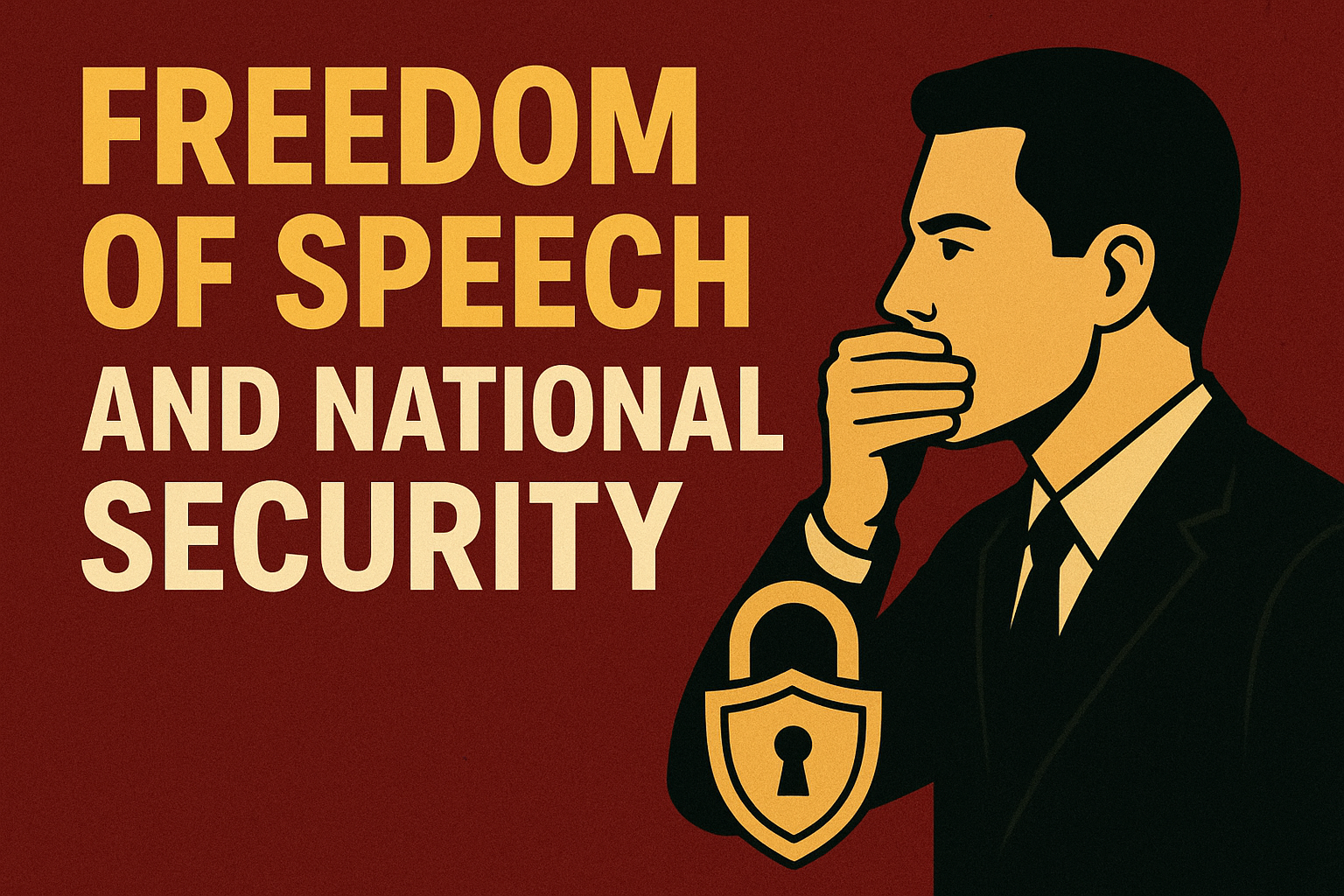
Article 19(1)(a) of the Constitution of India provides us (the citizens) the right to freedom of speech and expression which is, of course, subject to ‘reasonable’ restrictions. It is also one of the most essential elements of democracy. In the words of Chief Justice Shastri in the case of Romesh Thapar v. State of Madras (1950) ‘freedom of speech and of the press is the cornerstone of every democracy’. The public must defend the right of open criticism and debate regarding the policies of the government in the interest of popular self-governance, and in the interest of public education. However, this freedom is, fortunately, or unfortunately, not absolute. Article 19(2) provides the State with the right to impose ‘reasonable’ restrictions on speech in the interest of the sovereignty and integrity of the State, the security of the State, public order, etc. There is a constant Unease in Indian law about the balance between restrictions on free expression and national security. This article aims at this constitutional balance, particularly to what extent the state can limit speech for the sake of security, and how courts ‘protect’ expression, which are the dynamics of the debates on freedom of speech and national security.
Constitutional Basis of Freedom of Speech and Its Link to National Security
No one can deny that the right to free speech under Article 19(1)(a) is one of the most significant fundamental rights. Courts have called it one of the “basic and indivisible rights” of any democratic polity. It includes all forms of expression, be it through word, any medium of print, or through electronic means, or even through acts that are symbolic of resistance and/or protest. Article 19(1)(a) does, however, provide that the right to free speech does have some limitations in that laws may Fine speech in the interests of “sovereignty and integrity of India, security of the State, friendly relations with foreign States, public order, decency or morality, contempt of court, defamation or incitement to an offence. It is these exceptions that show the framers’ intent to balance the liberty of the individual in order to protect that individual against State interests that are deemed to be compelling, such as national defence, etc.
Numerous landmark cases have even shaped this balance. The Supreme Court in the case in the case of Romesh Thappar v. State of Madras (1950) even struck down an order for the banning of a newspaper in circulation and even affirmed that it is only with extremely narrow boundaries that such speech may be restricted.The Court rejected vague broad grounds of “public order” that could be stretched beyond Article 19(2) limits. Similarly, in Shreya Singhal v. Union of India (2015), the Court invalidated Section 66A of the IT Act for vagueness and overbreadth. It held that “mere discussion or even advocacy of a particular cause howsoever unpopular is at the heart” of free speech, and that laws may only curtail speech that incites harm .The Court stressed that any restriction must have a proximate link to protecting public order or national security absent that link, the law creates a chilling effect on legitimate expression .
In mere terms, Article 19(1)(a) affords wide protection, but it coexists with Article 19(2). The list of security-related grounds in 19(2) shows that the Constitution explicitly contemplates limiting speech when national interests (sovereignty, State security, foreign relations) are at stake. Thus, the constitutional scheme embeds the tension between freedom of speech and national security from the outset: free speech is the rule, but the State may respond if speech crosses into threats to the nation.
Reasonable Restrictions Under Article 19(2) for National Security
Article 19(2) permits restrictions on free speech in the interests of “security of the State”, “friendly relations”, “sovereignty and integrity” and related matters. All told, the grounds in clause (2) include:
• Security of the State (e.g., rebellion, armed insurgency)
• Sovereignty and integrity of India (e.g., secessionist propaganda, territory claims)
• Friendly relations with foreign States (e.g., inciting war)
• Public order (e.g., riotous, or panic-inciting speech)
• Decency or morality, contempt of court, defamation, and incitement to an offence (other societal interests).
These grounds are interpreted very closely. For instance, the Court in Romesh Thappar emphasised that “security of the State” refers to serious threats like violent overthrow of government, not routine disorder. While public order is a broad concept, “security of the State” has been confined to extreme acts endangering the nation’s stability.Thus, Kedar Nath Singh v. State of Bihar (1962) held that sedition laws (expressly aimed at disturbing State security) are valid only when the speech has “the tendency to create disorder or disturb public peace by resort to violence” .The Court warned that interpreting “security” or sedition to cover mere criticism would be unconstitutional. In effect, the judiciary has treated “security of the State” as an especially high threshold: speech must present a clear and present danger of violence or violent conspiracy against India to fall outside Article 19 protections.
“National security” itself is not defined in the Constitution, but the Supreme Court often treats it as akin to the interests covered in Article 19(2). Security related restrictions typically rely on Article 19(2)’s “security of the State” or “sovereignty and integrity” clauses. In practice, governments tend to view “national security” expansively, covering terrorism, espionage, cyber-attacks, subversion, and major threats. Legally, though, courts need any law invoking security to be clearly linked to such grave dangers, lest it unreasonably curtail speech.
In practice, certain kinds of speech are seen as especially fraught for security. Hate speech and sectarian propaganda can trigger communal violence, so laws like BNS 192 (promoting enmity) and 295A (outraging religious sentiments) are enforced to curb incitement. The same could apply for prescriptions of terrorism propaganda. Volumes of speeches admire ISIS or tell people to join extremist groups that are drawn to sedition and UAPA. The state counters misinformation e.g., misinformation that leads to mob lynchings by blocking specific websites or by taking people into custody which falls under cyberspace laws.
An example is the sedition law (BNS 152). Under this law from colonial times, it is an offence to create disaffection to the government. In Kedar Nath Singh, the Court sustained the constitutionality of sedition, albeit with a limitation; only such speech that has a tendency to create disorder” or a disturbance of public peace by violence” may be punished. The mere criticism of government policy, or even a mild expression of disapproval of government policy, is not seditious under this test. In recent years, however, some law makers have pressed sedition charges to some people in ways that some people see it as an overreach. For example, over 60 Kashmiri students were booked for sedition in 2014 simply for not cheering in the cricket match victory of India. The charges sparked an outrage of the public, and the government reviewed the charges and subsequently, dropped the charges. Such cases show the extent to which the authorities can control the speech of the people by the security laws. To avoid this, the court have made it clear that the criticism of the government can be made freely and is protected by law, unless, of course, sufficient evidence to the incitement of violence is present.
As for other cases showing dynamics in the situation: people have been banned and prosecuted for displaying logos of so-called Lahore and Kashmir, as well as Kashmir/Pakistan maps, based on the argument of offending sovereignty. Encrypted messaging in distribution and inauthentic documents are major reasoning for the issuance of propaganda. National security has been used as an explanation for the anticipative removal of the online documents that the government considers as controversial. On the other hand, a chill on legitimate engagement can result from strict execution. Activists complain that the exceedingly invasive monitoring of the so-called “conflict” areas of Kashmir and the Northeast has resulted in a major decrease of unapproved public discourse. After the major lockdown of Kashmir in 2019, there was considerable snitching and self censorship by the government, that was caused by widespread security protocols. The width of the boundaries of speech and security are remarkably in depth, with the government regarding as controversial order and speech constituents that pertain to the unification of the people of the country, and the people as unit foggy and vague legal arguments for the total disregard of the criticism of the speech pertaining to order and the unification of the country.
Digital Age Challenges: Free Speech, Social Media & National Security Risks
The balance is increasingly being shaped by the weight of the digital revolution. While the reach of speech over social media can be informative and incite debate, the risk of speech becoming propaganda is far greater. Misinformation and propaganda, even at the expense of disinformation videos and deepfake technology, can incite violence and unrest in a viral fashion. Moreover, the comparable strong end-to-end encryption on apps and on the internet, by virtue of being dangerous, provide authorities a strong interest in being able to access the apps freely.
India’s rules on intermediaries seek to tackle at least a slice of these issues by requiring major messaging services, notably WhatsApp, to provide authorities the means to identify and trace a message’s “first originator.” Critics point out this constitutes mass surveillance of message tracing. The Electronic Frontier Foundation has stated that the rules being proposed concerning mass surveillance on a private internet are, professionally, “fundamentally incompatible” with a realm to speak freely. In common parlance, if these rules were to be enacted in practice, digital platforms would be required to break the end-to-end encryption, and this would compel the services to either retain information about the message on their devices which would be a privacy-violating mass surveillance of the devices of users and message recipients or on their disinformation servers. Puppet masters of the rules have seldom avoided being described as closure of the CHILL and open CHILL rules without advocating for CHILL rules. In common parlance, this means the rules in question, if being proposed or to be enacted, would be expected to be remotely used to silence dissent and critique. These proposed changes would render digital platforms less attractive, even dangerous for the workers to be open about the activities of their censorship disinformation campaigns for information that it may have had consent to share.
At the same time, the worries of the government over the content available online continue to bring forth more orders for takedown and blocking under laws such as Section 69A of the IT Act. Very broad categories such as “public emergency” and “public safety” have been used to justify the blocking of news sites and social media for certain geographical locations. The Supreme Court has underlined that the internet is now and is likely to continue to be “intrinsic” to the exercise of free speech, and that shutdowns and blocks are forms of state action that must be justified to the court with a considerable amount of legal reasoning. The challenges are also two-sided: social media has enabled the organised dissemination of hate speech and the intentional conspiracy to commit a crime, leading to the state security challenged social media based on the two-sided nature of the problems. Overall, the digital era has sharpened the issues at hand: the need to find a balance between encryption, privacy, and security, the need to mitigate the risks of a digital lockdown on cyber threats, and the right to freely express oneself online.
Legal and Statutory Framework Governing Free Speech & National Security
A significant segment of Indian law recognises the Speech/Security nexus. Beyond Art 19 and the IPC, now BNS, other significant laws include:
• Unlawful Activities (Prevention) Act (UAPA): UAPA is India’s principal anti-terrorism law. UAPA has an extremely broad provision describing a ‘terrorist act’ and grants sweeping detention and other powers. UAPA is, therefore, often a case about speech. UAPA has been brought to Doc. 30 in an arbitrary fashion to target civil society and defenders of human rights. It is clear that only UAPA has about 2.2% of the total number of UAPA cases between 2016-2019 which resulted in a conviction. This suggests that UAPA is primarily an intimidation tool, and many UAPA cases are kept pending. Other provisions of UAPA which place the burden of proof of innocence upon the accused sculpt their own civil liberties. The UAPA has been amended in contemporary times to include even financial terror in the UAPA which has attracted a lot of understandable criticism especially around dissent.
• The National Security Act (NSA) 1980: This is a law on preventive detention. It empowers one to detain a person for 12 months without charge on the basis of a belief that that person is a threat to security. This Act is meant for straight/jam emergencies; however, it has been lent even to the vocally critical, which has attracted even general complaint of misuse. (No specific citation available, but fringe NGOs NSA as overbroad)
•Information Technology Act, Section 69A: Empowers the government to block online content or web resources that threaten “sovereignty and integrity of India, defence, security of the State, friendly relations” etc. The rules under Sec.69A have been used to block news sites and social media posts. High Courts have generally required that blocking orders comply with procedure, but critics say the language is vague. (The Telegraph Act’s suspension rules similarly allow communications shutdowns for public safety.)
•Indian Penal Code: Several sections curb speech under the guise of order/security:
• 124A (Sedition)/ BNS 152: Punishes incitement of disaffection toward government. Though rarely leading to conviction since Kedar Nath Singh limited its scope, the law has been invoked against activists and journalists.HRW notes it stays “a powerful tool used by authorities to criminalise dissent.”
•153A/BNS 192: Criminalises promoting enmity between groups. Used in hate speech cases and sometimes controversially in dissent cases (e.g., under-claims of “anti-national” remarks).
• 505/BNS353: Pertains to statements creating fear or alarm in the public to commit an offence. Broadly worded, it has been used to penalise alleged false news or rumours.
• Other sections (e.g., 295A on religion) may be invoked under the pretext of security or public order.
• Other Laws: The Foreign Exchange Management Act (FEMA) and certain rules under the IT Act (like the “intermediary guidelines”) add layers of regulation. For instance, platform intermediaries must remove “unlawful” content swiftly under penalty. NGOs have raised concerns these powers can be used to stifle critical media under security pretexts.
Such legislation results adverse to Amnesty. Note the absence of adequate drafts and weak protections. Such laws include UAPA and FCRA (foreign funding law) and have been “weaponized” to attack dissent and non-profits without meeting international obligations. Implications of the sedition law have been no exception. In 2022, the Supreme Court requested all sedition laws frozen, declaring the law “is not in tune with the current social milieu” in explanations of its decision. Such an explanation signals developments of the law, specifically that the margin of security proscribed insulator security laws is not a free range.”
Case Laws: Courts Protecting Free Speech While Ensuring Security
The judiciary conducts its function in a supportive capacity. The Supreme Court, through its jurisdictions, has always annulled and/or restricted legislative attempts to overly criminalise and regulate expression. We witnessed Shreya Singhal (2015) significantly reduce the scope of censorship on the internet as she propounded that restriction of speech is only constitutional when it defeats the test of incitement to an imminent and direct harm. Equally, Anuradha Bhasin v. Union of India (2020) emanating from the Kashmir communications blackout: The Court characterised the suspension of the internet as a ‘drastic measure’ that is to be confined within the vicinage of necessity and proportionality. It posited that all orders to shut down the internet must be public, must be limited as to the objectives, the duration of the orders must be restricted, and the orders must be subject to consistent monitoring, as unfettered access to all forms of communications is a prerequisite to the enjoyment of the right to free speech.In doing so, the Court effectively applied a proportionality test balancing national security against the fundamental right. As one Justice said, any shutdown must be “necessary and unavoidable” and accompanied by reasons so that affected citizens may challenge it.
In the area of sedition, courts have also enforced limits. In Kedar Nath Singh, a five-judge bench upheld sedition laws only to the extent they penalise incitement to violence. The Court explicitly held that “[e]very citizen has the right to criticise his government so long as criticism does not incite violence.” Likewise, in Aseem Trivedi v. Maharashtra (2015), the Bombay High Court quashed sedition charges against a cartoonist, reiterating that actual incitement of violence is required for sedition. These rulings affirm that political criticism even if harsh lies at the core of free speech.
The Supreme Court has often invoked tests akin to the “clear and present danger” standard of U.S. law. For example, in Shreya Singhal, the Court noted that restrictions could only curb speech when it crosses the line into “incitement” of harm. Similarly, in Khankhoje v. State of Maharashtra and other cases, courts have struck down vague provisions that threaten to “chill” protected speech. In all these decisions, the judiciary emphasises proportionality: a restriction must genuinely serve a compelling security interest and be no broader than necessary. Legislations or executive actions failing that test is invalidated. This oversight function is a crucial safeguard against executive overreach.
In short, Indian courts have repeatedly held that freedom of speech and national security must be balanced with liberty as the default. They have struck down sweeping bans (as in Romesh Thappar ), protected online expression (Shreya Singhal), and demanded accountability for restrictions (Anuradha Bhasin ).These cases show that the state can not use security and the shield or they cannot use it according to their own will to suppress dissent, any restriction on speech should have a strong reasoning and backing.
Finding the Constitutional Balance Between Freedom of Speech and National Security
The perfect equilibrium acknowledges that neither total free expression nor total domination is tolerable. Total censorship puts at risk the ability to govern democratically. Conversely, there is harmful expression that can pose actual threats to a community. For the Supreme Court, in the case concerning the internet in Kashmir,”liberty and security have to be balanced but it is the people’s freedom that is most important, not the freedom of the government.” This logically means that there is a need to have laws that limit freedom of expression to be clear, specific, and to involve the courts. One example is the Anuradha Bhasin directions that require the imposition of any communication shutdown to be prompt, to be made public, and to be subject to a process of review. In the same way, when laws are formulated using vague generalisations such as,”public safety,” the courts demand the imposition of adequate boundaries.
In practice, achieving this equilibrium also demands political courage and civic participation. In conflict zones such as Jammu & Kashmir, which are particularly sensitive, there have been instances, as a result of indiscriminate limitations, the backlash is increasing alienation. Human rights monitors observe that laws applied to Kashmir journalists and the extensive surveillance have created a significant speech sphere. Even outside of judicial systems, parliament still needs to enact reforms, and the executive must show self-restraint to guarantee that security legislation is not misused to practice censorship. In a diverse democracy such as India, the situation is made worse by global challenges resulting in increasing polarisation and transitional threats.
Achieving this balance could look like (1) Transparent laws: making sure there are clear definitions and guardrails around restrictions; (2) Proportional enforcement: enforcement directed at opinions and expression that are real and immediate threats, not just opinions that are unpalatable; (3) Judicial review: courts rigorously examining if any restriction survives constitutional scrutiny; and (4) Alternative measures: when possible, other than bans, it may be speech or education that should be considered (counter speech, etc). Learning from international measures and norms (“necessity and proportionality”) may assist India in addressing the questions in issue as many democracies are doing.
But speech and national security concerns in modern-day governance are not fully separable, and in a democracy, security, and therefore national security, must be prioritised in a more ‘thin’ or limited way. As the courts have said, a society is not in an appropriate state if through fear of dissent. It should be noted, however, appropriate restrictions, in the context of terrorism and cyberwarfare, are necessary. A ‘triple jump’ of sorts, that is, the constitution, through the courts, and informed national debate has led to a smart and balanced outcome that protects the nation and its rights.
Conclusion: Balancing Freedom of Speech and National Security in Modern India
Indian experiences demonstrate that balancing free speech and national security is an eternal conflict that has no simple solution. Free speech is constitutionally protected yet also curtailed for this country’s welfare. In landmark cases, Romesh Thappar and Shreya Singhal, Kedar Nath Singh, and Anuradha Bhasin, been court cases where overbroad restrictions would be invalidated and furthermore, in real danger, instances an actual concern needing danger was brought to the attention in speech. Altogether, these pieces of legislation like the UAPA and Sedition Law fall victim to removal of the laws.
Moving forward, the focus should be on smart regulation and not censorship en-mass. Legal scholars point out that speech laws should be companied by Spatiotemporal adjustability in the legislation to fit the “contemporary social context.” New challenges like the digital space that is bombarded with misinformation require response and not an outright ban on the regulation of speech. Meeting the legal legislative criteria with national security obligations for the exercise of free speech during conflict in the country will require thoughtful laws and active democratic processes, with the expectation of restricting and balancing laws to accompany by transparent measures executed, to demonstrate and legally incorporate rules associated with put keeping and laws. The balance in this equation privacy and your security will only in valuable time demonstrate and allow India to display democratic freedom. However, in this case, India’s democracy and rule of laws will be in a fine balance, and peace and freedom protected by the laws in order to preserve the democracy through a fine balance. The focus on this will be the case for democracy and the rule of law to balance peace with freedom.
About Author
Wasiq Billah Lone, currently pursuing his legal education, is an emerging legal researcher passionate about Constitutional Law, Human Rights, and regulatory frameworks in India. His work focuses on examining evolving legal challenges through a balanced lens of doctrine and practical realities. He strives to produce research that is both academically rigorous and socially relevant.