

Introduction
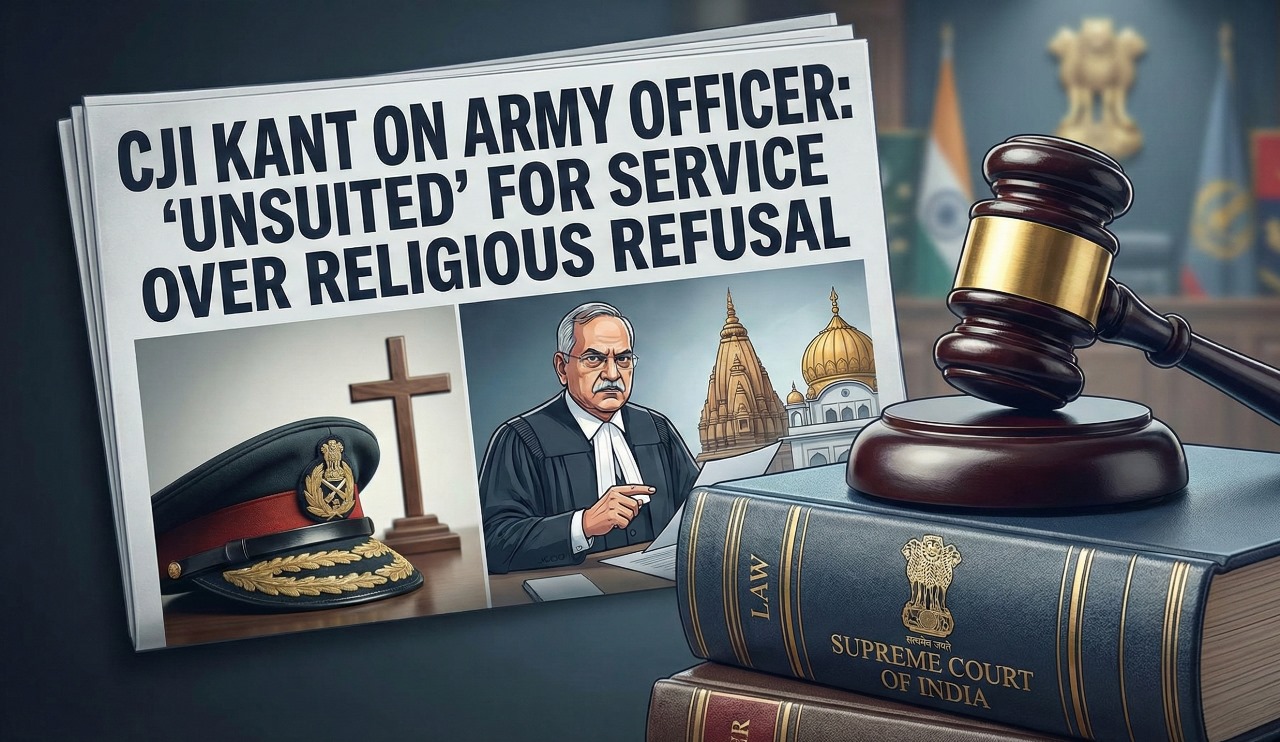
In a courtroom exchange that left little room for ambiguity,” Chief Justice of India Surya Kant didn’t mince words. Looking at the case of a Christian Army officer who refused to enter his regiment’s temple and gurdwara, the CJI delivered a stinging assessment: the officer was “completely unsuited” for military service.”
The Supreme Court on Tuesday upheld the dismissal of Lieutenant Samuel Kamalesan, who was terminated in 2021 after refusing to participate in weekly religious parades at his unit in Punjab. What might sound like a straightforward religious freedom case turned into a masterclass on military discipline, leadership expectations, and what the court sees as non-negotiable aspects of service life.
The Defiance That Cost a Career
Commissioned in 2017 into the 3rd Cavalry Regiment, Lt. Kamalesan commanded Sikh, Jat, and Rajput soldiers. When ordered to join his troops for religious ceremonies at the regiment’s temple and gurdwara, he drew a line in the sand. As a Protestant Christian committed to monotheism, he argued, entering the inner sanctum and performing rituals violated his conscience.
His compromise? He’d stand in the courtyard, remove his shoes and belt, even wear a turban where required—but crossing into what he considered the worship zone was a bridge too far.
The Army wasn’t buying it. After repeated refusals and counseling by senior officers—and even a pastor who assured him it wouldn’t violate his faith—disciplinary proceedings began in 2019. Two years later, he was shown the door.
A Judicial Dressing-Down
The bench of CJI Surya Kant and Justice Joymalya Bagchi pulled no punches during Tuesday’s hearing. When Senior Advocate Gopal Sankaranarayanan argued that his client’s Article 25 rights had been trampled, the court countered with pointed questions about what constitutes essential religious practice versus personal sentiment.
Justice Bagchi was particularly sharp, noting that a pastor had given the green light for temple entry. The judge’s message was clear: you can’t claim a private interpretation of faith once you’re in uniform, especially when your own clergy disagrees with you.
But it was CJI Kant’s observations that truly stung. Calling the conduct the “grossest kind of indiscipline,” he questioned what message such behavior sends to troops who view these spaces as sacred. The courtroom moment that captured headlines came when the CJI remarked that the officer should have been dismissed for this alone—adding that leaders must lead by example, not insult the faith of those they command.
When Sankaranarayanan warned the ruling would “send a wrong message,” CJI Kant shot back: “This will send a strong message.”
Discipline Over Doctrine
The court’s reasoning centered on a fundamental military principle: cohesion cannot be compromised. For Sikh soldiers in the regiment, the gurdwara represents one of the most secular spaces available. An officer’s refusal to enter with them, the bench held, wasn’t just about personal faith—it was about breaking the bond between leader and led.
The Army had argued that devotional practices are a wellspring of morale. War cries reference deities. Festival celebrations bring units together When an officer yews away from such common experience, the structure of regimental life becomes unraveled.
The court agreed with this opinion that if the Chief of Army Staff found the officer in violation of military ethos, judicial intervention would not have worked. The bench stressed the obligation of the Armed Forces, but it emphasized discipline, shared morality, and unity—nothing more that a single interpretation of religion could be.
The Aftermath
Lt. Kamalesan had requested proportionate punishment, pointing to six blemish-free years of service. The court wasn’t interested. Despite acknowledging he might excel in other areas, the CJI’s assessment was unequivocal: he was “absolutely a misfit” for an Army that demands both discipline and a secular approach.
The Delhi High Court had earlier ruled that this wasn’t about religious freedom—it was about obeying lawful commands. The Supreme Court rubber-stamped that view, sending ripples through military and legal circles about where personal conscience ends and professional duty begins.
While the Supreme Court of India‘s dictum clearly identifies unity and discipline as necessary in the Armed Forces, uniformity and discipline are not just ideals for military officers, but in the Armed Forces; in the Armed Forces unity and discipline are not ideals; they are essentials. And those who can’t embrace the collective ethos, regardless of their reasoning, might find themselves on the outside looking in.
ABOUT: Swapnil Mishra is a student at The Legal School and a law graduate of LNCT University in Bhopal. studies corporate and commercial law with a strong interest. Through his writing, he hopes to simplify, make practical, and make difficult legal concepts understandable. has experience in paralegal work, contract preparation, and legal research.