

Introduction:
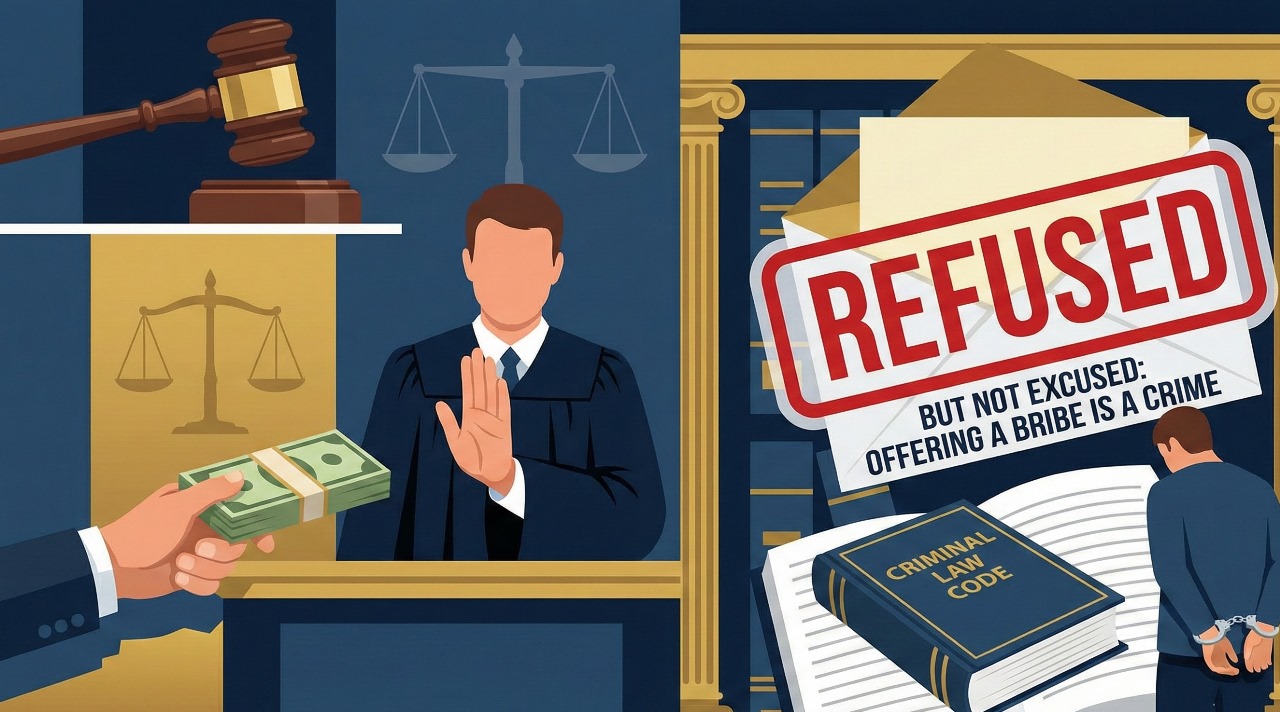
In a major ruling that solidifies India‘s anti-corruption principle, the Delhi High Court has made it clear that you cannot be successfully bribed and you must not commit an offence to a criminal. Though the offer is rejected, the mere act of offering a bribe is punishable even when it is only acceptable.
This may not seem crazy to many. But if no money had been transferred and the public servant refused the bribe, what is the damage? But it is different to the law, for reasons of course.
The Legal Principle:
In the Prevention of Corruption Act, your offense is complete when you try to compensate for a public servant who does not deserve your favor so that you can influence their official positions. I cannot blame the public servant, whether she accepts my offer, refuses, or even reports you to authorities. In attempting to do something illegal, it is not a crime that it has been successful.
Think of it this way: If someone tries to shoot you but misses, they are still guilty of attempted murder. Nothing of who they are is erased from your absence, they might be criminals. In fact, giving away a bribe would be viewed as corrupt intent and undermines public office’s integrity, regardless of its outcome.
Why This Matters:
The decision to the Delhi High Court highlights a common misconception many would probably have bolstered by this practice, but it has thus far made the decision of the Delhi High Court to raise an issue. People thought they could escape liability and claim to have rejected the bribe or that there was no actual corruption because money was not accepted.
This reasoning is fundamentally wrong. If the law did only punish bribes, it would induce other perverse incentives. Corrupt people could make multiple attempts knowing they would only have to face consequences when someone did take the money. Honest public servants who reject bribes would avoid prosecution and prevent the bribe-givers. This law would reward failure rather than prohibit wrong doing.
The Broader Message:
This judgment sends a powerful message to both sides of the corruption equation. It is a stark warning for bribe-givers, to realize when you make that offer you have crossed a legal line. It cannot be done in destroying it by rejecting your offer and you cannot defend yourself by pointing to the truth of someone who tried to corrupt you.
As public servants, it reminds them that not only the law is about refusing to bribe a payoff; it has been expected. And their refusal does not leave the crime off the hook.
Real-World Implications:
This ruling enhances the authority of police and anti-corruption agencies in practical terms. They do not need to prove that money actually flooded hands or that a public servant has been influenced. One could see that a test of the offer itself, if witness testimony, recordings, or sting operations, are sufficient to prove the offer.
This is particularly important when honest officials are spotted by bribery attempts. Earlier, some might have hesitated, thinking that if they had only accepted the bribe, there were no more things left for a case to contest. Now it becomes clear that the offer itself is valid evidence of crime.
Conclusion:
The Delhi High Court decision is not new law— it’s affirming what has always been the legal system. But it is a timely reminder in a period of corruption as big as it is today. The law does not excuse corruption or offer partial credit for failure. When it comes to bribes, trying is the same as succeeding; succeeding in getting a criminal record, that is.
“The message is clear: don’t even attempt it. In the eyes of the law, just trying is enough.”
ABOUT AUTHOR:
Swapnil Mishra is a student at The Legal School and a law graduate of LNCT University in Bhopal. studies corporate and commercial law with a strong interest. Through his writing, he hopes to simplify, make practical, and make difficult legal concepts understandable. has experience in paralegal work, contract preparation, and legal research.