

Introduction:
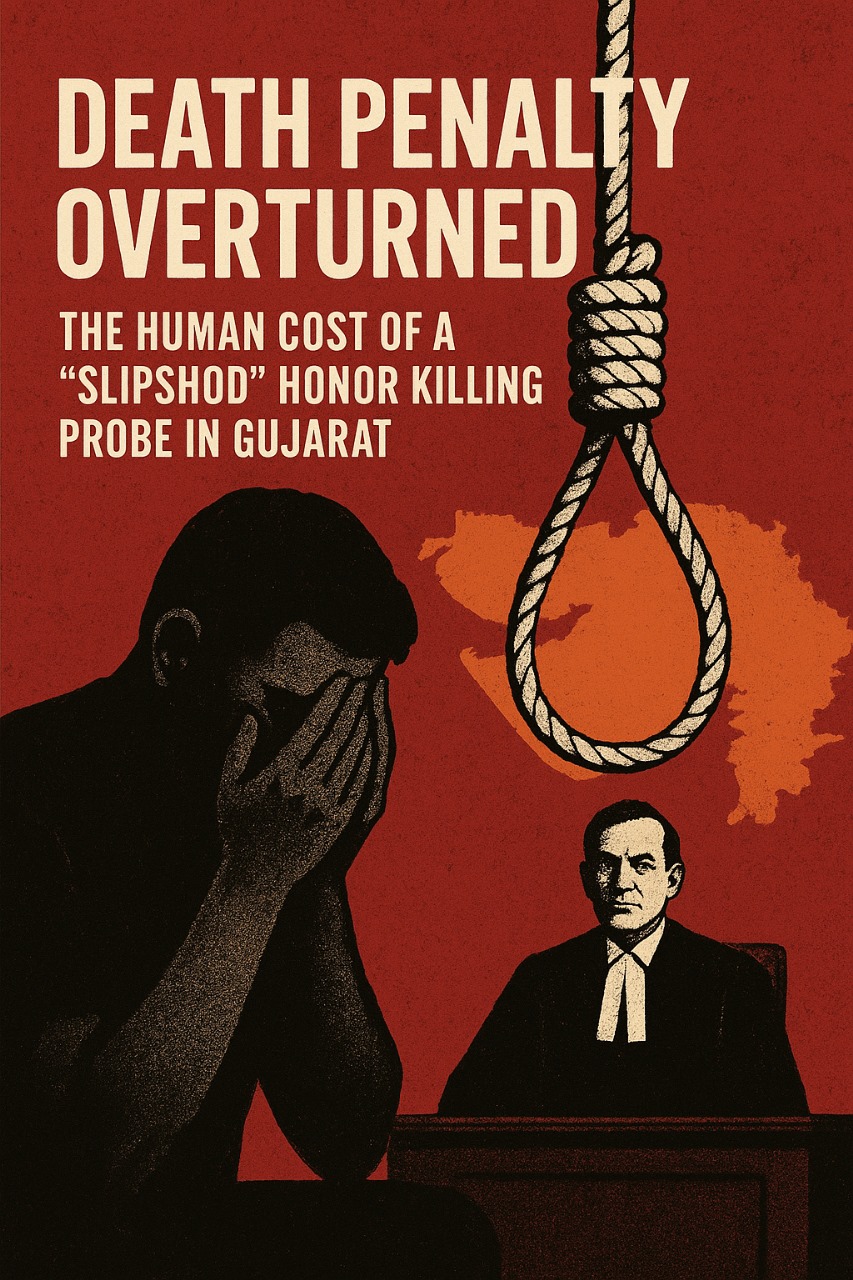
On the heels of an outrageous indictment of police work, the Gujarat High Court overturned a man who admitted that he had killed a man in an alleged honor killing case, citing a “slipshod” investigation which failed to fulfill basic criminal prosecution standards. Vipulbhai Bharatbhai Patani, accused of murdering his own brother and sister-in-law, in 2017, has found an extremely important flaw in the manner in which serious crimes are investigated and prosecuted in India.
The Case That Fell Apart
This narrative of the prosecution appeared straightforward on paper. The complainant, his brother, and sister-in-law were allegedly attacked by five men carrying swords on August 4, 2017. For example, Patani was claiming he orchestrated the murders as an honor killing, and claimed he purchased sedative tablets to help addicts drug them through food before the attack.
But when the Gujarat High Court, the justices Justice Ilesh J. Vora and Justice P.M. Raval, examined the evidence, the case fell apart. The court found it was not enough to establish a complete and unbroken chain of circumstantial evidence that made up the bulk of all cases in which no witness or confession was offered.
Critical Investigative Failures
The court’s observations paint a troubling picture of the investigation. The Forensic Science Laboratory officer failed to collect fingerprints or footprints from the crime scene—basic evidence that could have corroborated or challenged the prosecution’s theory. The investigating officer admitted relying on interrogations by the Local Crime Branch, yet these crucial interrogation details were never formally documented or presented in court.
Plus, the evidence in scientific reports found nothing in the victims’ bodies of sedatives, which was the opposite of a common line of the prosecution case. The procured bloodstained weapons did not mean anything as the prosecution could not prove these discoveries are made in the face of the accused at face value under the Indian Evidence Act.
The Danger of Incomplete Evidence
The Gujarat High Court cited Sharad Birdhichand Sarda v. State of Maharashtra, a landmark case in which the court held that circumstantial evidence must be complete and any link that could be concluded beyond reasonable doubt must be completely linked. Even if only one link is missing or weak, the prosecution case is unsustainable.
The court discovered many instances of misdirection: for instance, Patani’s misintentions for honor killing – unproven motives for death, uneasily recovered weapons, missing forensic evidence, and an investigation so poorly documented that it raised more questions than it answered. The prosecution’s failure wasn’t just technical; it was fundamental.
A Pyrrhic Victory and Broader Implications
The trial of Patani does not come to an end because nobody gets out. If he is guilty, a family has been taken away from justice because investigators failed to do their job properly. If he did not, a man would have been on death row for years for a crime he did not commit. Both a failure of the justice system.
The case highlights a persistent problem in Indian criminal justice: the gap between conviction and evidence. In their rush to secure convictions in heinous crimes, investigating agencies sometimes prioritize speed over thoroughness, theory over proof. This serves neither justice nor public safety.
Conclusion
In the verdict, the Gujarat High Court acquits Patani represents a clear message: if the crime is serious or public opinion is powerful, proof will remain an burden on prosecution. Slipshod investigations, missing evidence, and unknown theories can not be the basis for human life.
In fact, the court rightly pointed out that each link must be thoroughly convincingly proved to be worthy of prosecution in the light of a fair, admissible evidence. That duty – incompetence or ignorance, but full justice collapses. This case should also serve as a wake-up call for police departments across India, that full-time investigations are not bureaucratic practices. They’re the difference between justice and its shadow.
ABOUT Author:
Swapnil Mishra is a student at The Legal School and a law graduate of LNCT University in Bhopal. studies corporate and commercial law with a strong interest. Through his writing, he hopes to simplify, make practical, and make difficult legal concepts understandable. has experience in paralegal work, contract preparation, and legal research.