

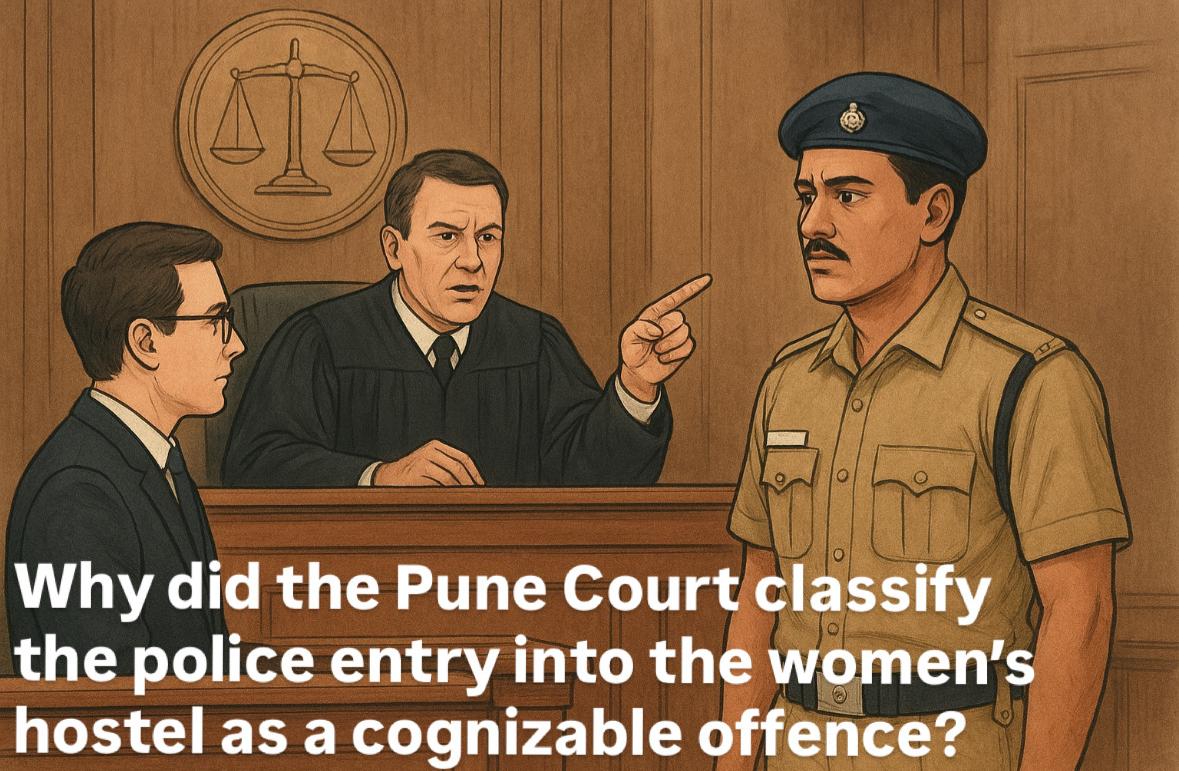
The Pune Court held that the police officers’ conduct amounted to a cognizable offence because their actions are violated both statutory requirements and constitutional safeguards, specifically those concerning the privacy, dignity, and safety of women in a hostel.
1. Entry Without Authority
The Court observed about the police:
- Entered a private women’s hostel without an identification.
- They did not produce any written order, search warrant, or any DD entry.
- Failed to show their identity cards, even when asked for the same.
As under the Criminal Procedure Code (CrPC) or New Criminal Act as BNSS, police can enter private premises only when acting:
- Under a valid search warrant (Sections 93–100 CrPC / corresponding BNSS provisions),
- In exceptional urgent circumstances, which must be recorded and justified for the purpose of safety.
Hence, the officers had no such legal justification, for that their entry unauthorized and illegal.
2. Violation of Women’s Right to Privacy and Dignity.
The Supreme Court has repeatedly held cases for women’s safety (e.g., in Puttaswamy, Lalita Kumari, etc) that:
- Women in private spaces enjoy heightened privacy protections
- State action that intrudes without reason amounts to constitutional violation
The Court emphasized that barging into a locked women’s hostel at night, without authority, is an invasion of bodily autonomy and dignity, thereby attracting criminal liability.
3. Prima Facie Offences that apply are Cognizable
Based on the facts and conduct, the Court noted the police conduct could amount to:
- Criminal Trespass – Section 441/447 IPC
- House-trespass – Section 448 IPC
- Outraging the Modesty of a Woman – Section 354 IPC
- Criminal intimidation, depending on statements made (if any threats were made).
- Misuse of official position.
These offences are cognizable, means:
- Police must register an FIR immediately (not after departmental inquiry)
- Police can begin an investigate without a warrant.
Thus, the Court ordered registration of an FIR and that’s why no departmental inquiry can substitute criminal proceedings.
4. Police Cannot Take Shelter Under “Routine Checking” as Rejected Argument
The Court rejected the police argument that the entry was “routine checking,” but the Court held:
- Routine checks cannot override fundamental rights
- Especially in a women-only residential space, greater caution and procedural propriety are mandatory as a higher sensitivity.
- Entering without identification amounts to abuse of power and breach of trust
5. Conduct Was “Serious, Not Trivial”
The Court clarified that the misconduct was:
- Not a minor procedural or administrative lapse.
- But a substantive violation attracting criminal consequences as a serious act.
- Warranted registration of a Cognizable Offences.
Thus, the Court directed that an FIR be lodged against the concerned officers.
Hence, the police entry was treated as a cognizable offence requiring immediate legal action for a safety of women.
About the Author :-
Aditi Anil Bhoyar is a final-year B.A.LL.B. student at Manikchand Pahade Law College, Chhatrapati Sambhajinagar, Maharashtra. Deeply passionate about law and its impact on society, she aims to bridge legal knowledge with real-life issues. Through her writing and future work, she hopes to contribute meaningfully to justice, fairness, and public awareness.