

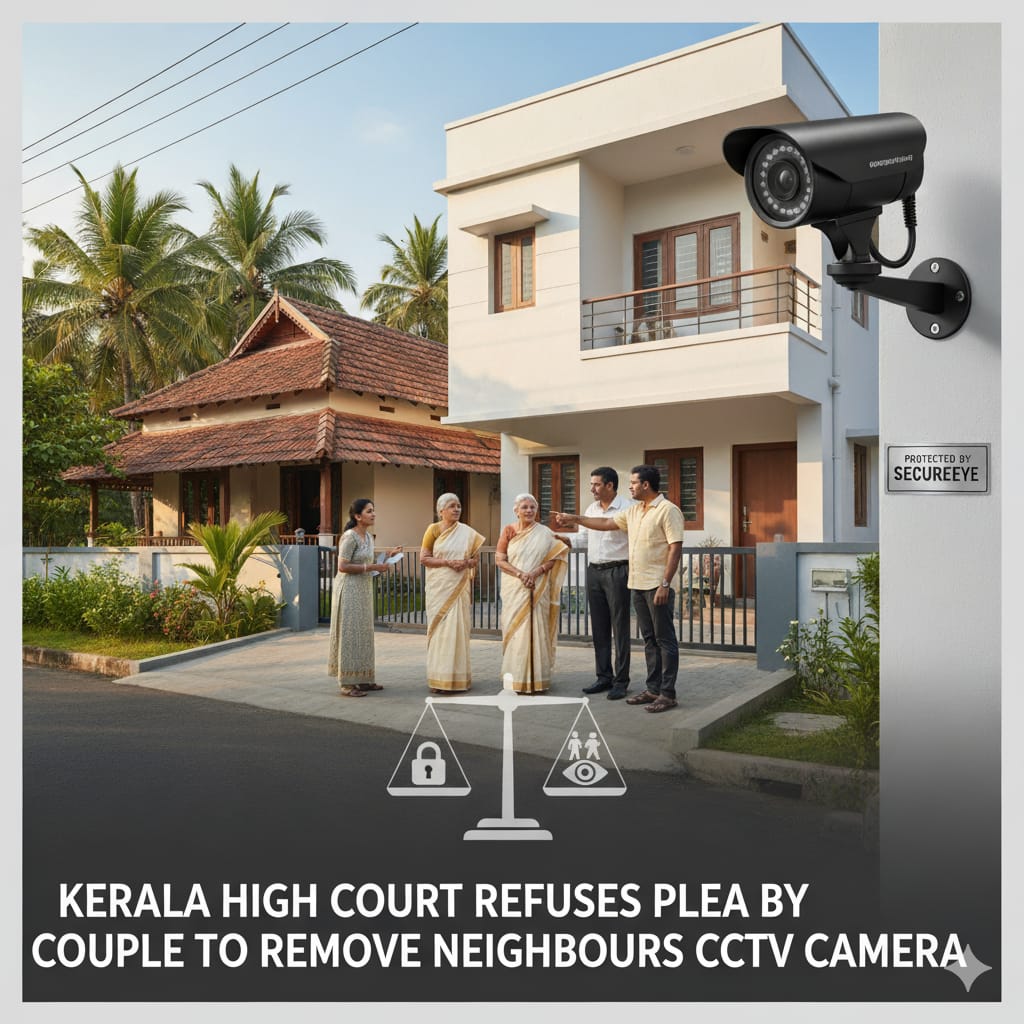
The Kerala High Court recently dismissed a plea from a couple contesting their neighbors’ CCTV camera, ruling that the surveillance, installed to protect an elderly woman facing criminal threats, could not be removed. [Sivasankaran v. Sankarankutty v. state of kerala & Ors.] Justice and Nagaresh reasoned that the constitutionally protected right to privacy must be immediately balanced against another person’s fundamental right to life insecurity. Relying on the Supreme Court’s landmark KS Puttaswamy v. Union of India judgment, the judge reiterated that these rights operate under A framework of proportionality, not in isolation
The court added, “An individual lives within himself, within a community, and within a state, and his personal autonomy is constrained by the values, rights, and moral rights of people who are just as free and as equal as him. The right to privacy of one and the right to security, which is an element of the right to life of another, are to be balanced delicately when they are in conflict with each other.”
Arguments and the conflicting narratives
The petitioner contended that their neighbors had installed a CCTV camera equipped with a focus line that was directly aimed at their drawing-cum-dining area and bedroom. They argued this constituted an intrusion into their privacy and evolution of Article 21 (right to life), claiming the camera was installed purely to harass them. Their complaint to the police yielded no action, prompting the lawsuit.
However, the respondent neighbors, comprising an elderly woman and her two children, offered a strictly different justification. Their counterstatement alleged that the elderly woman, the widow of the petitioner’s deceased brother, was a victim of grave offenses (including criminal intimidation, attempted rape, and an outrage of modesty) perpetrated by the petitioner himself. They asserted that the camera was installed by the general solely for the woman’s safety due to his continued harassment
After reviewing the facts and submissions, the court found that the petitioners failed to produce evidence proving the cameras were installed for snooping into their private space. The court ultimately stressed that the case involved elder crime victim facing credible threat, which decisively tipped the balance in favor of insuring her security and safety
The court concluded, “As far as respondents 5 to 7 are concerned, they have a right to life, a safe and secure life. It is to protect their safety and security that the CCTV cameras are installed in the circumstances. Unless there is an established case of snooping into the affair of the petitioners, there cannot be a direction to respondents 5 to 7 to remove the CCTV cameras.
ABOUT THE AUTHOR
I am Nishu Lamba, a law graduate and a growing legal writer. I am building my career as a corporate lawyer with my skills in contract drafting and legal research. Through my writing, I aim to make legal topics clear and easy to understand for readers.