

Introduction
The Supreme Court of India has declined to urgently list a plea seeking the immediate enforcement of stricter air pollution norms in line with the ‘Delhi Air Quality’ standards set by the World Health Organization (WHO). The Court said that the matter would be taken up later as part of the broader ongoing hearings related to Delhi’s pollution crisis, which are already scheduled this week.
What the Petition Asked For
The plea, filed by a concerned advocate, sought urgent directions for the government to implement the ‘Delhi Air Quality’ standards as recommended by the WHO. The petitioner pointed out that Delhi’s pollution levels have reached “hazardous” categories, posing serious health risks to millions of residents, especially children and the elderly.
He urged the Supreme Court to order the immediate adoption of WHO air-quality norms and the preparation of a national plan to combat air pollution. However, the bench led by Justice B.R. Gavai declined to list the case on an urgent basis, noting that the larger issue of Delhi’s air pollution is already being heard by the Court in another matter.
Supreme Court’s Observation
While refusing the request for an urgent hearing, the bench observed that the plea could be tagged with the existing pollution cases already before the Court. Justice Gavai stated that the Court is closely monitoring the issue of ‘Delhi Air Quality’ and that a separate urgent listing is unnecessary at this stage.
Rising Public Concern Over ‘Delhi Air Quality’
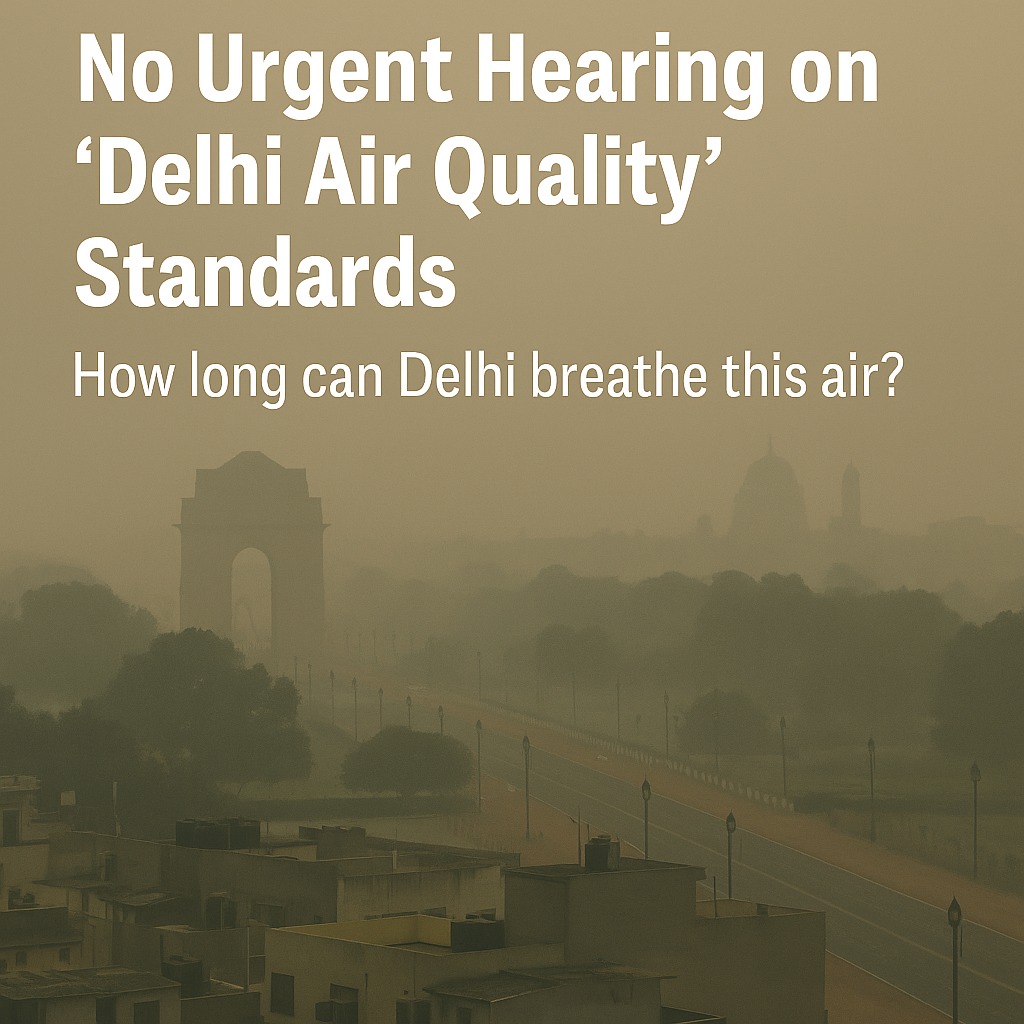
Meanwhile, the ‘Delhi Air Quality’ continues to deteriorate, with several monitoring stations recording levels far above the safe limit. The Air Quality Index (AQI) in many parts of Delhi and NCR has crossed 450, categorised as “severe,” meaning that the air is unsafe for breathing even for healthy individuals.
Doctors have reported an increase in respiratory illnesses, eye irritation, and lung infections, especially among school-going children. Environmental activists have expressed disappointment at the Court’s refusal for an urgent hearing, saying that every day’s delay in enforcing stricter standards affects millions of people living under toxic air conditions.
Government’s Stand on ‘Delhi Air Quality’
The government has assured that measures are being taken to control stubble burning, regulate construction dust, and restrict vehicle emissions. Currently India follows its own National Ambient Air Quality Standards. However, Indian Air Quality standards are less stringent than WHO’s standard guidelines.
Although, according to the petitioner, Indian Air Quality standards are now outdated. These are not sufficient to protect public health. We need to adapt the WHO’s guidelines to control ‘Delhi’s Air Quality’ for the benefit of the human race.
Conclusion
The environmentalists and policymakers are shaken with the Supreme Court’s decision of not hearing the plea on ‘Delhi Air Quality’. The Court said that it is already looking into the matter. However, the citizens of Delhi are still breathing in the unsafe air.
The administration is working at such a slow speed that the citizens of Delhi are deeply worried about their health because of the increasing smog and low air quality. However, hopes still remain with the Supreme Court that it will shortly provide guidelines to control the ‘Delhi Air Quality’