
Definition
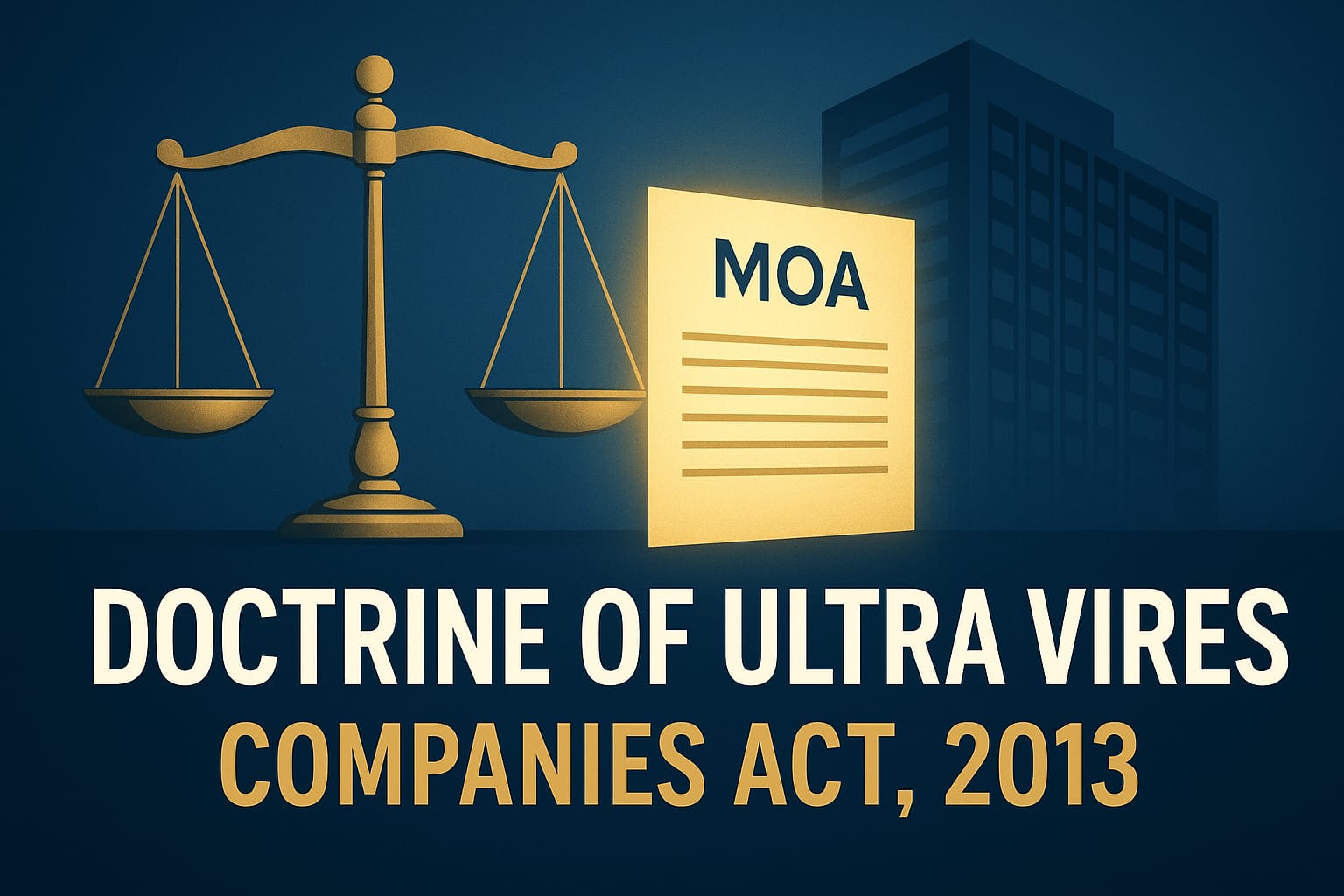
The Doctrine of Ultra Vires states that any action performed beyond the power is considered ultra vires. The company’s actions are only valid when they are within the powers defined in the Memorandum of Association.
Scope
The Doctrine of Ultra Vires does not pertain to unincorporated businesses, like sole proprietorships, and partnerships are also outside the scope of the doctrine.
It is limited to entities that have undergone legal incorporation and are thus recognized as separate legal persons; the Doctrine of Ultra Vires is only applicable to those companies that possess a separate legal identity.
Legal Consequences
When a company performs legal action beyond its power or authority, there are legal consequences and legal implications that can be served. Any person who has suffered a loss due to an Ultra Vires act of the company can file a suit against the company for damages; this can include the shareholders who may have suffered financial loss as a result of the company’s action. The directors of the company can also be held personally liable for any losses suffered due to the ultra vires act of the company. In some cases, the directors may be held jointly and severally liable for the losses incurred.
The Concept of Corporate Veil in Indian Company Law
The doctrine of ultra vires, under the Companies Act, 2013, is a fundamental concept in corporate law that obligates a company to act only within the authority of the power and intended purpose expressed in its Memorandum of Association (MoA). This Latin phrase, meaning ‘beyond the powers,’ safeguards shareholders, creditors, and the public by prohibiting actors from exceeding lawful purposes and unauthorized decision-making.
For example, if a company is incorporated to provide educational services, but it decides to engage in crypto currency trading or create a real estate business, those activities are not stated in its MoA. Therefore, investment in those areas is ultra vires and will be declared void and unenforceable.
The Doctrine of Ultra Vires was one of the central principles established in the case of Ashbury Railway Carriage & Iron Co. v. Riche (1875) and is applicable today with the Companies Act, 2013, as it continues to affirm that a company may only exercise actions within the legal objects for a corporation. Furthermore, it approaches an ethical and response rationale so that actions are in accordance with the corporate governance and invites promotion for trust and habitual compliance to the shareholders, accuracy in allocating investments, and a statutory framework for corporate accountability.
Historical Origin of the Doctrine of Ultra Vires
Ashbury Railway Carriage and Iron Co. v. Riche (1875) is a landmark English court case that established the ultra vires in corporate law, the case established that any act beyond the power outline in the Memondrum of Association are void, this was developed by the house of lords, to protect the shareholders and creditors from overreach to ensure that the funds are used for the purpose they are created.
The adoption of the Doctrine of Ultra Vires Act in India through the Companies Act, 1956, and later reinforced in the Companies Act, 2013. This ensures that the companies must act in accordance with the Memorandum of Association and only engage in activities within the scope defined therein. Indian courts have played a significant role in interpreting and safeguarding the shareholders, creditors, and other stakeholders.
The companies that act beyond the power of the MoA have voided their contracts.
Legal Foundation under Companies Act, 2013
Section 4(1)(c) of the Companies Act, 2013 requires any company’s Memorandum of Association (MoA) to note “the objects for which the company is considered to be incorporated and any matter which is also considered necessary in furtherance thereof”. This requirement, referred to as the Object Clause, clearly outlines the company’s lawful scope of activity and constitutes an overarching framework on which the actions of the company will take place.
The statute is rooted in the notion that the company is required to act within the parameters of the objectives identified in its MoA. It acts as a protection for the stakeholders, shareholders, creditors, and public in order to ensure they are dealing with companies engaged in permissible business activities. If the company decides to act outside the stated objectives, it has acted ultra vires (beyond its authority), and the action will be void and unenforceable.
As an example, if a business is incorporated specifically for “education services, then the MoA would reflect if the objectives included the provision of educational programs or educational services, etc. If that company then decided to engage in some business that in no way relates to education (whatever that is), for example, to invest in a real estate property, that action would be considered ultra vires because it is outside of the objectives noted in the MoA. In other words, the investment, in such a case, would not be acknowledged as the company’s legal act, and the people involved in the decision-making could get into trouble for not exercising their power.
Overall, Section 4 (1) (c) limits companies to their stated purposes to maintain both operational focus and legal integrity. Such a movement would mean that the actions taken beyond the stated purposes might be treated as unauthorized, and the directors could be held liable for such action.
Essentials of the Doctrine
- Beyond Object Clause
According to the Companies Act, 2013, it is a requirement that the Memorandum of Association (MoA) of a company explicitly states “the objects for which the company is proposed to be incorporated and any matter considered necessary in furtherance thereof”. This clause, known as the Object Clause, defines the scope of the company’s legal activities and serves as the foundational framework for its operations.
- Violation of Statutory Limits
Companies and their directors are subject to statutory constraints that come from the Companies Act, 2013, and are expected to comply with the relevant provisions that can be found in that act or the MoA and the company’s Articles of Association (AoA). When a company exceeds statutory limits, such as engaging in unauthorized business activities or prohibited acts, it cannot only be characterized as ultra vires, but it can also subject the company and/or its officers to civil or criminal liability.
- Exceeding Director’s Power
Although directors act as agents of the company, the extent of their authority is limited entirely by the MoA, AoA, and Companies Act. They are to exercise only those powers that are specifically provided to them or circumstances where they have been expressly delegated authority. Not only can they carry out the partnership agreement, but also any contract in an amount equal to or greater than their inherent authority, which is termed as ultra vires, can be executed or authorized even without the exercise of this authority.
Example: When directors of an educational services company create a partnership to invest in real estate (which is not within the legal business), this is outside the MoA and exceeds their authority and powers. Such a situation might result in the partnership covenants being void, and the directors could face personal liability for acting without the necessary authority as well as for acting beyond their powers.
Effects and Consequences of Ultra Vires Acts
- Void Ab Initio Nature
Void Ab Initio Nature, in simple words, means that something void from the beginning is considered null.
- Implications for the Business
- No binding effect: If a contract or transaction is ultra vires, the business is not bound by it. If a company takes more loans than it is permitted or crosses the limits set by its object clause, it will be voided automatically.
- Injunction: The members of the company have the right to apply for an injunction to stop any present or future ultra vires activities.
- Regulatory Repercussions: The Companies Act of 2013 has provisions for imposing fines or operational restrictions on companies, which will effectively characterize their business operations as negative if they infringe the ultra vires doctrine.
- Consequences for the directors
- Personal Liability of Directors: Directors who approve or engage in ultra vires activities can be held personally liable for any resulting losses suffered due to the illegitimate transaction. This may cause legal repercussions.
- Obligation to company capital: Directors are required to use company funds only for legitimate business purposes as allowed by the articles of association and memorandum.
- Repercussions for other parties
- Lack of enforceability: Because ultra vires contracts are null and void from the start, third parties cannot use them against the business. This shields businesses from unapproved outside liabilities.
- Lender Protection: In some cases, a lender who makes a loan for an ultra vires purpose may be able to get an injunction to stop the business from using the loan.
Case Laws on the doctrine of ultra vires, under the Companies Act, 2013
- A. Lakshmanaswami Mudaliar v. LIC (1963)
This case is an important legal matter in corporate law. It deals with the doctrine of ultra vires under the Memorandum of Association (MoA) of a company. The Supreme Court held that the contribution was ultra vires, void, and not even ratifiable with the approval of the shareholders. The chief priests of the United India Life Assurance Company were directed to refund the amount personally, thus confirming the supreme authority of the ultra vires doctrine and the necessity of abiding by the company’s MoA. In this scenario, the executives granted a Rs. 2 lakh donation to a trust which aimed at creating technical or business knowledge. However, once the firm was nationalized through the LIC Act, LIC rivaled the donation as being ultra vires.
- Re Jon Beauforte (1953)
Re Jon Beauforte (London) Ltd (1953) is a landmark case in English company law that perfectly illustrates the concept of ultra vires, which restricts a company’s powers to the activities defined in the memorandum. In this particular case, the memorandum of the company limited its operations to dressmaking only, whereas the company engaged in the production of veneered panels. After the company was declared bankrupt, the supplier who had sold coke to the company for this purpose claimed the amount from the company. The judge declared the contract voidable since the operation was ultra vires, that is, beyond the company’s allowed activities. The supplier was unable to recover the payment made because, although they had no idea about the limitation, constructive notice is given to the public regarding a company’s specified objects, and thus any contract that goes beyond the specified objects is void and cannot be enforced.
Distinction Between Ultra Vires and Other Doctrines
- Ultra Vires: The Doctrine of Ultra Vires says that any action done beyond the power or authority is considered ultra vires. The company’s actions are only valid when they are within the powers defined in the Memorandum of Association. For example, A company formed to run a publishing business enters into a contract to start a manufacturing plant. This act is beyond its powers and hence void.
- Intra Vires: The Latin term, intra vires, means “within the powers ” and is commonly used to refer to a legal act, which could be the act of a person, official, or organization, that did not exceed his, her, or its legal authority or power. It denotes a situation opposite to an ultra vires act, where the action taken is beyond the limit or range of the person’s power to act. For instance, the same company purchases new printing machines that are within its licensed business activities and therefore good.
- Illegal Acts: An act that is prohibited by law, such as a criminal offense or a violation that incurs civil liability. An illegal act is always void from the outset (void ab intio). For example, A company manufactures and sells banned narcotics, which is against the law and punishable, hence illegal, not merely ultra vires.
Exceptions to the Doctrine
The doctrine of ultra vires does not apply in the following conditions:-
- Shareholders’ Ratification: Acts ultra vires of the directors but intra vires of the company—such acts, though beyond directors’ authority, can be ratified by shareholders if they fall within the company’s objects, e.g., a contract entered into without prior board approval but within company objectives may be validated by shareholders
- Irregular Action: Acts done irregularly but within the object clause can also be ratified by the shareholder.
- Property acquisitions: Property acquired via an ultra vires act still vests in the company.
- Incidental/consequential action: the doctrine does not invalidate an act that is not ultra vires unless expressly prohibited in the law.
- Implied Authority: Acts deemed within the company’s authority by statute are not ultra vires even if not explicitly in the memorandum.
- Executed contracts: When both parties have executed a contract, even if the contract was ultra vires, the contract will not be voided based on the doctrine of ultra vires.
- Unregistered Companies: The principle of ultra vires only relates to corporations that are duly registered and have their own legal persona. It is not applicable to unincorporated businesses such as sole proprietorships or partnerships.
Modern Relevance and Criticisms
The ultra vires rule was softened by modern business practices and court decisions, along with the widespread drafting of the Memorandum of Association (MOA) that includes a broad scope of activities and the provision of protection for the innocent third parties negotiating with the companies having good faith. In contemporary commerce, companies typically draft very wide and general object clauses, covering a range of possible business activities, to minimize the risk that a transaction will be ultra vires and, therefore, void. The broad MOA ultimately provides corporations with the flexibility to encroach upon their original object of incorporation, in order to adapt as viable business models change, without being subjected to an ultra vires challenge to legality. Courts have adopted a similar, more flexible rule that favors the protection of innocent third parties when dealing with companies contracting with them, especially where the contract in question is within the company’s objects, in spite of internal procedural irregularities happening and leading to the delay of contracts. This preference encourages certainty of commerce by ensuring that third parties do not have their commercial certainty disrupted by the outcome of the courts invalidating contracts as declared ultra vires from merely technical violations of the original objects of the company. Nowadays, the ultra vires doctrine in business transactions remains merely a protective shield of the corporate governance structure and not a sword of public policy in an attempt to intervene in a valid business transaction in corporate law.
Conclusion
In conclusion, the doctrine of ultra vires continues to be important under the Companies Act 2013 in enabling corporate accountability and the confidence of investors, by ensuring that the companies act only within their specified objects of law as defined in the Memorandum of Association (MoA). In this sense, it prevents the misuse of company funds and the performance of unauthorized actions beyond the legal powers afforded to the company, while also seeking to protect shareholders and creditors and ensuring the integrity of companies. Although modern practice has avoided some of its rigidity through widely drafted MOAs and the intervention of the judiciary to protect third parties in an ultra vires situation, the doctrine still acts as a basic safety valve against excessive actions by directors or companies, ensuring a level of transparency, limits to risk, and accountability in good corporate governance. Trust in the functioning of companies is maintained because of the legal binding of the company to its specified stated purposes (referring to the MoA), and through offering remedies if acts performed exceed the extent of the authorities granted.
FAQs
- What is the Doctrine of Ultra Vires under the Companies Act 2013?
It prevents companies from acting beyond the objectives mentioned in their Memorandum of Association.
- Can an ultra vires act be ratified by shareholders?
No, ultra vires acts are void from the beginning and cannot be ratified.
- What are the main case laws on the doctrine of ultra vires?
Ashbury Railway Carriage v. Riche (1875) and A. Lakshmanaswami Mudaliar v. LIC (1963) are leading cases.
- Is the doctrine of ultra vires still relevant in modern company law?
Yes, though its scope is limited, it ensures companies act within legally defined objectives.
5. Can a company do anything it wants once incorporated?
Not really. The Doctrine of Ultra Vires under the Companies Act, 2013, draws a strict line around what a company can and cannot do. For instance, if a firm created to run an educational institution starts a real estate business, it violates this doctrine. This article explains how the law restricts corporate powers to protect investors and maintain business integrity.
About the Author
Aastha R. Y. is a first year law student pursuing BBA LLB from the University of Mumbai and she has interest in Legal research and writing.
One thought on “Doctrine of Ultra Vires under the Companies Act, 2013 – All you need to know.”