

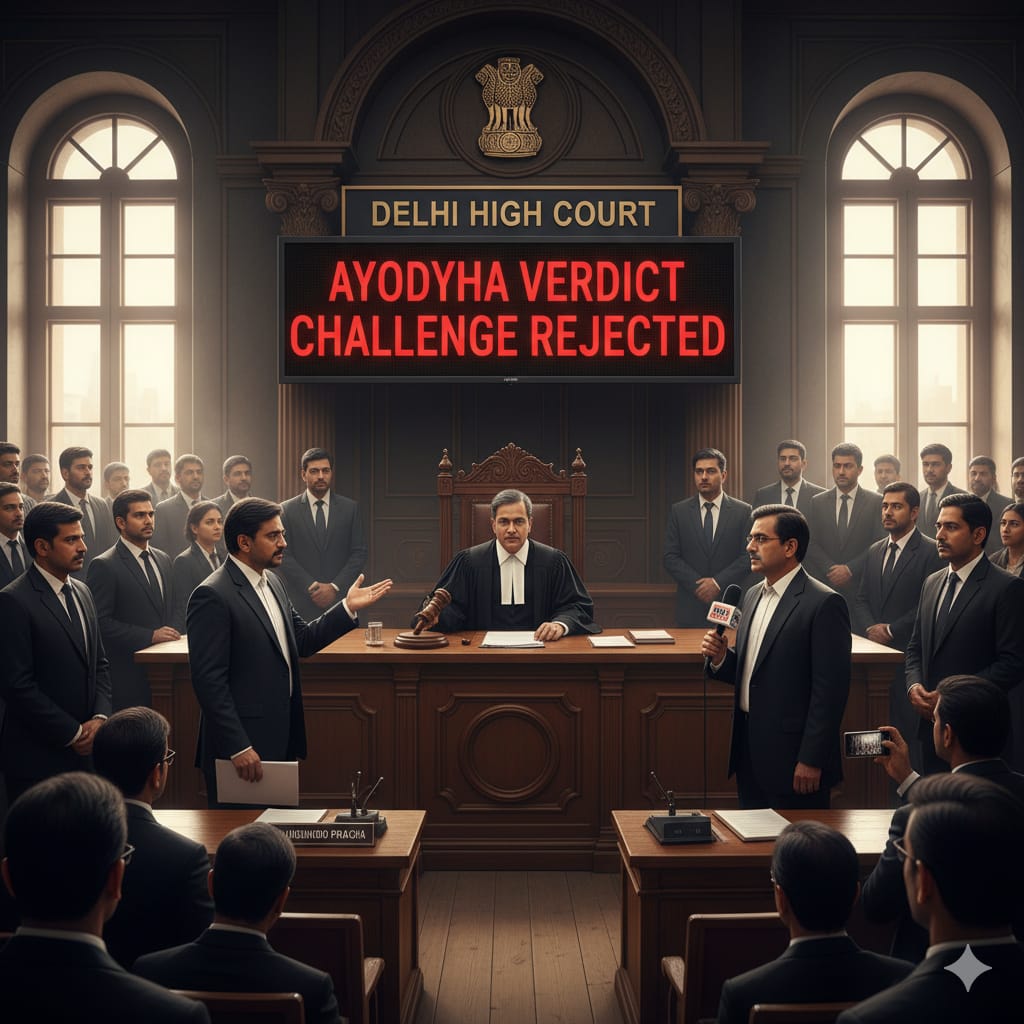
Delhi Court Rejects Advocate Mehmood Pracha’s Plea Challenging Ayodhya Verdict
Court Reaffirms: Supreme Court Judgments Are Final and Binding under Article 141 :-
As a Summary, In a key development, the Delhi court has dismissed the petition filed by Adv. Mehmood Pracha, who challenged the Supreme Court judgment of 2019 in the Ayodhya land dispute. The court made it clear that no subordinate court has the authority to reopen or review a decision delivered by the Supreme Court of the same case, reaffirming the constitutional principle that the apex court’s word is final and binding under Article 141 of the Constitution.
So, The Delhi court’s rejection of advocate Mehmood Pracha’s plea has once again brought attention to the finality of Supreme Court judgments and the boundaries of judicial review. The site believed concerned to be Lord Ram’s birthplace, where the Babri Masjid stood until its 1992 demolition. In November 2019, the Supreme Court delivered its historic verdict, granting the land to Hindu parties for the Ram Temple and allotting five acres to Muslims for a new mosque.
Therefore, as the land dispute has been one of India’s most sensitive and long-standing legal battles.
Despite this final resolution, advocate Mehmood Pracha approached the Delhi court, claiming that the Supreme Court’s ruling violated the principles of secularism and equality before law, both of which form part of the basic structure of the Constitution.
The Delhi court rejected Mehmood Pracha’s plea, saying it has no power to review a Supreme Court judgment. Referring to Article 141, the court said that whatever the Supreme Court decides is final and must be followed by all other courts.
If anyone wants to question a Supreme Court decision it also clarified that, it can be done only through a review or curative petition in the Supreme Court itself.
The judgment highlights that the Court’s decisions are final, and also respecting this rule is important to maintain order, trust, and stability in the legal system.
About the Author :-
Aditi Anil Bhoyar is a final-year B.A.LL.B. student at Manikchand Pahade Law College, Chhatrapati Sambhajinagar, Maharashtra. Deeply passionate about law and its impact on society, she aims to bridge legal knowledge with real-life issues. Through her writing and future work, she hopes to contribute meaningfully to justice, fairness, and public awareness.